Volkswagen’s Auto Guangzhou 2025 launch introduced new PHEVs and outlined a five-year strategy for electrification and intelligent mobility.
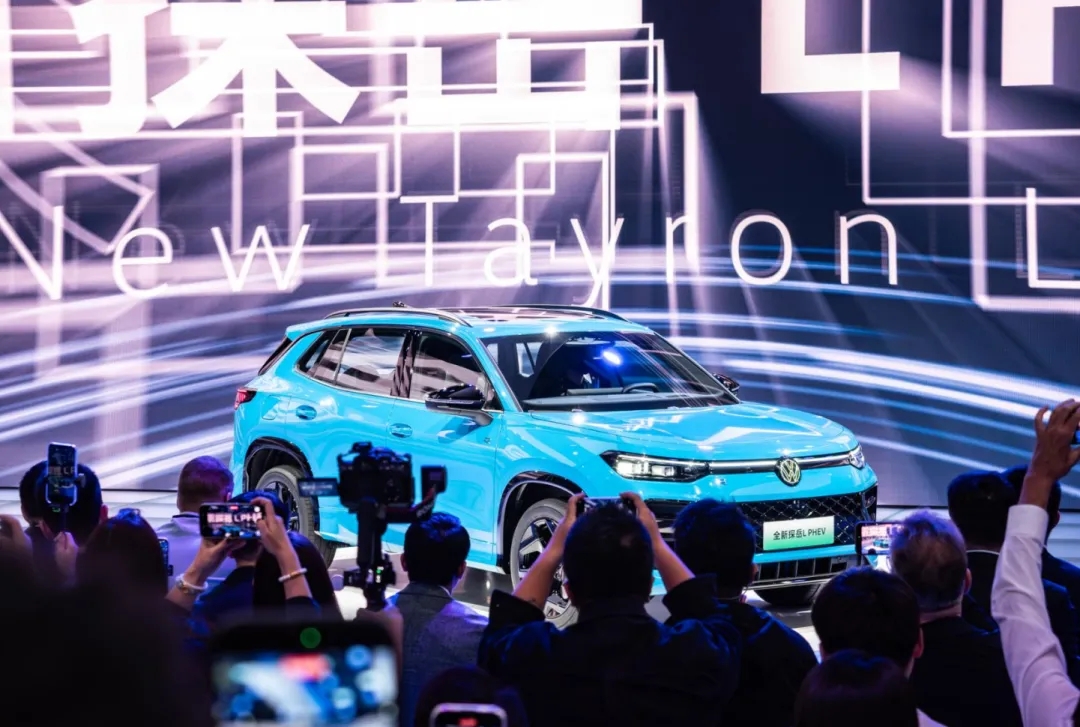
On the opening morning of Auto Guangzhou 2025, automakers crowded the schedule with back-to-back launches—and Volkswagen was no exception.

The event was led by Stefan Mecha, CEO of Volkswagen Passenger Cars Brand China, joined by FAW-Volkswagen and SAIC-Volkswagen executives presenting individually.
Beyond the new Passat ePro from SAIC VW and the Tayron L PHEV from FAW VW, the focus centered on Volkswagen’s five-year strategy and what it calls its biggest product offensive in the China market.
It is clear that Chinese consumers now expect more from Volkswagen than the traditional “German precision engineering” and “reliability.”

In the era of intelligent connected vehicles, electrification and software-defined mobility have become essential pillars—and Volkswagen must respond.
This press conference offered a look at how the brand plans to do so.
Two new models from FAW VW and SAIC VW
The two models announced—SAIC VW’s Passat ePro and FAW VW’s Tayron L PHEV—are both plug-in hybrid electrified vehicles.

Each is equipped with a PHEV system consisting of a 1.5-liter turbo hybrid-dedicated gasoline engine, high-voltage battery and electric motor.
The Passat ePro features Volkswagen’s EA211 1.5T EVO II high-efficiency hybrid powerplant.
Specific figures for combined driving range and all-electric range remain undisclosed.
SAIC VW said the “e” in ePro represents “electric-driven experience,” “evolution” and “elegance,” positioning the model to deliver stronger performance and lower consumption through optimized coordination between gasoline and electric power.

Both companies emphasized that the two new models will adopt Volkswagen’s latest intelligent features, though no technical details were given.
Effectively, the Passat ePro and Tayron L PHEV will supplement and update their respective product lines, but whether they can gain advantage against similarly priced domestic NEVs will depend on capability and pricing.

Ultimately, the two vehicles served mostly as the “opening act” — the more significant message came from the five-year roadmap presented by Mecha and the two JVs.
Intelligence across ICE, HEV and EV
In today’s intelligent-mobility landscape, cross-border collaboration with China’s tech ecosystem has become central for global automakers.
As FAW-Volkswagen Sales Co. General Manager Wu Yingkai said, Volkswagen’s goal is to advance intelligent systems across internal-combustion, hybrid and battery-electric platforms—achieving “intelligence without energy-type barriers.”
In NEVs, Mecha said Volkswagen will launch the largest model offensive in its history: 21 new NEVs by 2027, and 31 by 2029.

FAW-Volkswagen will introduce 17 new products by 2026, 14 of which will be NEVs.

SAIC-Volkswagen, meanwhile, announced the new product line ID.ERA, confirming multiple new models in 2026 and previewing the brand’s first 9-Series flagship SUV, which it claims will set new standards in intelligent driving assistance, smart cockpit architecture, and energy performance.

The company also opened early public experience sessions for the 9-Series flagship—signaling the vehicle’s near-completion.
For FAW-Volkswagen, which recently crossed 30 million cumulative sales, and SAIC-Volkswagen, now approaching 26 million, the 9-Series may become a defining test of how the joint-venture model evolves in China’s intelligent-electrification era.
Discover more from ChinaEVHome
Subscribe to get the latest posts sent to your email.