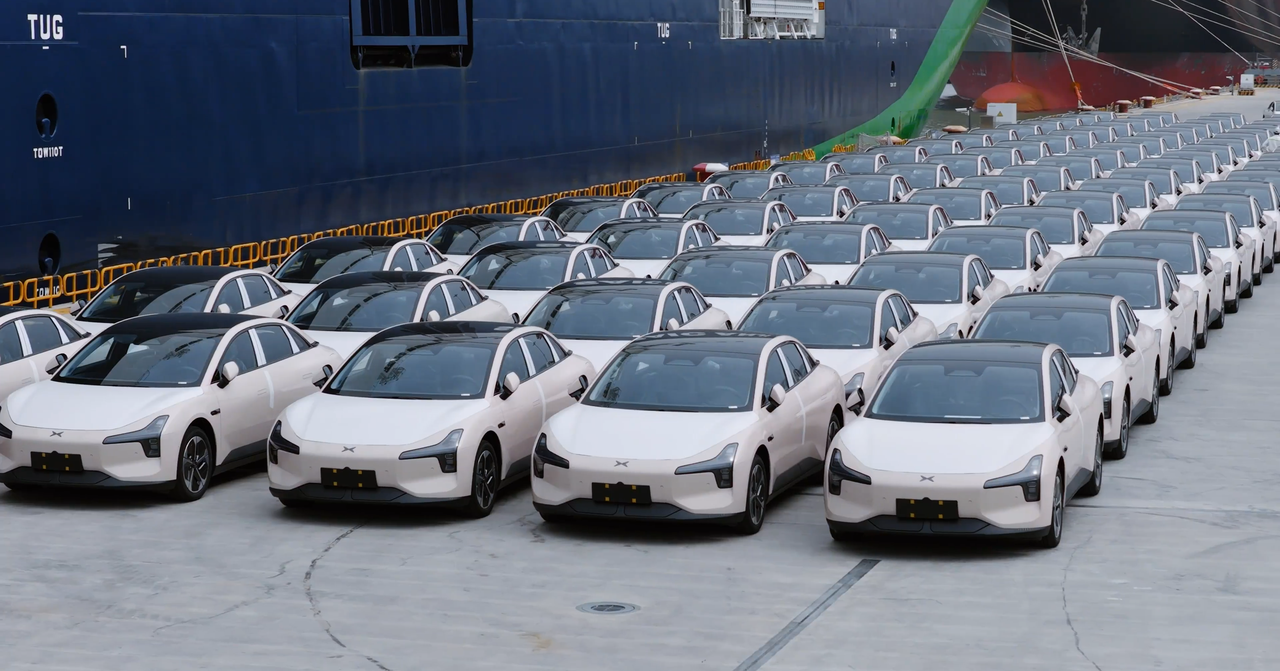
- China exported 320,000 NEVs in February, up 120% year‑on‑year, driving the overall surge.
- January–February NEV exports hit 670,000 units, up 88%, with PHEVs surging 150% YTD.
- Europe, led by Germany (+488% in February), and Asia remain the top destinations for Chinese NEVs.
China’s vehicle exports maintained strong momentum in the first two months of 2026.
According to data released by Cui Dongshu, secretary general of the China Passenger Car Association, cumulative exports reached 1.55 million units, up 61% year on year.
In February alone, China exported 750,000 vehicles, marking a 79% increase from a year earlier. Although down 7% from January, export volumes remained at a relatively high level.

The export surge contrasts with softer domestic demand at the start of the year.
Amid weaker retail performance at home, automakers have increasingly shifted resources overseas, supported by improving product competitiveness—particularly in new energy vehicles and SUVs—which are opening up new markets.
Passenger vehicles remained the backbone of exports. In February, their share rose to 84%, with SUVs emerging as the key growth driver, helping domestic brands gain traction in mid- to high-end segments.
Meanwhile, Tesla’s exports declined sequentially, but this did not alter the broader upward trajectory of China’s NEV exports.
New energy vehicles were the primary engine of growth. In February, China exported 320,000 NEVs, up 120% year on year.

For the January–February period, cumulative NEV exports reached 670,000 units, up 88%.
The export mix continues to shift toward electrification in February. Battery electric vehicles (BEVs) accounted for 28% of exports, plug-in hybrids (PHEVs) 15%, and hybrids (HEVs) 8%, while internal combustion engine (ICE) vehicles fell to 37%.
The report notes that China’s NEV exports in January–February exceeded expectations, driven primarily by PHEVs and HEVs replacing BEVs as the main engines of growth.

In particular, PHEV pickup exports showed strong momentum, emerging as a key highlight within the commercial NEV segment.
In detail, China exported 440,000 BEVs in January–February 2026, up 65% year-on-year, while PHEV exports reached 240,000 units, surging 150% over the same period.
From a regional perspective, Europe and Asia remained the primary destinations for NEV exports.
Among them, the German market stood out, with exports rising 488% year-on-year in February, making it the fastest-growing market.

At present, the European Union remains the core market for BEVs, while demand in Southeast Asia and Central and South America shows relatively higher volatility.
In contrast, demand for PHEVs continues to grow steadily across Europe and North America, with markets such as Turkey in the Middle East emerging as new growth drivers for PHEV exports.
In terms of volume, Brazil, the United Kingdom, Belgium, Italy, and Thailand ranked as the top five export destinations for NEVs in February, with 45,935 units, 22,794 units, 20,675 units, 17,639 units, and 14,398 units, respectively.
Looking ahead, as localization and overseas channel development accelerate, reliance on pure exports is expected to evolve.
However, at this stage, NEVs remain the core driver of China’s global automotive expansion.
Discover more from ChinaEVHome
Subscribe to get the latest posts sent to your email.