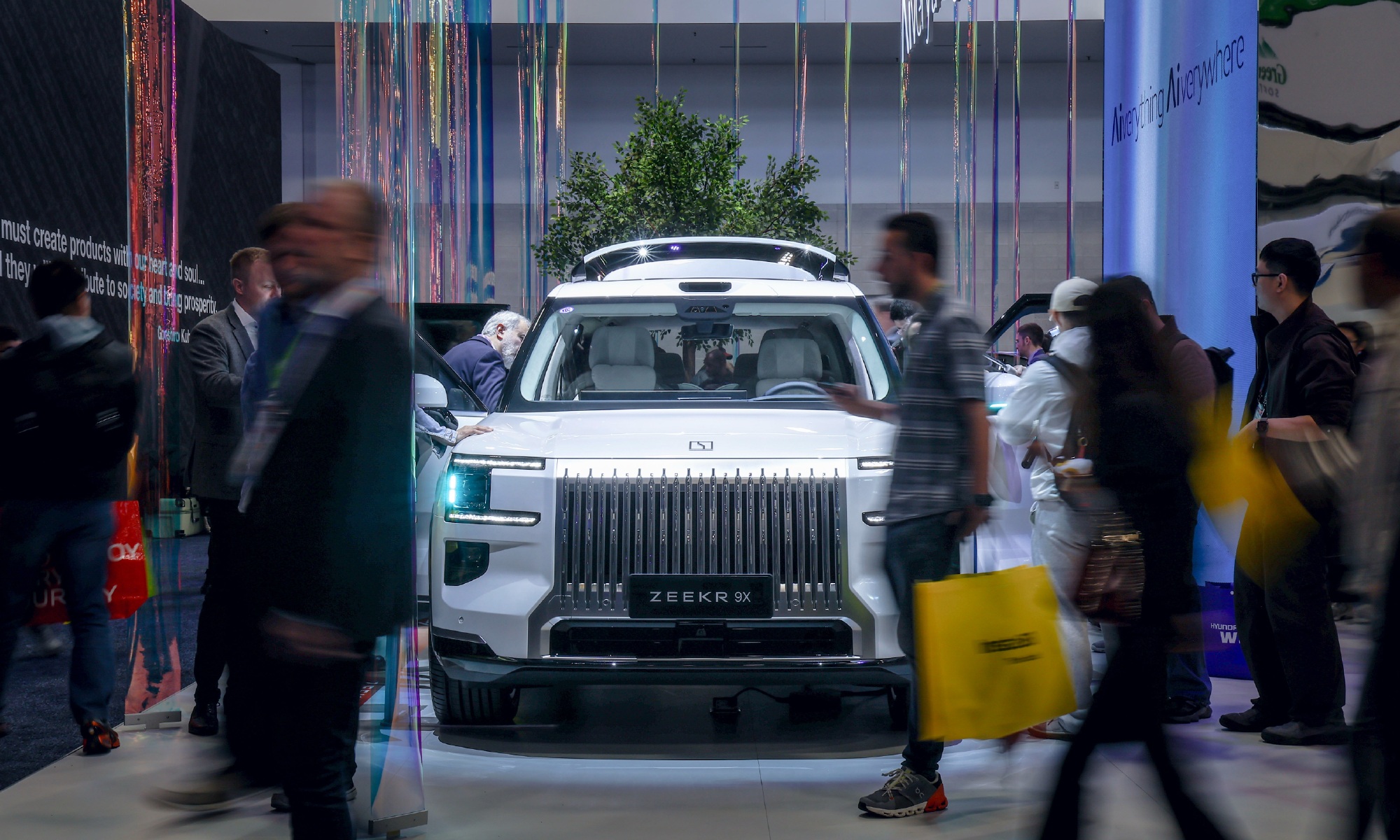
- Zeekr 9X sold 21,541 units in Q1 2026 but lags in tier-1 city rankings, showing uneven urban traction.
- About 54% of Zeekr 9X sales came from tier-1 and new tier-1 cities while 46% came from tier-2 and below.
- Strong word-of-mouth and wealthy private-business buyers in Zhejiang and Pearl River Delta drive its lower-tier surge.
In China’s large SUV segment during the first quarter of this year, both the Zeekr 9X and NIO ES8 secured what could be described as stage victories.
According to Yiche statistics, the NIO ES8 and Zeekr 9X sold 45,160 units and 21,541 units respectively in Q1 2026, ranking first and second in China’s large SUV sales chart.
In the RMB 500,000 ($73,000) large SUV segment, the Zeekr 9X has reportedly remained the sales leader for five consecutive months.

As the “main battlefield” for new energy vehicles, sales performance in China’s tier-1, new tier-1, and tier-2 cities usually serves as a direct reflection of a model’s market strength.
However, the Zeekr 9X has shown a counterintuitive pattern in Yiche’s city-tier sales rankings.
In Yiche’s top-20 best-selling models ranking for tier-1 cities, the Zeekr 9X ranked 15th with sales of 3,841 units, a stark contrast to the NIO ES8’s 11,889 units, and trailing models such as the Tesla Model Y L and Mercedes-Benz GLC.

Meanwhile, the Zeekr 9X failed to make the top-20 best-selling model rankings in both new tier-1 and tier-2 city categories.
Looking at individual major cities, the model’s performance was solid, though not overwhelmingly dominant.
For example, in March this year, the Zeekr 9X sold 10,060 units, second only to the NIO ES8.
Yet in major cities such as Beijing, Shanghai, Guangzhou, Shenzhen, and Hangzhou, Zeekr 9X sales totaled fewer than 3,500 units — roughly half the volume of the ES8.
To the broader market, the Zeekr 9X simply appears to be a strong-selling model. But publicly available sales data from major cities suggests a more nuanced picture beneath the headline figures.
That contrast itself is what drew our attention — and what prompted this discussion.
Where Is the Zeekr 9X Actually Selling?
As mentioned earlier, the Zeekr 9X failed to crack the top-20 best-selling model rankings in China’s new tier-1 and tier-2 cities during Q1, while placing only 15th in tier-1 cities.
So where did those 21,000-plus Zeekr 9X units actually go? The short answer: tier-1, new tier-1, and tier-2 cities still form the core market.
Data from the China Automobile Dealers Association shows that among the top 20 cities for Zeekr 9X sales, 12 were new tier-1 cities, while tier-1 and tier-2 cities each accounted for four.
Among them, tier-1 cities contributed 3,845 units, or roughly 18.1% of total sales; new tier-1 cities delivered 7,669 units, accounting for about 36.1%; and tier-2 cities added 6,041 units, or approximately 28.4%.

Together, these cities accounted for more than 80% of Zeekr 9X sales in Q1 this year. The remaining roughly 3,700 units flowed into tier-3 cities and below.
The Zeekr 9X’s best-selling markets included major cities such as Hangzhou, Guangzhou, Shenzhen, Chengdu, and Beijing.
Zhejiang province alone contributed roughly 18.3% of total sales, with Hangzhou ranking first at 1,771 units.
It is worth noting that one major reason the Zeekr 9X failed to appear in Yiche’s top-20 rankings for new tier-1 and tier-2 cities is the sheer scale gap.
The last-place models in those rankings were the Geely Boyue L with 9,446 units and the Honda CR-V with 8,232 units respectively — both significantly ahead of the Zeekr 9X in volume.

However, from the perspective of sales distribution across city tiers, the Zeekr 9X has performed relatively strongly in lower-tier tier-2 cities and below.
For example, tier-1 plus new tier-1 cities accounted for roughly 54.2% of Zeekr 9X sales, while tier-2 cities and below represented approximately 45.8%.
By comparison, for the NIO ES8 in Q1, tier-1 and new tier-1 cities accounted for roughly 65% of sales, while tier-2 cities and below contributed about 35% — roughly 10 percentage points lower than the Zeekr 9X.
This suggests that a sizable portion of Zeekr 9X units were sold into lower-tier markets, with some tier-2 cities even outperforming new tier-1 cities.
For example, Wenzhou and Taizhou recorded sales of 528 units and 494 units respectively, surpassing Wuhan (467 units), Chongqing (389 units), and Zhengzhou (448 units).
As for exports, the Zeekr 9X remains largely a blank slate in official terms.
According to company plans, large-scale deliveries to Middle Eastern markets are not expected to begin until June this year at the earliest.
Industry sources say that current overseas Zeekr 9X vehicles are mainly being purchased by individual buyers in the Middle East and Europe through Chinese used-car platforms or parallel-export brokers, often at premiums of RMB 50,000-100,000 ($7,300-$14,600).

These scattered export orders likely have only a limited impact on overall sales for now.
Overall, tier-1 and new tier-1 cities remain the Zeekr 9X’s core market.
However, compared with the NIO ES8, the model has delivered surprisingly strong results in tier-2 cities and below, particularly in southern China, where its street presence may be stronger than the raw sales rankings suggest.
In lower-tier markets, automakers’ marketing strategies and consumers’ information channels differ significantly from those in China’s top-tier cities.
That divergence may directly explain why the Zeekr 9X carries a relatively high sales share in smaller cities.
So after answering the question of where the Zeekr 9X is selling, the next issue becomes: who exactly is buying it?
Who Is Buying the Zeekr 9X?
China’s market has never lacked large three-row SUVs. Spanning price ranges from RMB 200,000 to RMB 600,000 ($29,000-$88,000), and covering both battery-electric and range-extended hybrid powertrains, nearly every mainstream NEV brand has at least one flagship large SUV in the segment.
With an average transaction price above RMB 500,000 ($73,000), the Zeekr 9X is unquestionably expensive.

On one hand, in lower-tier markets where charging infrastructure still lags behind, plug-in hybrids offering both fuel and electric power generally enjoy stronger acceptance due to reduced range anxiety.
On the other hand — and perhaps more importantly — purchasing logic among consumers in lower-tier markets differs from that of buyers in tier-1 cities.
Last year, J.D. Power surveyed 13,253 vehicle owners across 81 Chinese cities and 61 brands.
The study found clear differences in purchasing decisions for premium NEVs priced above RMB 400,000 ($58,000) across city tiers.
In lower-tier markets, more than half of consumers prioritized recommendations from acquaintances and real-world owner word-of-mouth within local social circles.
One Zeekr 9X owner from a lower-tier city told ChinaEV Home that five of his friends had purchased the same vehicle.
Meanwhile, according to Jielan Road data, the Zeekr 9X achieved an NPS (Net Promoter Score) of 87.8, trailing only the AITO M9 and AITO M8, and slightly above the NIO ES8’s score of 86.

Taken together, the Zeekr 9X’s relatively strong performance in lower-tier markets appears to have benefited significantly from grassroots word-of-mouth momentum.
Crucially, many of the Zeekr 9X’s strongest-performing cities are located in economically vibrant private-business hubs such as Zhejiang province and the Pearl River Delta region.
As mentioned earlier, the Zeekr 9X’s sales in Zhejiang cities such as Wenzhou, Taizhou, and Hangzhou far exceeded those in many northern cities.
A report by Car Fans showed that the Zeekr 9X’s typical buyer profile skews toward business owners and corporate executives, with many customers upgrading from German luxury brands such as BMW, Mercedes-Benz, and Audi.
This suggests that the model’s core consumer base may be closely tied to entrepreneurs in Zhejiang and Guangdong provinces.
Of course, the Zeekr 9X is not an isolated case. The AITO M9, which previously dominated the RMB 500,000 ($73,000) large SUV segment, displayed a similar pattern.

Data shows that the AITO M9 sold 117,192 units in 2025. Broken down by city tiers, tier-1, new tier-1, tier-2, and tier-3-and-below cities contributed 23,611 units, 37,739 units, 26,408 units, and 29,434 units respectively.
Tier-1 plus new tier-1 cities accounted for 52.3% of sales, while tier-2 and below cities represented 47.7%.
Backed by Huawei’s brand influence and years of channel expansion, the AITO M9 performed almost as strongly in lower-tier markets as it did in China’s largest cities.
Its positioning as both a business and family vehicle also helped it gain traction in high-end executive transportation scenarios.
Similar to the Zeekr 9X, many AITO M9 buyers were affluent consumers upgrading from BBA brands.
Today, the Zeekr 9X has surpassed the AITO M9 in sales for five consecutive months, firmly holding the crown in China’s RMB 500,000 ($73,000) range-extended large SUV segment.
By leveraging grassroots reputation in relatively lower-tier markets, it has arguably become one of the hottest premium SUV models within influential consumer circles.
More importantly, for any model to achieve lasting success, it cannot rely solely on isolated regional sales booms.
Deep penetration across different markets is essential. The former dominance of the AITO M9 in the RMB 500,000 ($73,000) large SUV segment illustrates this clearly.
After analyzing where the Zeekr 9X sells well and who is buying it, the next question is whether it truly has the credentials to become the “king” of China’s lower-tier markets.
Can the Zeekr 9X Truly Rule Lower-Tier Markets?
Objectively speaking, based on sales performance over the past three months, the Zeekr 9X has indeed emerged as the new “king” of China’s RMB 500,000 ($73,000) large SUV segment.
By comparison, the AITO M9 sold 11,345 units over the same period, leaving the former benchmark model down in fourth place.
Whether in terms of design language, platform capability, or overall driving experience, current data suggests the Zeekr 9X remains a highly competitive vehicle with further growth potential and strong market recognition.

But when the focus shifts specifically to lower-tier markets, can the Zeekr 9X truly claim dominance?
Looking at sales distribution, tier-1 and new tier-1 cities remain the Zeekr 9X’s core markets.
However, compared with rivals such as the NIO ES8, it does carry a higher sales proportion in tier-2 cities and below — approaching the AITO M9’s performance pattern from last year.
That said, compared with the NIO ES8’s sales in northern Chinese cities during the same period (9,292 units), the Zeekr 9X’s 6,462 units do not hold an advantage.
In some lower-tier markets, the Zeekr 9X also trails the NIO ES8 in tier-3-and-below cities such as Chaozhou and Yichun.
This indicates that the Zeekr 9X’s market penetration remains relatively limited in certain regions.

In many of these cities, traditional premium brands such as BBA remain deeply entrenched, while among NEVs, AITO and Tesla continue to dominate consumer mindshare.
Based on current results, the Zeekr 9X has not yet fully penetrated every city tier strongly enough to support the conclusion that it is the undisputed “king” of lower-tier markets.
Why focus so heavily on the Zeekr 9X’s lower-tier market performance?
As mentioned earlier, a premium model seeking long-term success cannot rely solely on strength in isolated markets. Individual regional markets have limited capacity, and correspondingly limited influence.
Only by embedding itself across city tiers, breaking through different consumer circles, and improving both visibility and market trust can a premium vehicle establish lasting recognition and influence.
From this perspective, turning lower-tier markets into a stable foundation carries strategic importance for any high-end vehicle.
Part of the reason the market still remembers the AITO M9 likely stems from its strong lower-tier market performance.
Viewed through the lens of word-of-mouth momentum, the Zeekr 9X’s strategy of expanding downward into smaller markets is not inherently flawed.
But whether this early lead proves durable — or merely short-lived — will depend heavily on its ability to expand beyond its current consumer circles.
If the timeline extends to three years, or even five years and beyond, and the Zeekr 9X can still maintain leadership or remain deeply remembered by the market, only then might it truly deserve the title of “king” of China’s lower-tier premium SUV market.
Discover more from ChinaEVHome
Subscribe to get the latest posts sent to your email.