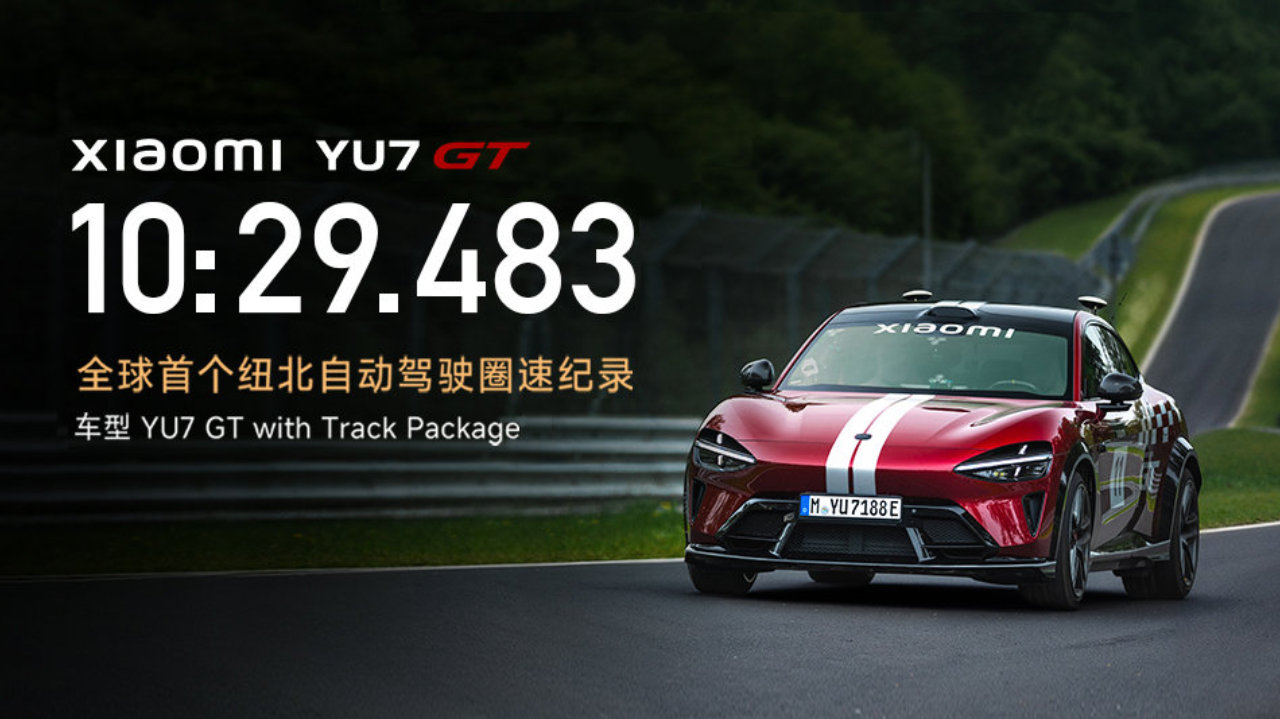
- Xiaomi YU7 GT completed the Nürburgring Nordschleife autonomously in 10:29.483 without human takeover.
- The car used lidar, 4D radar, 11 HD cameras, NVIDIA DRIVE AGX Thor 700 TOPS, and Xiaomi’s HAD software.
- Xiaomi aims to transfer high-speed autonomous controls and stability tech validated at Nürburgring into production vehicles.
The world’s first Nürburgring autonomous driving lap record has been set. Xiaomi’s YU7 GT completed the Nürburgring Nordschleife in 10 minutes 29.483 seconds, finishing the entire lap without human takeover or remote intervention.

The company also released a full onboard video, showing the vehicle navigating the circuit entirely through its own perception, decision-making, control systems. For Xiaomi, the run marks the first full-lap autonomous driving validation at one of the world’s most demanding race tracks.
The result stands in contrast to the vehicle’s previously recorded 7:22.755 Nürburgring SUV lap record. The autonomous run trailed the human-driven benchmark by just over three minutes.
Unlike traditional lap records focused purely on speed, an autonomous Nürburgring challenge measures something different. The key test is whether a vehicle can rely entirely on its own sensors, software, computing platform to complete a high-speed lap safely under extreme conditions.
Urban roads present traffic participants, intersections, traffic lights. The Nürburgring presents a different challenge. The system must continuously process high-speed corners, rapid weight transfers, changing grip levels. Every decision must be made in real time at racing speeds.

Xiaomi said the Nürburgring was selected because extreme-track testing helps refine vehicle dynamics models, high-frequency torque vectoring, millisecond-level stability control capabilities. Those technologies are expected to flow into future production vehicles through software iterations, helping drivers manage extreme situations on public roads.
The YU7 GT comes equipped with a lidar sensor, a 4D millimeter-wave radar, 11 high-definition cameras, 12 ultrasonic radars. Computing power comes from NVIDIA’s DRIVE AGX Thor platform, delivering 700 TOPS for multi-sensor fusion processing.
On the software side, Xiaomi relies on its HAD advanced driver-assistance system powered by the Xiaomi Auto World Model framework. The architecture combines 3D scene reconstruction with video-generation technologies, aiming to improve prediction accuracy in complex driving environments.
As Xiaomi’s highest-performance SUV, the YU7 GT features a V8s EVO electric motor capable of spinning at 28K rpm. Peak output reaches 738 kW (1,003 hp). Top speed stands at 300 km/h. Acceleration from 0 to 100 km/h takes 2.92 seconds.

This is not Xiaomi’s first Nürburgring milestone. Over the past two years, the company has increasingly used the Nürburgring as a technology showcase, building a validation framework around lap-time achievements across multiple vehicle programs.
The strategy reflects a broader shift in the industry. For decades, Nürburgring records served as proof of mechanical engineering capability. As software increasingly defines vehicle performance, the circuit is evolving into a test ground not only for powertrains and chassis tuning, but also for autonomous driving systems operating at their limits.
Discover more from ChinaEVHome
Subscribe to get the latest posts sent to your email.