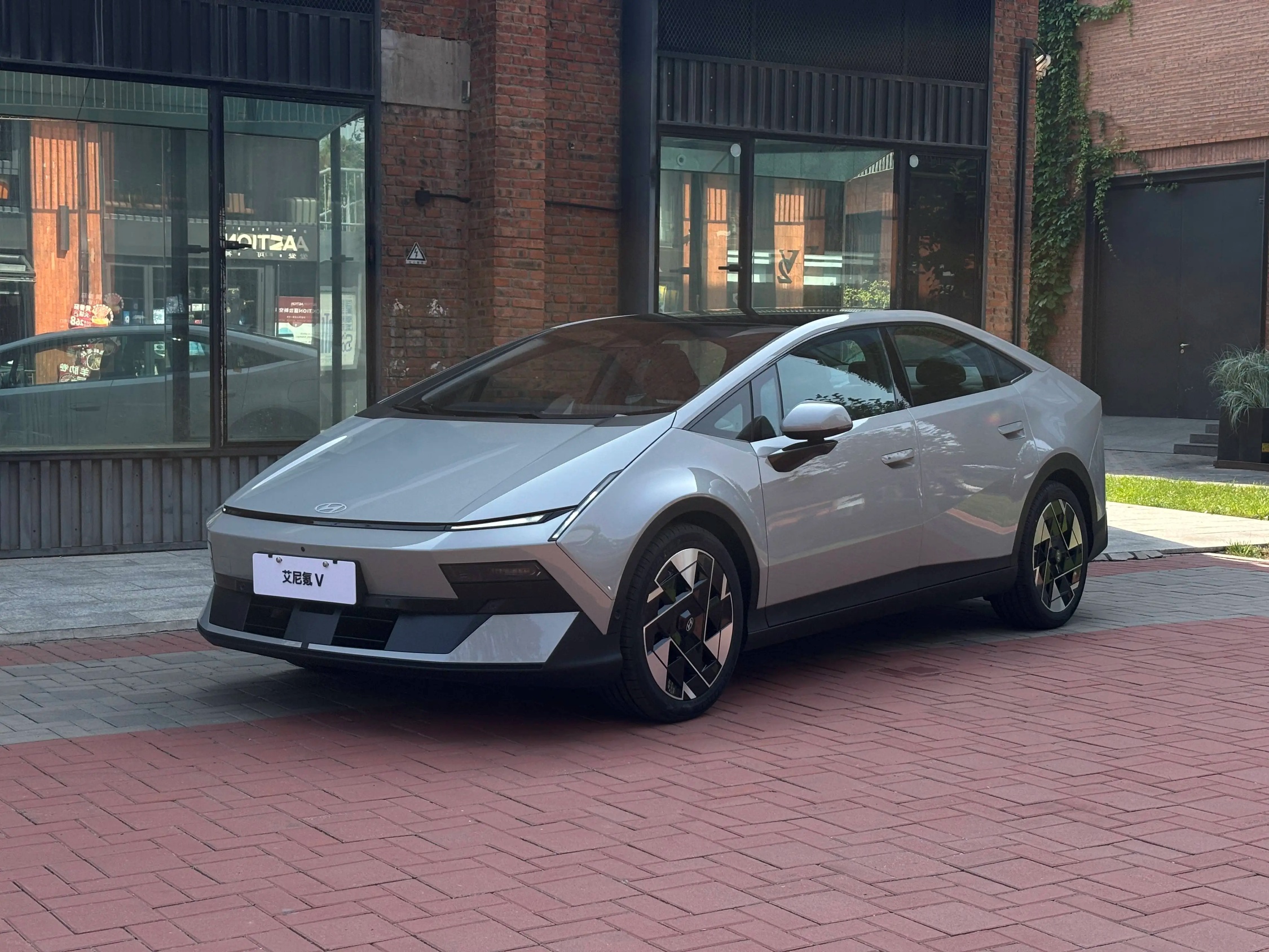
The EO is available in 64.2 kWh and 88.1 kWh packs, providing CLTC ranges of 540 km and 722 km, respectively.
On Oct. 29, Hyundai and BAIC’s joint venture in China, Beijing Hyundai, launched its all-electric compact SUV, the EO, offering three trims — FUN, SMART and TECH — with a price range of RMB 119,800 to RMB 149,800 ($16,870–$21,100).

Built on Hyundai’s global E-GMP electric platform, the EO is the joint venture’s first model under the architecture.
The SUV measures 4,615 mm in length, 1,875 mm in width and 1,675 mm in height, with a wheelbase of 2,750 mm.
It comes in seven exterior colors, including Twilight Purple, Pearl Black, Matte White, Cyber Silver, Pearl White, Turquoise Blue and Camo Gray.
The EO adopts Hyundai’s latest electrified design language, featuring a closed front fascia and a through-type “crystal matrix” light strip made up of 152 LEDs forming a “Galaxy Flow” pattern. The rectangular matrix headlamps enhance the vehicle’s futuristic appearance.

From the side, the SUV features a coupe-like silhouette with a sloping roofline from the B-pillar, hidden D-pillar, and floating roof design. Flush door handles support both electronic and mechanical opening modes.
Inside, the EO embraces a minimalist, tech-focused design with a wraparound cockpit and a 27-inch ultra-thin 4K display.

Powered by Qualcomm’s Snapdragon 8295 chip, the infotainment system supports rich multimedia and app extensions. The three-spoke dual-tone steering wheel includes paddles to adjust four levels of regenerative braking.
The center console integrates dual wireless charging pads and multiple storage compartments. Seats are upholstered in suede-like materials, with powered driver’s seat side bolsters, and both front seats feature heating and ventilation. Double-layer acoustic glass improves cabin quietness.
Cargo capacity stands at 506 liters, expandable to 1,540 liters when the 60/40 split rear seats are folded down. A hidden storage compartment beneath the trunk floor and 46 interior storage spaces enhance practicality.

Powertrain options include single-motor (160 kW) and dual-motor (233 kW combined output) setups. The EO uses BYD’s Fudi-supplied lithium iron phosphate batteries, available in 64.2 kWh and 88.1 kWh packs, providing CLTC ranges of 540 km and 722 km, respectively.
All trims support an 800V high-voltage fast-charging system that can charge the battery from 30% to 80% in about 27 minutes. The chassis combines a front MacPherson strut and rear five-link independent suspension.
Positioned in the RMB 150,000 ($21,000) class, the EO targets rivals such as BYD Yuan Plus, Volkswagen ID.4 X, and Geely Galaxy E5 in China’s increasingly competitive compact EV market.
Discover more from ChinaEVHome
Subscribe to get the latest posts sent to your email.