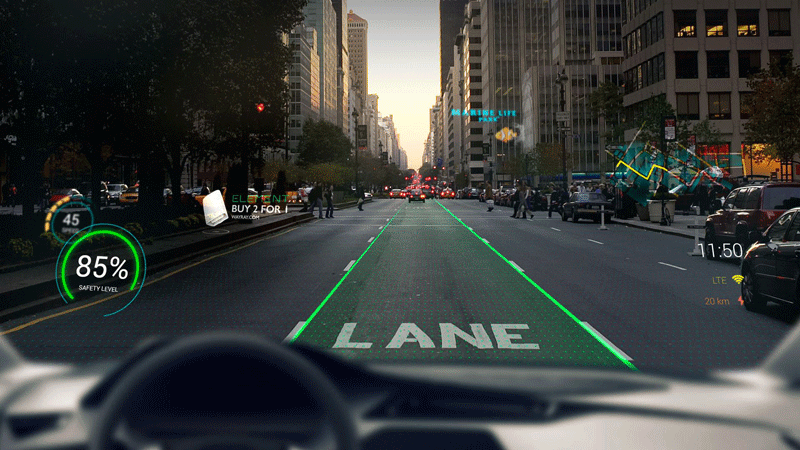
In H1 2025, standard HUD installations in NEVs reached 1.18 million units, representing 57% of all HUD-equipped vehicles.
CINNO Research’s latest report indicates that, driven by domestic brands and new energy vehicle (NEV) startups, the penetration of head-up displays (HUD) in China’s passenger car market is expected to reach 17% in 2025.
Among these, the standard-fit rate of AR-HUDs is projected at 6%, while the compound annual growth rate (CAGR) of standard HUD and AR-HUD installations across China’s passenger car market from 2025 to 2030 is estimated at 14% and 30%, respectively.

The report shows that in the first half of 2025, 48% of vehicles on sale come with standard HUDs, with domestic brands accounting for 69% of that total.
Among different automaker origins, domestic brands contribute 63% of HUD-equipped vehicles, German brands 21%, Japanese brands 14%, and US brands less than 1%.
NEVs show stronger HUD adoption. In the first half of 2025, standard HUD installations in NEVs reached 1.18 million units, representing 57% of all HUD-equipped vehicles.
For AR-HUDs, NEVs account for 94% of total standard installations, reflecting the collaborative push for high-end display technology by domestic and new energy manufacturers.

In terms of price segments, HUD standard installations are mainly concentrated in vehicles with an entry price of RMB 300,000 ($42,000) and above, accounting for 42%, followed by vehicles priced RMB 150,000–200,000 ($21,000–$28,000) and RMB 200,000–250,000 ($28,000–$35,000), which account for 22% and 20%, respectively.
For AR-HUDs, vehicles priced RMB 300,000 ($42,000) and above represent 39%, while RMB 100,000–150,000 ($14,000–$21,000), RMB 150,000–200,000 ($21,000–$28,000), and RMB 200,000–250,000 ($28,000–$35,000) account for 20%, 15%, and 15%.
This indicates that HUDs are rapidly penetrating both mid-to-low and high-end segments, with rising consumer acceptance.

Regarding HUD types, W-HUD remains the mainstream at 72%, while AR-HUD penetration has risen rapidly to 28%, up 4 percentage points year-on-year. P-HUD and C-HUD penetration remains low, with C-HUD nearly exiting the market. As technology matures and costs decline, AR-HUD and P-HUD are expected to appear in more new models.
With supportive policies, technological advances, and growing market demand, China’s HUD market is experiencing rapid expansion, gradually weakening the market dominance of foreign automakers.
Discover more from ChinaEVHome
Subscribe to get the latest posts sent to your email.
.jpg)
