- CATL has launched commercial Choco-SEB battery-swap service in Hong Kong with two stations and the first batch of taxis now operating.
- CATL plans about 36 swap stations in Hong Kong by 2030 to serve taxis, logistics fleets, and high-use commercial vehicles.
- Hong Kong deployment is a global proving ground for CATL’s Choco-SEB rollouts targeting dense cities worldwide.
Hong Kong Chief Executive John Lee Ka-chiu led a delegation to visit CATL on June 24, reviewing the latest progress of the company’s Choco-SEB battery-swapping ecosystem.

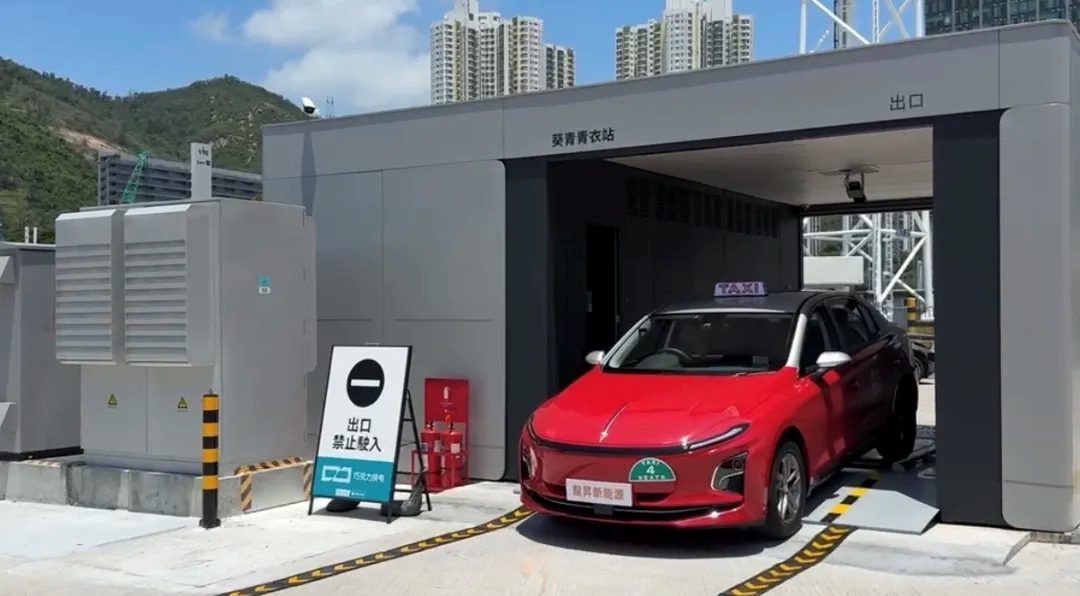
During the visit, Lee inspected multiple vehicle types compatible with the platform, including passenger cars, light trucks, commercial vans. He also experienced the right-hand-drive version of the Hongqi E-QM5 battery-swap taxi developed specifically for the Hong Kong market.
CATL said two Choco-SEB battery-swap stations have already entered operation in Hong Kong. The first batch of battery-swap taxis has also been delivered, entering commercial service.
The milestone marks the formal entry of battery swapping into Hong Kong’s public transportation sector. The model is now moving beyond pilot demonstrations toward large-scale commercial deployment.

Under current plans, CATL aims to continue expanding swap infrastructure across Hong Kong. The company expects to build roughly 36 battery-swap stations before 2030, covering major transport hubs, commercial districts, logistics corridors. The network will primarily serve taxis, logistics fleets, other high-utilization commercial vehicles.
Lee said Hong Kong remains committed to advancing the new-energy industry, accelerating the adoption of green technologies. He expressed hopes for deeper cooperation between Hong Kong and Fujian Province in the new-energy sector.
Since its launch in January 2022, Choco-SEB has become the centerpiece of CATL’s standardized battery-swapping strategy. The platform focuses on three pillars: unified battery standards, open vehicle compatibility, shared energy-replenishment networks.
The goal is to transform battery swapping from a proprietary automaker service into industry-wide public infrastructure.
At the 2025 Shanghai Auto Show, CATL joined hands with FAW Hongqi, Changan, BAIC, Chery, and GAC to unveil 10 battery-swap models. The Choco-SEB ecosystem now works with 11 automakers, 18 vehicle brands. A total of 25 production battery-swap models have been planned. Six vehicles, including the AION UT Super, Arcfox Beta S3, and Hongqi E-QM5, have already entered the market.

Network construction is accelerating in parallel. As of May 2026, CATL had built 1,650 Choco-SEB battery-swap stations across 127 cities in China, covering major new-energy vehicle markets. The company targets more than 3K stations by year-end, extending coverage toward highways and intercity transportation corridors.
For CATL, Hong Kong represents one of the most important international urban deployments of the Choco-SEB ecosystem. Compared with mainland China, Hong Kong features higher population density, tighter land resources, more complex urban traffic conditions.
These characteristics make the city an important proving ground for validating the operational viability of battery swapping in dense metropolitan environments.
If the network achieves stable large-scale operations in Hong Kong, CATL could replicate the model in other high-density cities such as Singapore, Tokyo, Seoul, and parts of Europe. The experience gained in Hong Kong may serve as a reference template for the global expansion of CATL’s battery-swapping ecosystem.
Discover more from ChinaEVHome
Subscribe to get the latest posts sent to your email.