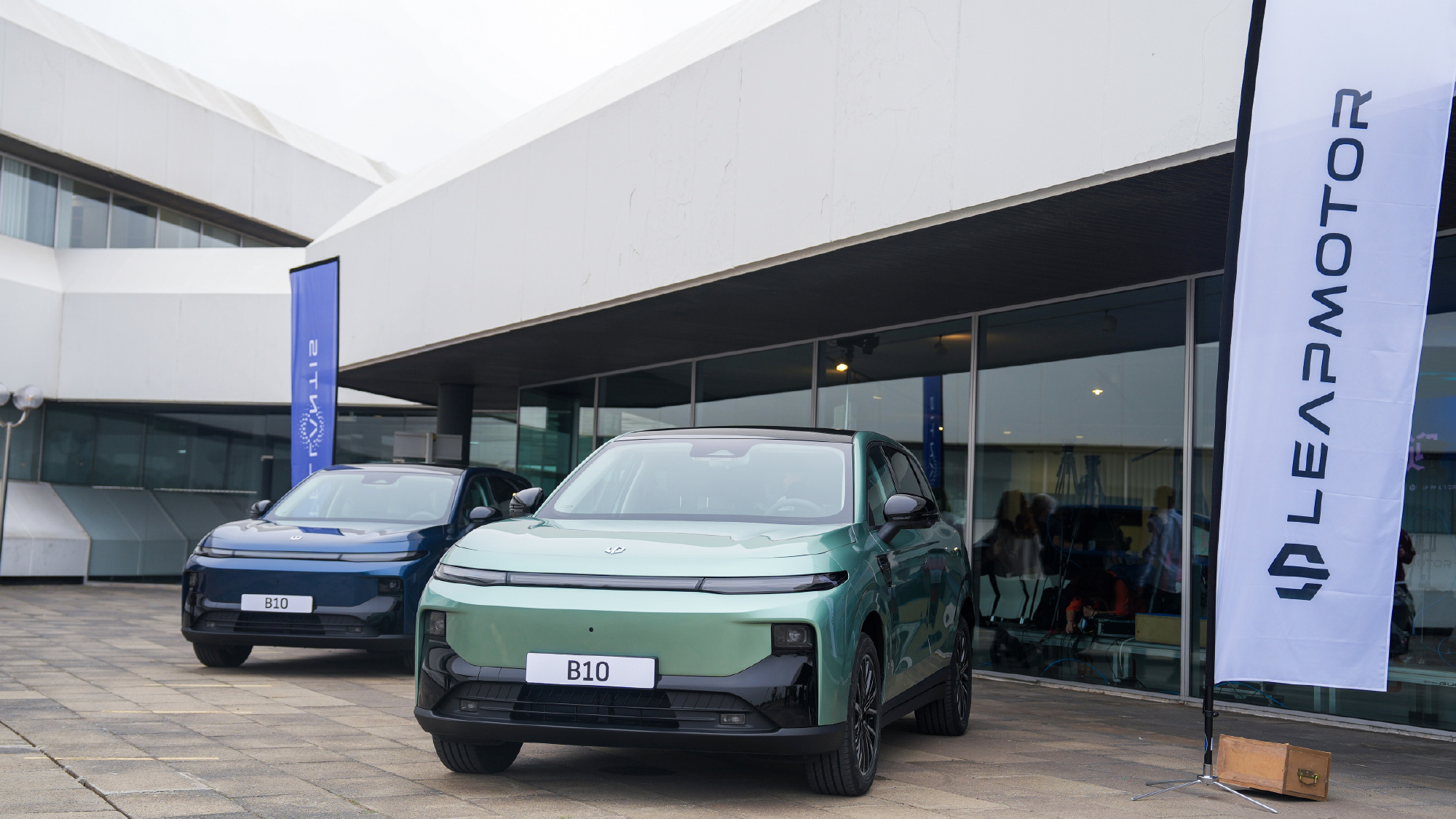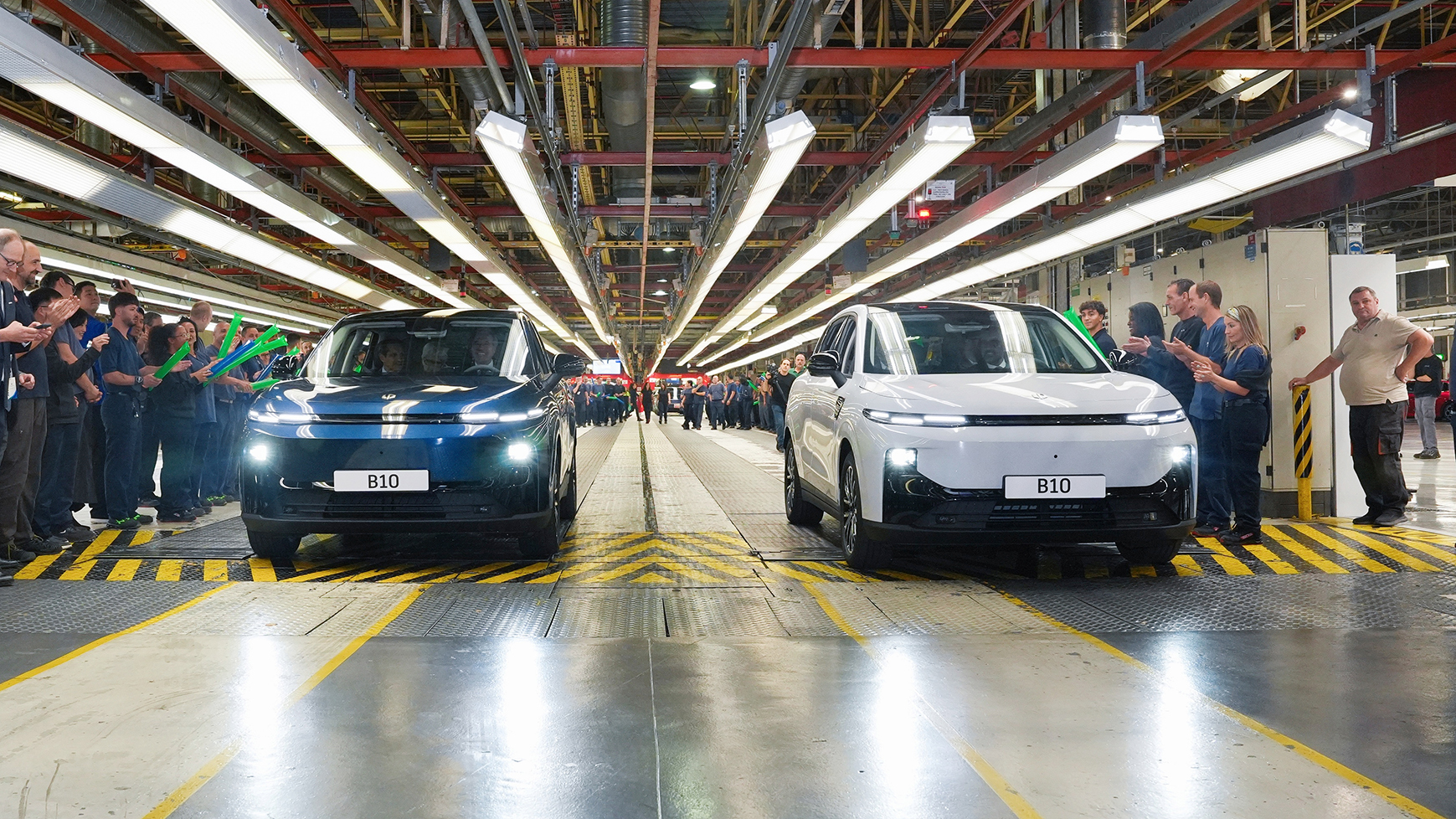
- Leapmotor began local B10 production at Stellantis’ Figueruelas plant in Zaragoza, signaling a strategic push to localize manufacturing and capture European EV market share amid intense pricing and competition pressures.
- The Figueruelas complex has 300,000 annual capacity, Leapmotor reported over 27,700 global B10 orders last month including 8,000 in Europe, and Leapmotor’s first nine-month overseas exports topped 150,000 units.
- The move directly targets mainstream European compact EVs, but execution risks include rapid ramp timing, integration with Stellantis operations, local hiring and shift changes, and sustaining margins while scaling.
On October 16, at the Figueruelas plant in Spain’s Zaragoza province, three lines appeared across the screens at the ceremony marking the start of production of the Leapmotor B10:
Two forces.
A bright electric future.
Built in Europe.
On the main backdrop, the LEAPMOTOR and STELLANTIS logos stood side by side, exactly the same size. Blue for Stellantis, green for Leapmotor.
When it came time to cut the ribbon, the Stellantis host brought out two ribbons, one blue and one green.
I didn’t think much of it at the time. Looking back, I realized just how much thought had gone into those details.
The ceremony itself was a high-profile affair.
Yao Jing, China’s ambassador to Spain, traveled to the event. Other guests included Jordi García Brustenga, Spain’s Secretary of State for Industry; Jorge Azcón, president of the Government of Aragon; and senior executives from both companies’ European operations.

During this trip, ChinaEV Home visited a Leapmotor showroom in Paris, a car dealership in Madrid that has been operating since 1950, and another Leapmotor dealership in Zaragoza. We also toured the Mallén battery plant, about 30 km from the vehicle factory.
Just months earlier, that battery plant had been an empty building. By August, two months before vehicle production began, it had already turned out Leapmotor’s first battery pack made in Europe.

Three days later, back in China, I found myself thinking about the ceremonies, the handshakes, the conversations, and the speeches we had heard firsthand.
One thing became increasingly clear: Leapmotor is no longer being treated as an outsider in Europe.
That realization became the starting point for this story.
This is not simply a record of Leapmotor’s European operations or our trip there. It is also an attempt to clear up a few misconceptions and, through one company’s experience, offer another way to think about how Chinese automakers expand overseas.
Here goes.
Two Ribbons
At the B10 production ceremony on October 16, newly appointed Leapmotor International CEO Danilo Annese made a statement that caught my attention:
“The B10 is the first Chinese branded vehicle made in Europe.”

The moment I heard it, I thought about the debate those words might spark back in China.
Yet Annese was arguably the most restrained speaker of the day.
Jordi García Brustenga, Spain’s Secretary of State for Industry and Tourism, was considerably more enthusiastic.
He even told a story about a watch he had recently bought.
The previous Sunday, he said, he had deliberately chosen a watch from a Nordic brand. But when he got home and opened the box, he discovered that it had actually been made in China.

He used the story to make a point:
“This is a highly viable, desirable and sustainable combination: China’s strengths together with Europe’s.”
The wording may sound a little European in translation, but the recognition and enthusiasm behind it were unmistakable.
Jorge Azcón, president of the Government of Aragon, went even further.
He called it a “historic day” and spoke excitedly about what might come next.
“Soon, we’ll be talking about breaking production records,” he said.

What struck us most at ChinaEV Home was that the Spanish officials and Stellantis executives did not seem to view the B10 or its production line simply as a Chinese investment or a Chinese car arriving in Europe.
Nor did they treat Leapmotor as a foreign newcomer.
Instead, they spoke about the project in the context of Spain, Stellantis, and the jobs and future of the Figueruelas plant. It had become part of the local industrial story.
That sentiment was particularly clear in a speech by Silvia Vernetti, Stellantis’ head of joint ventures and strategic planning.
“The transition to electric mobility must also be an industrial transition,” she said.
“If our partnership represents strategic cooperation, Zaragoza is the proof that we can bring together global technology, competitiveness and European industrial capabilities.”
She ended her speech by repeating the three lines displayed behind her:
Two forces. A bright electric future. Built in Europe.
Eleven Years
During his speech at the production ceremony, Leapmotor founder, chairman and CEO Zhu Jiangming went back to something that had happened 11 years earlier.
In 2015, Zhu, then 48, was traveling in Spain when he spotted a small Renault electric car on the street.
That encounter gave him the idea of building cars himself.
After returning to China, he brought together 41 engineers and founded Leapmotor.
He recalled that moment at the ceremony:
“It was on the streets of Spain that I first had the idea of building cars. After returning to China, I gathered 41 engineers and started Leapmotor.”

Zhu had almost certainly thought carefully about telling this story on such an occasion.
And it was hard to miss the symbolism: a company whose idea was born on a street in Spain had returned 11 years later to manufacture cars there.
Some of the figures Zhu shared carried their own significance.
He noted that China’s new energy vehicle penetration rate had approached 70% the previous month, compared with more than 30% in Spain and over 40% across Europe.

He also spoke about Leapmotor’s ambitions.
The company, he said, had entered the world’s top four NEV brands this year, with a global sales target of 1 million vehicles. Its next ambition was to rank among the world’s top ten automakers by total vehicle sales, across all powertrain types.
In the first nine months of 2026, Leapmotor’s overseas vehicle exports exceeded 150,000 units, meeting its full-year export target ahead of schedule.
By the end of September, cumulative global deliveries had topped 1.8 million vehicles.
Then there were the B10’s overseas orders.
Zhu disclosed that the model received more than 27,700 orders worldwide in the previous month, including over 8,000 from Europe.
Just the Beginning
According to the official figures, the Figueruelas plant where the B10 is now being built has been operating for 43 years and has produced more than 10 million vehicles.
Today, it employs about 4,400 people and has an annual production capacity of 300,000 vehicles.
Around 80% of Spain’s automotive production capacity is concentrated within a 300 km radius of the plant.

These details matter because Leapmotor is not starting from scratch in Europe.
It has entered an automotive manufacturing ecosystem that has been operating for decades, and one where its arrival appears to have been warmly received.
How warmly?
At a media interview following the October 16 ceremony, Stellantis Senior Vice President Óscar Fernández described the project’s timeline as “record-breaking.”
It took just over a year to convert the production line and bring the B10 into production.

The plant had already begun building its first pre-production B10 vehicles in August, using them to train newly recruited workers.
Local Spanish media, including television stations, magazines and newspapers, were particularly interested in what the project meant for factory utilization and employment.
How many jobs would B10 production create? How much of the plant’s capacity would it use?
If I recall correctly, Fernández initially put the number of additional jobs at somewhere between 450 and 600.
Zhu later clarified that the conversion had created around 450 industrial jobs, while the broader industrialization project involved approximately 600 people, including both transferred workers and new hires.

To increase production, the factory has also adjusted its shift patterns, introducing rotating morning and afternoon shifts alongside a fixed night shift.
Local reporters were equally keen to know whether Leapmotor would build another model there.
They kept pressing for an answer.
During the interview, Annese confirmed that the B05, known as the Lafa 5 in China and one of Leapmotor’s best-selling models, would enter production in Zaragoza in the first quarter of 2027.

He also said more Leapmotor models would eventually be produced at Stellantis facilities across Europe, not just in Spain.
As for the first European-built B10s, deliveries to customers in Spain and other European markets are scheduled for December 2026 through January 2027.
There was another detail worth noting.
A large number of journalists attended the event, including representatives from major local outlets.

Watching the media interview as a journalist, I was struck by how much it resembled the kind of press event a domestic automaker might hold in its home market.
The questions were direct, the discussion lively, and the interest in the project’s local impact very real.
Seven Months
There is another part of Leapmotor’s European manufacturing operation worth discussing: its battery plant.
Located in Mallén, about 30 km from the Figueruelas vehicle factory, it is Leapmotor’s first battery plant in Europe.
The first locally assembled battery pack rolled off the line in August, two months before the B10 entered production.
Just seven months earlier, the building had been empty.

According to the company’s timeline, the project went from site selection to battery-pack trial production and manufacturing in roughly ten months.
Site selection began in October 2025.
In February 2026, the team received the keys to the building. The first battery pack came off the line in August, followed by PPAP production part approval in September.
The official production ceremony was held in October.
Getting all of that done so quickly in Europe is remarkable, particularly given the approvals and industrial processes involved.

Stellantis was clearly proud of the achievement, too.
One of its representatives made an interesting observation during the ceremony:
“We often hear the expression ‘Chinese speed,’ as though that kind of speed were only possible in China. But when you bring together the right expertise, the right mindset and mutual trust—and that last part is very important—you can achieve the same speed here in Europe.”
During our tour, a Leapmotor representative, Mr. Gao, explained that the Mallén plant follows the company’s manufacturing standards in China.
For now, battery cells are still supplied from China, while battery-pack assembly takes place in Europe.
The first phase starts with an annual capacity of 60,000 battery packs, which can rise to 100,000 once the production line is fully ramped up.
The second phase has a planned peak capacity of 200,000 packs a year.

This is Leapmotor’s first battery factory in Europe, and, according to the company, the first standalone overseas battery plant established by a Chinese automaker.
Its production is also closely matched to the needs of the B10 assembly line at Figueruelas.
Speaking at the ceremony, Zhu emphasized the importance of batteries as one of the most critical components in a vehicle.
This, he said, was the first time Leapmotor had brought its battery manufacturing operations overseas.
The company plans to continue expanding its European manufacturing footprint, eventually covering production lines, batteries, electric drives, electrical and electronic systems, and complete vehicles.
Taking Down the Wall
Writing this brings me back to a visit we made on October 14 to a Stellantis & You dealership in Madrid.
The site originally housed a Citroën importer in Spain and has been selling cars since 1950.
Today, the dealership handles all Stellantis brands.
Across Spain, Stellantis & You has ten dealerships selling Leapmotor vehicles, accounting for roughly 20% of Leapmotor’s sales in the country.

We were welcomed by Javier Marijuan, Stellantis & You’s director of new-car sales in Spain, a seasoned veteran of the business.
He told ChinaEV Home that Leapmotor had sold around 2,300 vehicles through their dealerships in the first nine months of 2026.

Two dealerships in the Madrid region alone accounted for more than 600 of those sales.
B05 sales had also been doubling over recent months, he said, making Leapmotor the fastest-growing brand in their Spanish network.
Then something rather memorable happened.
Marijuan pointed to a wall inside the dealership and made a gesture as if he were pushing it down.
They were planning to expand the space dedicated to Leapmotor, he explained, because they expected to sell at least 3,000 Leapmotor vehicles next year.
The following day, we visited another Leapmotor dealership, this time in Zaragoza.

The dealer had started selling Leapmotor cars in the second half of 2025.
Customer orders had doubled compared with last year, as had the size of the team. The dealership was now taking roughly 40 to 50 orders a month.
The head of the dealership group was optimistic about the brand’s prospects locally.
“Yesterday, we signed our third sales location,” he told us.

Until then, the group had two Leapmotor sales points, one in Zaragoza and another in Huesca, about 70 km away.
He added, with some satisfaction, that we were the first to hear the news.
I was curious about why local customers were choosing Leapmotor.
The managers at the two dealerships gave remarkably similar answers: local presence.
By entering the Stellantis sales network, Leapmotor had gained more than just places to sell cars.
It also had access to the infrastructure that comes with car ownership, from repairs and servicing to insurance and other support.
At the dealership we had visited earlier in Paris, the local manager described it as a network within a 20- to 25-minute drive of customers.
Spain, though, had another factor at work.
“One important reason people choose Leapmotor is that the factory is right here,” the Zaragoza dealer told ChinaEV Home.
“It’s not just about the employees. The factory has received a lot of attention in local news and on social media. People are really looking forward to it.”
He even suggested that Leapmotor had become one of the most familiar choices for local customers considering an electric car.
Another thing that surprised us was just how established the brand seemed to have become in Spain.
The Zaragoza dealer explained that local BEV buyers generally had their own garages and relatively comfortable incomes.
For many of them, a Leapmotor was their first electric car.
He also recalled that, if his memory served him correctly, the B10 had been Spain’s best-selling electric car in July.
Marijuan, meanwhile, offered a comparison from his own dealership experience.
In his view, Leapmotor had reached roughly the same level as Citroën in their local business, although it was still a little behind Jeep and Peugeot.
According to Leapmotor’s official figures, by October 2026 the brand had more than 1,000 retail locations across 36 European countries.

The average customer was just a 22-minute drive from the nearest dealership.
For those customers, Leapmotor is no longer just an unfamiliar Chinese name.
It is a brand they can reach in about 20 minutes, buy a car from, return to for repairs, and increasingly see being manufactured close to home.
Let’s Get to Work
That brings us back to Leapmotor itself.
During a group interview at the Paris Motor Show on October 12, Zhu Jiangming was once again asked about the benefits and risks of the company’s partnership with Stellantis.
His answer was unusually candid, and one that everyone in the room seemed to remember.
He compared the relationship to a marriage.
“It’s like two people who have just gotten married,” he said.
“Things have been stable for a while. They’ve had a child and built a family. But could they still get divorced? That depends on how they live together.”
“To make the marriage last, they need to understand each other better, be more tolerant and support each other. That’s how you make it work for a lifetime.”
Zhu sees similarities between Leapmotor’s current approach in Europe and the joint-venture model foreign automakers adopted when they entered China.

He pointed to Volkswagen’s longstanding partnership with FAW as an example.
Those foreign automakers, he argued, had achieved considerable success in China.
“I think that is a model we should learn from in today’s market,” he said.
Beyond the importance of making the partnership work, Zhu pointed out another distinction between Leapmotor and Stellantis.
Their relationship, he said, goes deeper than traditional joint ventures such as FAW-Volkswagen.
“We already have a family connection, because Stellantis is one of Leapmotor’s major shareholders. So in theory, there’s no reason this partnership shouldn’t work.”
That led him to a principle he considers important:
“We don’t set boundaries. Once you start drawing boundaries, things get stuck. We work together.”

Stellantis, for its part, has its own reasons to make the partnership work.
In May, the group announced its five-year FaSTLAne 2030 strategy, outlining plans to invest €60 billion over five years, launch more than 60 new models and increase utilization at its European factories from around 60% to 80%.
During the October 16 media interview in Zaragoza, Silvia Vernetti, Stellantis’ head of joint ventures and strategic planning, was asked whether Leapmotor was an important partner in reaching those goals.
Her response was immediate and unequivocal:
“Absolutely.”
There is one last moment worth recording.
As the media interview in Zaragoza was coming to an end, the host, Rosa, delivered a final message in Spanish-accented English:
“Make sure you remember Stellantis and Leapmotor—because we’re going to do big things.”
Discover more from ChinaEVHome
Subscribe to get the latest posts sent to your email.