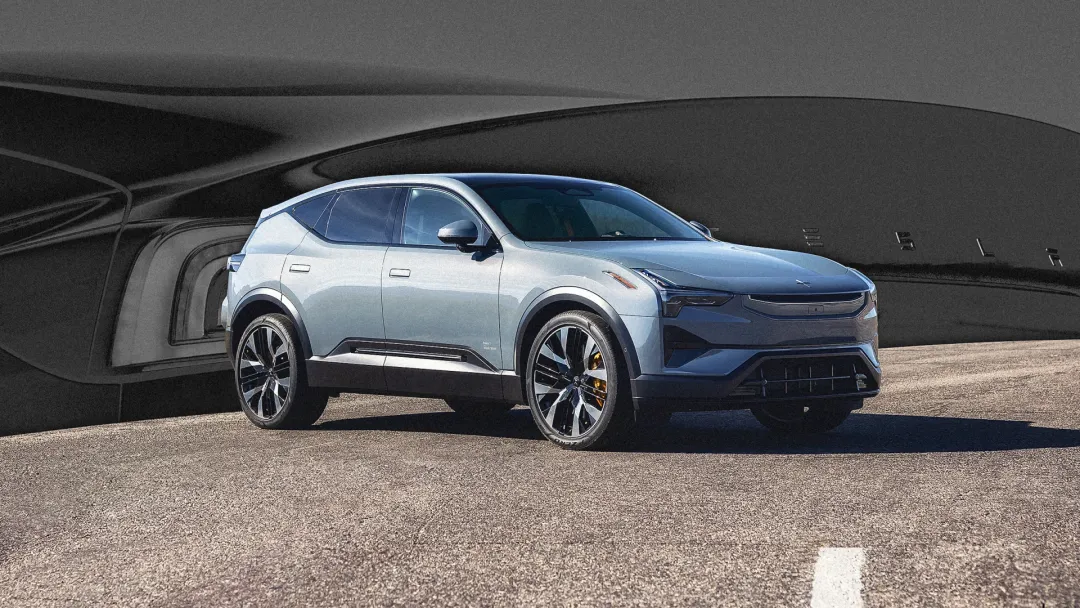
Geely has once again injected capital into Polestar.
On June 16, PSD Investment Limited—a key investor under Geely Holding Group—injected $200 million into Polestar. The company is ultimately controlled by Eric Li.
Whether it’s investments from Geely-affiliated backers or the Chinese team leading the R&D of Polestar 7 and 8, all signs suggest Geely hasn’t abandoned this brand, which has nearly vanished from the Chinese market.
For most people, memories of Polestar linger around its denial of exiting China after the 2025 Spring Festival. Further back, the Polestar 3—launched in China in March 2023—only began global deliveries in late June 2024 and appeared in MIIT’s filing list in August.
When Polestar resurfaces, the first reaction is confusion: Where did Polestar go? Was it abandoned? Will it re-enter China’s competitive market?
Polestar is a fascinating brand. It embodies nearly every major contradiction in the auto industry: traditional automakers’ struggle to transform, the uphill battle for premium EVs, China’s brutal market competition, and Europe’s wariness toward Chinese EVs.
After less than six months of adjustments, Polestar can now briefly answer those three questions: It has “returned” to Europe; Eric Li invested $200 million on June 16; and a near-term return to China is unlikely.

Its silence in China and activity in Europe have polarized perceptions across the two regions. Focusing solely on China raises questions like “Will Polestar be abandoned?” while observing Europe reveals Geely’s continued support.
What is Polestar’s true status? Recent moves by Polestar and Geely may offer clues.
Silence in China
Polestar’s story in China has hit a pause.
Since April, when Polestar and Xingji Meizu Group terminated their joint venture—with Polestar reclaiming distribution rights and independently operating in China—the brand has gone radio silent in the Chinese market.
Years of declining sales made Polestar’s retreat overseas unsurprising:
- 2021: 2,048 deliveries in China
- 2022: 1,717
- 2023: 1,100
- 2024: 3,120 (per foreign media, amid rumors of clearance discounts)
Globally, however, Polestar’s trajectory was the opposite:
- 2021: 29,000
- 2022: 51,000
- 2023: 54,600
- 2024: 44,900 (down 15% YoY)
Meanwhile, China’s NEV market exploded:
- Penetration surged from 5.4% (2020) to 40.936% (2024).
- Annual sales leapt from 1.367 million (2020) to 12.866 million (2024).
Domestic brands soared:
- Li Auto: 32,600 (2020) → 500,500 (2024)
- BYD: 427,000 (2020) → 4.2721 million (2024)
Against this backdrop, the Polestar 4—praised as “the best-driving SEA-based car”—managed only 2,087 sales in China in 2024, accounting for two-thirds of Polestar’s annual China sales.
Polestar’s struggles stem partly from the inherent challenges of premium EVs, but also because each model lagged behind Chinese rivals in space, tech, and range.
Production delays plagued Polestar from day one. The Polestar 2 launched in April 2019 but only began deliveries in July 2020.

Initially, the Polestar 2 held appeal: at ¥298,000 ($41,446.45), it undercut the imported rear-drive Model 3 (¥377,700/$52,546.59) by nearly ¥80,000 ($11,126.56). Its Volvo-performance heritage and comfier seats won over some buyers, despite inferior software and weight.
But during the wait, the China-made Model 3 launched in December 2019 (¥299,100/$41,612.80), and the XPeng P7 debuted in April 2020 (¥229,900/$31,984.70). As a compact sedan on Volvo’s CMA platform, the Polestar 2 suffered from limited space and a high rear tunnel. The P7’s NGP and Tesla’s tech edge overshadowed Polestar’s “performance” focus. Despite later price cuts to ¥252,800 ($35,166.90), it missed its window.
By November 2023, the Polestar 4 arrived (¥299,900+/$41,722.67+) facing the Model Y, NIO ES6, and Zeekr 001.

While the Polestar 4 boasted strong performance, an 8155-powered Polestar OS, and 682km CLTC range (vs. NIO ES6’s 625km), it still trailed:
- Range: Less than 2024 Zeekr 001 (750km)
- Tech: Lacked Zeekr 001’s 800V system or NIO ES6’s battery swap
- Brand: Remained niche in China
Despite improvements, the Polestar 4 faced software glitches: parking camera failures, erratic ADAS logic, slow infotainment, and unstable Bluetooth keys. By 2023, China’s NEV market was cutthroat. Such flaws damaged its reputation. The Polestar 3, which only reached MIIT in August 2024, now faces rivals like the NIO ES8, Li L9, and AITO M9.

Did Polestar try to fix this? Yes. Price adjustments for Polestar 2/4 and Polestar OS upgrades showed effort. But results were minimal. Input-output imbalance may be the clearest reason for its partial retreat.
Deeper reasons trace back to statements by then-Polestar China CEO Feng Dan at the 2023 Shanghai Auto Show:
“Polestar lacks both volume and brand recognition in China. These are objective realities—detours we’ve taken, ‘tuition’ we’ve paid. Going forward, we must build the brand before chasing sales.”
This was Polestar’s first public admission of its core problems in China: low brand awareness and muddled positioning.
Polestar knew its issues. Yet despite 7 China CEOs since 2017 and the 2023 Polestar Technology JV with Xingji Meizu Group (led by Shen Ziyu), solutions remained elusive. For a European-rooted brand, pivoting overseas made more sense than forcing China.
A “Second Spring” in Europe?
Terminating the Xingji Meizu JV and shifting distribution to Polestar signaled a clear exit from China’s near-term competition.
For Polestar, Europe and the U.S.—where brand recognition and driving dynamics matter—are its comfort zone.

With the Polestar 3 and 4, Q1 sales hit ~12,000 units, up 76% YoY. Europe accounts for 75% of Polestar’s sales, with the UK making up 25%.
This drove significant improvement:
- Revenue: $608 million (+84.2% YoY)
- Gross margin: Turned positive to 6.8% (from -7.7%)
- Net loss: Shrank 31.2% to $190 million
For Western buyers, Polestar’s appeal lies in design and performance. The 2026 Polestar 4 Dual Motor:
- 0-100km/h: 3.7s (vs. Tesla Model 3 AWD: 3.1s)
- Power: 544 hp (vs. Model 3 AWD: 460 hp)
- Range: Up to 755km CLTC (2025 model; 2026 TBA) vs. Model 3’s 715km
Amid BMW/Mercedes/Audi’s conservative EVs, Polestar satisfies performance seekers. But its Achilles’ heel is price:
- U.S. Model 3 AWD: $47,490
- 2026 Polestar 4 Dual Motor: $64,300
This aligns with Polestar’s luxury positioning: the upcoming Polestar 5 and 6 target the Porsche Taycan, Audi RS e-tron GT, and Porsche 911.
Overseas forums praise Polestar’s handling and Volvo ties but mock its “arrogance.” Part of its edge comes from anti-Tesla sentiment. Elon Musk’s political involvement in 2025 has amplified Tesla resistance in the West.
Polestar seized this moment, launching a U.S. lease program for Tesla owners offering up to $20,000 off. A Polestar 3 (~$93,000) could drop to $73,000—$7,000 cheaper than a base Model S ($80,000). A Polestar exec revealed nearly half of Polestar 3’s Q1 U.S. sales came from Tesla owners.
Even in the UK, Polestar registered 1,174 vehicles in May (vs. Tesla’s 2,016)—a 273% YoY jump. Polestar UK MD Matt Galvin told The Independent they’re converting Tesla owners at a “very high rate.”

Polestar has made Europe its priority. Global CEO Michael Lohscheller stated: “Europe is absolutely the most important… We focus on our strengths, and they’re clearly in Europe—we have a strong service network, many dealers with Volvo, and excellent brand awareness.”
Polestar has chosen: be a local powerhouse, not a foreign underdog.
Geely’s Global Lever?
Polestar’s silence in China reflects its growing detachment.
This shift is evident in production:
- The Polestar 7—a future volume driver—is designed for Europe. It will be built at Volvo’s new Slovakia plant (250k annual capacity), operational by 2026 for a 2027 launch.
- For North America, the 2026 Polestar 4 will shift production from China to Renault Korea (Geely holds 34%) to bypass U.S.-China trade tensions.
- Since August 2024, the Polestar 3 has been built in South Carolina for Europe and North America.

As for Polestar’s Chengdu plant? Its last mention was in July 2024, when Polestar denied rumors of its closure and production shifts to Chongqing/Geely plants.
Unless China sales surge, Polestar’s production focus will move overseas. China’s role may pivot to R&D—the Polestar 7 and 8 are led by Chinese teams.
Though ex-Polestar China CEO Shen Ziyu pledged long-term commitment, Polestar now appears positioned as a global luxury brand under Geely Holding, leveraging partial Chinese production and tech but targeting overseas premium markets.
This is precisely what Geely lacks. Despite a 2024 share reduction, Polestar remains perceived as Volvo’s global premium arm—a European-rooted, Volvo-backed brand with steady overseas sales. Among Geely’s portfolio, Polestar faces lower export barriers.
As a semi-independent entity (Geely doesn’t fully own it), Polestar enjoys flexibility. Geely Auto stated in its Q1 earnings call it has “no plans to acquire Polestar.” Polestar could become Geely’s bridgehead for exporting premium EVs.
With Volvo struggling to balance EV/ICE transitions, the pure-electric Polestar may serve as Geely’s lever for global premium EV growth.
Through expanded dealerships and active operations, Polestar is no longer invisible in the West—exactly what Geely wants to see (whether positive or negative PR).
For example, Top Gear’s James May wrote in The Times last month: “While parked at a gas station for crisps, a man ran up excitedly: ‘Is this the car with no rear window?’ He was too breathless to notice me doing a bad haka while trying to open the door… But then, this brand is owned by Volvo.”

May’s quip highlights Polestar’s advantage: Volvo’s legacy means near-zero explanation cost abroad—something it sorely lacked in China’s China-trusting EV market.
Can Polestar leverage this edge to thrive overseas?
Discover more from ChinaEVHome
Subscribe to get the latest posts sent to your email.