Geely integrates Zeekr, Smart, and others into Qianli Technoloy, aiming for unified ADAS solutions and accelerated OTA rollout across brands.
On August 4, several sources have revealed that Geely intends to integrate Zeekr’s previously independent intelligent driving team into Chongqing Qianli Technology to centralize resources and improve efficiency.
Subsequent updates indicate that the consolidation effort is not limited to Zeekr. The approximately 100-member smart brand team is also being merged, though the Lotus R&D team will remain independent for now. Additionally, the Geely Automotive Research Institute and Megvii’s Mach Drive will also be integrated into Qianli Technology.

If the news is accurate, once the consolidation is complete, Qianli Technology will become an intelligent driving company with over 3,000 employees, providing unified intelligent driving solutions for multiple Geely-owned brands.
Zeekr has not yet made an official statement regarding the rumors. However, according to internal sources cited by ChinaEVHome, Zeekr’s smart driving team will be “basically merged.”
Undoubtedly, this is another major move responding to the “Taizhou Declaration” issued at the end of last year. The most optimistic expectation is a significant enhancement in Geely’s intelligent driving capabilities.
One Geely, One Smart Driving System
Currently, WeChat blogger “Stronger Tang” and the publication Yijian Auto have reported this integration first, citing exclusive sources.
On August 1st, Geely held a “mobilization meeting,” attended by high-level staff from Geely Auto, Zeekr Technology, and Chongqing Qianli Technology.
Yijian Auto revealed that speakers included Qianli Technology CEO Yin Qi, Co-President Wang Jun, Geely Auto CEO Gan Jiayue, and Zeekr Group VP Chen Qi.

During the meeting, it was stated that Geely would only have “one intelligent driving system” moving forward, specifically the “G-Pilot” solution provided by Qianli Technology.
“Stronger Tang” also detailed staff movements after the business integration.
Reportedly, Zeekr’s 1,300–1,500-person ADAS team will directly join Chongqing Qianli Technology, with no change in compensation. After negotiation, their workplace may also remain the same—currently spread across offices in Shanghai and Chongqing.

The smart brand R&D team may choose to join either Qianli Technology or the Geely Automotive Research Institute, but they must undergo interviews (which are said to be relatively easy). Existing employees may also opt out of signing new contracts and could receive compensation (e.g., N+1 packages).
However, the report also noted that the merger is still in its early stages. Details like the leadership team, task division, and priority assignments within the merged Geely-Zeekr ADAS systems are still under discussion. The earliest visible outcomes may emerge by the end of August.
Notably, the intelligent driving strategies for other Geely-related brands such as Volvo are not covered in the current reports.
In the long run, consolidating the previously fragmented ADAS architecture into a single framework will undoubtedly maximize internal resource efficiency and achieve the goal of “reducing costs and increasing efficiency.”
From a customer perspective, the unified architecture may ensure that vehicles across Geely’s sub-brands will share consistent smart driving capabilities and even gain simultaneous access to advanced features.
In short, centralizing ADAS development under Qianli Technology could very well be a win-win strategy for both Geely and its customers.
Leveling Capabilities, Speeding Up Updates?
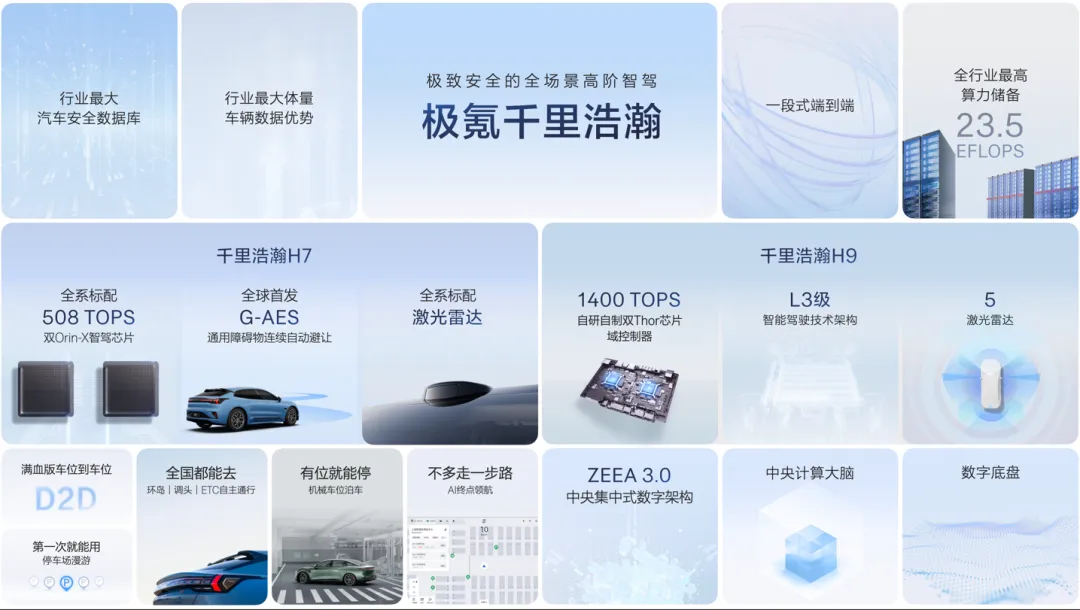
In March this year, the “G-Pilot” smart driving brand made its public debut, dividing capabilities into five levels—H1, H3, H5, H7, and H9—based on performance boundaries, much like BYD’s tiered approach.

From lowest to highest, the H1 tier supports only rule-based highway NOA (Navigation on Autopilot). Higher tiers gradually advance through urban commuting NOA, full-scenario end-to-end NOA, valet parking, and finally H9, which supports an architecture capable of L3 autonomous driving.
Before the G-Pilot system’s full rollout, Geely’s various sub-brands adopted ADAS solutions from different suppliers.
For instance, some Lynk & Co models used Ecarx solutions; Zeekr primarily relied on its in-house “G-Pilot” ; Geely Galaxy adopted Mach’s technology; smart and Zeekr both used in-house systems.
Because of this fragmented ecosystem, the hardware chips and computational power varied significantly between brands and models. Even vehicles with similar processing capabilities had inconsistent intelligent driving features. OTA (over-the-air) update schedules also differed.
A prime example is Lynk & Co and Zeekr, which merged into “Zeekr Intelligent Technology Holding Limited” mid-year. Yet their leading models’ ADAS capabilities differ widely.
Both the Lynk & Co 08 EM-P and the Zeekr 7X are priced at around ¥250,000 ($35,000), but the former uses Ecarx’s Dragon Eagle One chip and only supports highway NOA based on high-definition maps. Meanwhile, the Zeekr 7X, equipped with dual Orin-X chips and the in-house (now G-Pilot-based) end-to-end system, already supports full-scenario NOA.

Clearly, after system unification within Geely, next-gen versions of the Lynk & Co 08 EM-P and the new Zeekr 7X will likely share the same ADAS capabilities (G-Pilot H7). This will significantly enhance the appeal of the 08 EM-P to potential buyers.
Another issue is OTA update frequency.
Lynk & Co’s Mu Jun announced on social media that the 07 EM-P’s 1.9.0 OTA update launched on the evening of July 31. Meanwhile, Zeekr’s 6.5.0 OTA remains delayed, and Zeekr’s Dr. Zhu Ling candidly admitted to feeling “immense pressure.”

Once the ADAS system is unified, such delays in OTA rollout may be greatly reduced, allowing Geely’s various models to upgrade their smart driving capabilities in sync.
Given this massive ADAS team consolidation, it’s plausible we may see more large-scale integrations within Geely in the future—perhaps in supply chains or infotainment systems.
Whether these moves will help Geely reach its goal of 5 million annual vehicle sales remains to be seen.
Discover more from ChinaEVHome
Subscribe to get the latest posts sent to your email.