Mercedes-Benz plans to bring its solid-state battery technology to mass production within the next five years.
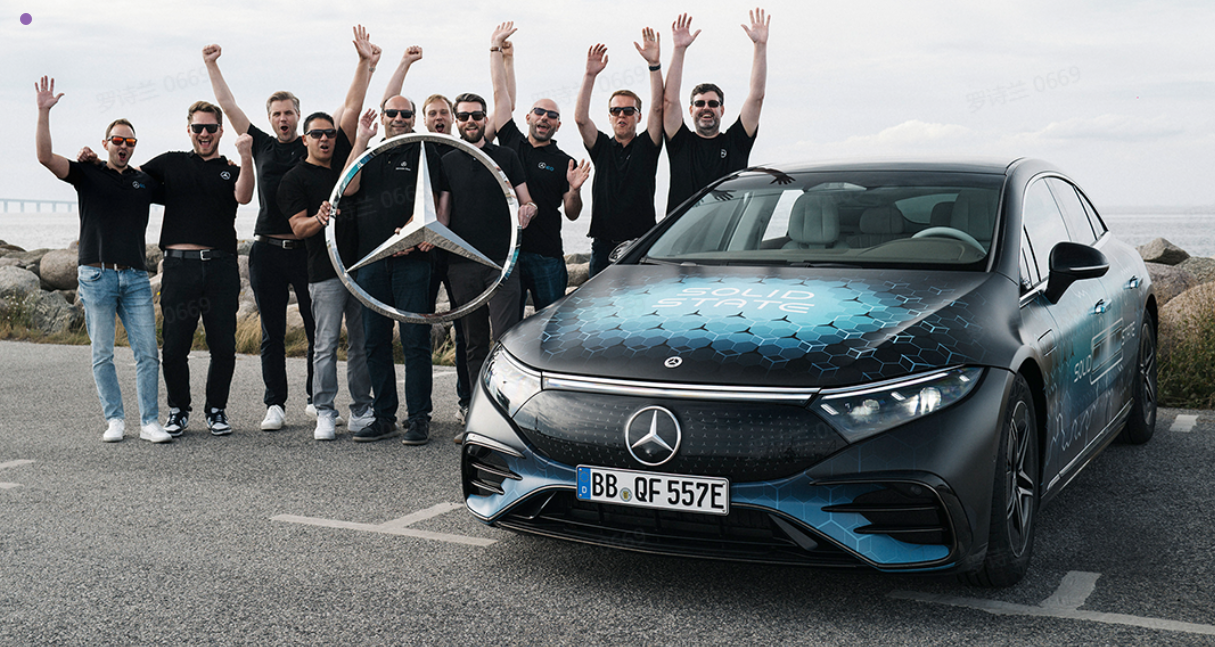
On September 11, Mercedes-Benz announced that its EQS prototype equipped with solid-state batteries successfully completed a long-distance cross-border test, covering 1,205 km on a single charge.
Remarkably, the car still retained 137 m of range upon arrival, surpassing the previous 1,202 km record set in 2022 by the VISION EQXX efficiency concept car.

The test route began in Germany, passed through Denmark, and concluded in Sweden, spanning diverse climates and road conditions.
Unlike controlled laboratory settings, the test was conducted entirely on open public roads, offering results that reflect real-world driving scenarios.
The solid-state battery was co-developed by Mercedes-Benz’s passenger car R&D team and the Formula 1 specialists at Mercedes-AMG High Performance Powertrains (HPP), with battery cells supplied by industry partner Factorial Energy.

The pack uses a sulfide-based solid electrolyte, achieving a gravimetric energy density of 450 Wh/kg—around a 25% improvement in theoretical range potential.
To address volume changes during charge-discharge cycles, the battery pack is fitted with pneumatic actuators. Notably, the prototype’s battery pack matches the production EQS in size and weight.
Mercedes first integrated solid-state battery prototypes into EQS test cars in 2024, with extensive validation in both lab and road conditions.

In February this year, the project entered public road testing, and the latest long-range trial further validates the efficiency and stability potential of solid-state technology. Mercedes stated it aims to bring the technology to mass production within the next five years.
Solid-state batteries are widely regarded as a pivotal next-generation technology for EVs, offering higher energy density and improved safety.
Other automakers are also racing to commercialize the technology: in May, BMW’s i7 solid-state prototype completed a test drive in Munich with mass production targeted for 2028, while Volkswagen showcased a solid-state prototype at the IAA Mobility in Munich using a Ducati motorcycle as its test platform.
Chinese battery makers are likewise accelerating commercialization. Earlier this month, EVE Energy announced the rollout of its 10-Ah all-solid-state battery, with plans for 100 MWh annual production capacity by the end of 2026. BYD and CATL also plan to begin small-batch solid-state production by 2027.
Overall, both automakers and battery manufacturers are entering the countdown phase for solid-state industrialization, with the next three to five years expected to be a decisive turning point for the technology.
Discover more from ChinaEVHome
Subscribe to get the latest posts sent to your email.