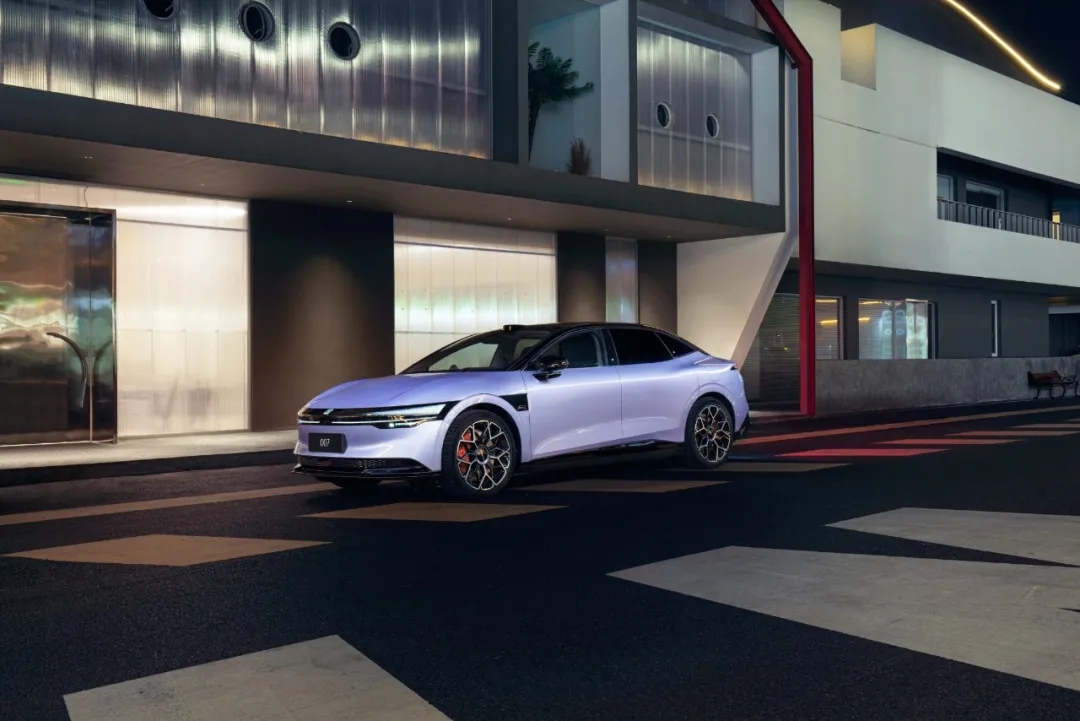
Zeekr’s facelifted 007 launch is delayed until 2026 due to strong demand and battery production constraints.
Amid a wave of model updates across its lineup, Zeekr is facing one of its rare delivery challenges.
According to the company, the facelifted Zeekr 007 — originally scheduled for launch in the fourth quarter — has been delayed to the second quarter of 2026.
The reason, Zeekr explained in an official Q&A, lies in strong order growth for the updated Zeekr 001 and 7X, which share the same 103 kWh battery production line. Demand has outstripped capacity, pushing delivery times beyond initial estimates.

With battery expansion taking time, delivery for certain variants has to be extended. Zeekr advised customers with urgent needs to consider the Zeekr 7X variant equipped with the 75 kWh ShenDun “Golden Brick” battery.
Because the facelifted 007 will now be invoiced and delivered in 2026, Zeekr has also introduced a policy to cover any resulting purchase tax difference for affected buyers.
To prevent further delivery disruption, the company chose to postpone the new car’s launch and prioritize delivery fulfillment.

At the same time, this move effectively reveals both the existence and the release window of the facelifted Zeekr 007 ahead of schedule.
So where does Zeekr’s “battery bottleneck” lie, and will the delayed 007 refresh still bring surprises?
1. The Delayed Facelift
The timing of the refreshed Zeekr 001 and 7X came as a surprise to many.
For example, the 001 facelift sold out so quickly that Zeekr advanced its release, logging more than 10,000 locked orders within three days.

Among them, 67% of customers chose the 103 kWh CATL Qilin battery, while 33% opted for the 95 kWh ShenDun “Golden Brick” pack.
Although detailed order data for the refreshed 7X remains undisclosed, given its smaller 75 kWh standard pack, most buyers are expected to prefer the 103 kWh Qilin version for extended range.
As the two models share the same 103 kWh Qilin battery production line, the surge in orders has created a supply bottleneck.
Auto blogger @哈啰先生 revealed that CATL’s ternary lithium battery shortage stems from the suspension of mining operations at its Yichun lithium site.

As a result, CATL and its joint venture Longpan Times have had to rely on external raw materials and stockpiles.
Production at Longpan Times is expected to resume in November, but the shortage is affecting not just Zeekr, but all Chinese NEV manufacturers.
It is therefore likely that the facelifted 007 will also offer both ShenDun “Golden Brick” and ternary lithium battery options — and share production lines with the 7X and 001.
In fact, the updated 007 was already listed in the Ministry of Industry and Information Technology’s new vehicle catalogue in September.
The new version’s exterior design aligns with the 007 GT, adding an active air intake grille, side air vents, and new wheel designs.

According to Zeekr, the originally planned update — between September and Q4 2025 — involved only minor interior and exterior tweaks, with the same ADAS and powertrain systems.

However, by the second quarter of 2026, its existing 800 V platform and driver-assistance setup may feel dated.
This raises expectations that the postponed 007 facelift could come equipped with a 900 V high-voltage platform, a 370 kW drive motor, and the Thor-U chip supporting the Haohan H7 ADAS system.
Some commentators see the delay as strategically beneficial.
By pushing the launch to Q2 2026, Zeekr 007’s update could coincide with the 007 GT’s next upgrade, keeping both models aligned in hardware — similar to how NIO ET5 and ET5T maintain parity.

This would avoid generational differences and simplify customer choice between sedan and shooting brake forms.
Still, Zeekr’s official explanation remains that the delay stems from battery constraints; whether the facelift will include a deeper upgrade remains to be seen.
For those awaiting the refreshed 007, the wait will be longer.
2. Prioritizing Deliveries Over New Launches
Zeekr’s proactive communication about the 007 delay marks a notable shift in its user operations this year.
On one hand, the company is ensuring transparency through its official social channels and dealer networks, improving customer engagement.
On the other, Zeekr is slowing its product cadence — moving away from frequent launches to maintain the premium image expected of a high-end EV brand.

As Zeekr’s fourth mass-produced model, the 007 remains one of the brand’s key volume drivers.
Even after more than a year on the market, it continues to rank among Zeekr’s top three sellers, behind only the 001.
But competition has intensified. Over the past year, Xiaomi SU7 and Tesla Model 3 have been joined by several new rivals.
Models like Xpeng P7 and IM L6 have also undergone major facelifts or full redesigns.
For instance, the new Xpeng P7 logged over 10,000 orders within seven minutes of launch and sold 8,104 units in September, ranking among the top three EV sedans priced above RMB 200,000 ($27,400).

The Zeekr 007 is likewise a strong contender in this price range, with its 800 V architecture and premium cabin as core strengths.
Yet with more EV sedans now featuring 800 V platforms as standard, Zeekr 007 clearly needs a refresh to stay competitive with more advanced hardware and ADAS systems.
Zeekr has set an ambitious 2025 sales target of 320,000 vehicles, but cumulative deliveries stand at 210,800 units so far — leaving pressure to catch up as 2026 approaches.
With the facelifted 001 and 7X already performing strongly and the flagship 9X soon entering the lineup, Zeekr’s year-end sales may still bring positive surprises.
Nevertheless, CATL’s battery production constraints have become an unavoidable reality. For Zeekr, ensuring timely delivery and service of its current models takes precedence over rushing out the new 007.
Discover more from ChinaEVHome
Subscribe to get the latest posts sent to your email.