Geely Galaxy’s V900 debuts at Auto Guangzhou 2025, emphasizing spacious interiors, advanced features, and high-performance specifications.
Auto Guangzhou 2025 returns for its annual showcase.
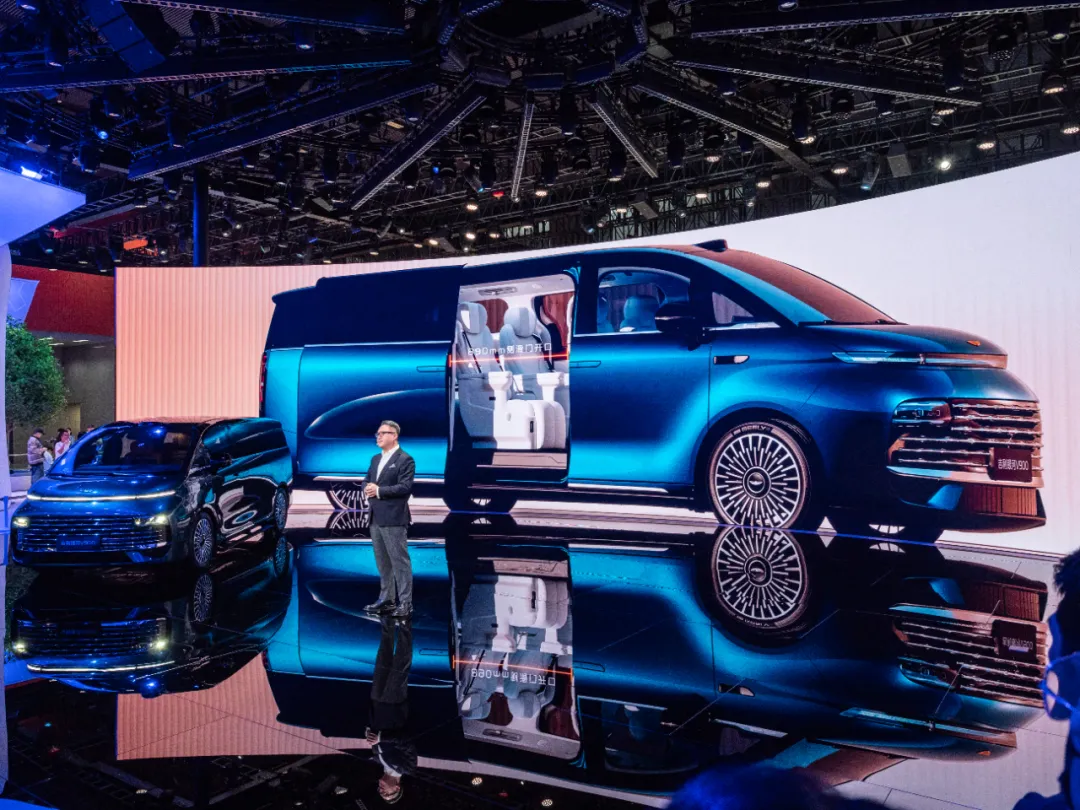
On November 21, Geely Galaxy unveiled the V900, the first flagship model of its V-series, making its global debut at the event.
The company presented a concise deck outlining the model’s competitive strengths, though detailed configuration and pricing information will likely be disclosed at a later launch.

Here’s a quick overview of the V900’s specifications: Dimensions measure 5360/1998/1920mm with a 3200mm wheelbase.
However, raw figures alone do not fully capture the V900’s interior advantages.

Geely Auto Group Vice President of Design Chen Zheng highlighted a more persuasive metric: even in a traditional three-row layout, second- and third-row passenger space both reach 1013mm.
Although comfort features differ between rows, the V900 places emphasis on spatial equality across seating positions.

Generous cabin scale also enables flexible seating configurations. In addition to the common three-row six-seat format and a premium two-row four-seat business layout, the V900 offers a four-row eight-seat variant.
The last Geely model capable of a four-row eight-seat configuration was LEVC’s L380.
During a brief hands-on session with the V900 cabin, a passenger of 1.84m height experienced ample headroom exceeding a full fist-width.

Both second and third rows provided generous comfort rather than what might merely be considered adequate.
Additionally, the door openings are wide, and with vehicle height exceeding 1.9 meters, taller passengers can enter without excessive bending.

Visually, the V900 introduces a new design language.
This includes the new Pegasus emblem and a ripple-inspired grille referencing water surfaces, marking a distinct identity from other Galaxy models.

Powertrain configurations feature CATL’s SOA extended-range hybrid battery paired with a 1.5T dedicated range-extender engine boasting 47.26% thermal efficiency — claimed to be the highest among mass-produced engines.

Generator efficiency is also notable, capable of producing 3.77kWh of electricity per liter of fuel, enabling CLTC combined range exceeding 1,200km.
All V900 models will feature a 340kW dual-motor all-wheel-drive configuration, which offers a performance edge compared with range-extended MPV competitors such as the Xpeng X9.
The V900 will support the Haina-H vast domain H5 intelligent driving suite, featuring AEB capable of emergency braking at up to 130km/h, AES double obstacle-avoidance maneuvers, and EMA emergency steering assistance.

Speaking at the debut in Guangzhou, Chen Zheng called the Greater Bay Area the “golden market” for MPVs, stating that the V900 aims to set a new benchmark in this high-value region.
From a brand perspective, the launch fills a major portfolio gap, positioning Galaxy as a full-category new-energy brand spanning sedans, compact cars, SUVs and MPVs.

Pricing expectations are high.
For reference, the LEVC L380, a pure EV with a 100kWh battery, starts from RMB 299,900 ($41,986).
As the V900 is an extended-range hybrid, battery costs are lower, suggesting potential pricing advantages.
While Geely Galaxy has not announced a launch date, following this global debut, the wait is unlikely to be long.
Discover more from ChinaEVHome
Subscribe to get the latest posts sent to your email.