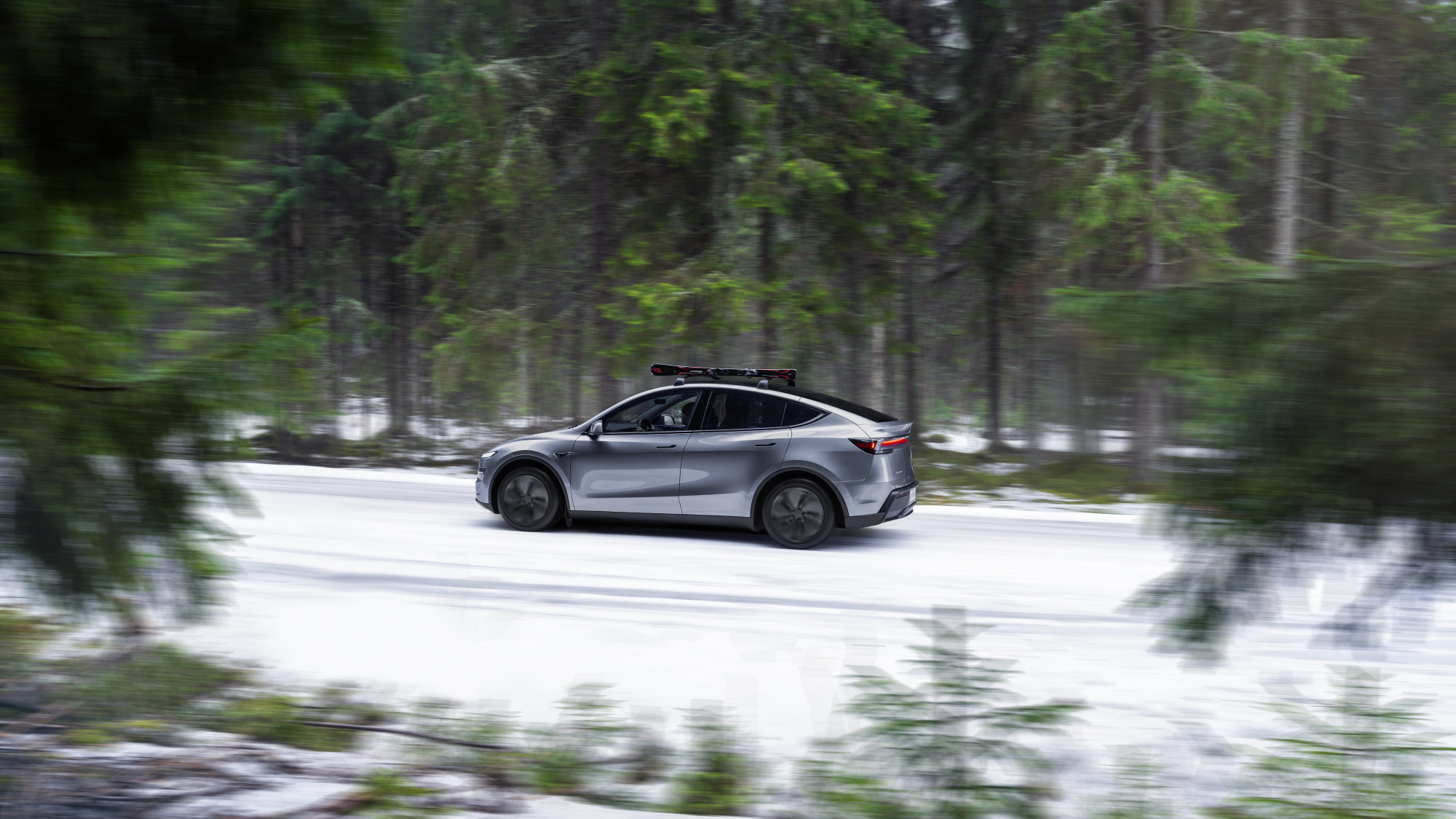
Leapmotor aims for global competitiveness, targeting 4 million annual sales with its new flagship models, D19 and D99.
Leapmotor delivered what may be the final launch event of 2025, and arguably the most ambitious new-entrant presentation of the year.
Exactly a decade after Leapmotor was founded in Hangzhou on December 26, 2015, founder Zhu Jiangming returned to the same city to set out goals for the company’s next decade.
At the brand level, Leapmotor aims to become a globally competitive automaker over the next ten years, with annual sales of 4 million vehicles serving as the key quantitative benchmark.

On the product front, Leapmotor is targeting the RMB 60,000–300,000 ($8,400–$42,000) mainstream and mid-to-high-end market, a segment it views as essential to achieving the 4 million-unit goal.
To that end, Leapmotor unveiled two flagship models positioned at the RMB 300,000 ($42,000) level: the D19 large SUV and the D99 MPV, both built on the new D platform.
Beyond the product launches, this article also revisits Zhu Jiangming’s remarks and Leapmotor’s journey, exploring how a Hangzhou-based startup once considered unremarkable, but labeled a “dark horse” over the past two years, has managed to reverse headwinds and step into a new decade.
Seeing a Once-in-a-Generation Opportunity
In 2015, Zhu Jiangming conceived the idea of building cars during a trip to Valencia with friends, a story often cited as Leapmotor’s origin.

At the opening of the event, Zhu paid tribute to Wang Jianping, a close neighbor and one of Leapmotor’s most important long-term partners.
Much of Zhu’s opening speech focused on acknowledging those who stood with Leapmotor during its early entrepreneurial years.

For example, the Leapmotor brand name was proposed by one of its founding investors, Zhang Wei, and embodies aspirations of “starting from zero, zero emissions, zero congestion, and zero collisions.”
Zhu also highlighted his more than 30-year business partner Fu Liquan, chairman of Dahua Technology.
During the industry’s most challenging period in 2020, Zhu and Fu personally contributed funds each month to ensure employee salaries were paid.
He further acknowledged early supporters such as Sequoia Capital partners Tony, Fu Xin and Neil Shen, as well as the Hefei municipal government and the Zhejiang provincial government, along with the city governments of Hangzhou, Jinhua and Huzhou.

A photo shown at the event captured all three city mayors—Hangzhou, Jinhua and Huzhou—in attendance.
Zhu said that since founding Leapmotor in 2015, he has believed the company could become a world-class automaker, and even aspired for it to rank among the global top 10—an ambition underpinning the 4 million annual sales target.
Notably, apart from executives overseeing finance, supply chain and operations, most of Leapmotor’s senior management did not come from traditional automotive backgrounds.

For a long time, this lack of conventional industry pedigree partly explained why Leapmotor struggled to gain recognition from established automotive circles.
Yet it was precisely this group that went on to create one of the most counterintuitive and “dark horse” stories in China’s EV sector.
A photo taken on December 26, 2015, often cited by Zhu as a symbolic starting point, shows that more than 90% of Leapmotor’s early team were R&D engineers.

As of today, most of Leapmotor’s senior executives still come from that original group, particularly those leading vehicle engineering and powertrain development, reflecting remarkable continuity over a decade.
For instance, Jing Hua, a Leapmotor vice president who became emotional when recalling early fundraising struggles in the company’s ninth-anniversary video, was the first employee Zhu hired. Jing, a former university classmate of Zhu, retired honorably this year.

Similarly, vehicle product head Cao Li previously led Dahua’s exterior design team, while product line chief Zhou Hongtao joined Dahua in 2001 as a technical engineer and rose through the ranks under Zhu’s leadership.

Others include Song Yining, head of Leapmotor’s electric powertrain systems, whose hair has visibly turned gray since that first group photo in 2015.
Zhu concluded his speech as a long list of employee names scrolled across the screen.
A serial entrepreneur who had already achieved financial independence, Zhu said he recognized the opportunity a decade ago, but it was the collective efforts of employees and customers that enabled Leapmotor to seize it.

Leapmotor now has more than 1.2 million users worldwide and has already met both its overseas and global sales targets ahead of schedule this year.
In 2026, it plans to challenge the 1 million annual sales mark, while setting its sights on 4 million units in the decade ahead.

Zhu emphasized that covering the RMB 60,000–300,000 mainstream segment is a fundamental requirement for any global automaker.
The question, however, remains whether a RMB 300,000 Leapmotor can still retain its “Leapmotor DNA.”
Dual D-Series Flagships
Zhu Jiangming’s confidence, and Leapmotor’s, rests on product strength.
In terms of design, the D19’s exterior needs little elaboration. Our preference is for the pure-electric version, which uniquely offers two standout features: a front trunk and a tri-motor configuration.

The pure-electric D19 provides a 176-liter front trunk. While not as large as ONVO’s, it still ranks among the largest in its price range, with a wide and low opening suitable for daily use as a substitute for rear cargo space.
The tri-motor setup is the core reason the D19 qualifies as a flagship.
Built on the LEAP 3.5D large-vehicle platform, the D19 features the new LMC 2.0 chassis control system.
The pure-electric version exclusively offers dual rear motors, enabling a tank-turn function with an exceptionally tight turning radius of just 3.6 meters.
This gives the D19 turning agility comparable to Leapmotor’s smaller T03 city car.

With a combined output of 540 kW, the tri-motor D19 achieves 0–100 km/h acceleration in the three-second range, likely between 3.6 and 3.9 seconds.
While the pure-electric version stands out, the range-extended D19 is also formidable. Its 80.3 kWh battery supports up to 500 km of pure-electric range, and with standard dual motors, it delivers 0–100 km/h acceleration in about four seconds.
Overall, the D19 exemplifies a “Leapmotor flagship,” offering a suite of capabilities rarely seen at its price point, all derived from in-house development and platform-level engineering.

Additional highlights include the global debut of Qualcomm’s 8797 automotive chip and an automotive-grade oxygen generation system.

The main drawback is timing: the D19 will not launch until April next year, meaning the highly anticipated large three-row SUV competition will arrive about four months later than expected.

However, one model is arriving sooner than anticipated—the Leapmotor D99, the brand’s flagship MPV.

The naming itself suggests a ceiling, unless the next flagship is called D100.

Interior details for the D99 have yet to be disclosed, leaving exterior design as the main point of reference. Its overall styling language and dimensions closely align with the D19.

In terms of powertrain, the D99 will mirror the D19 with both pure-electric and range-extended variants.
With a 115 kWh battery for the EV version and an 80.3 kWh pack for the range extender, it is poised to compete for best-in-class range among MPVs in its segment.
A Victory for Engineers
Leapmotor’s tenth anniversary also reflects the full cycle of China’s new energy vehicle startups—from rapid rise to cooling, and then resurgence.
The first Leapmotor model we test-drove was the S01 in 2019. While creatively designed, it failed to gain market traction. The T03 later turned the tide, paving the way for the success of models such as the C11, C01 and C10.

Even now, as Leapmotor sits atop the new-entrant sales rankings this year, Zhu maintains a strong sense of urgency. “We’ve only just crossed the subsistence line and reached breakeven,” he said. “There is no room for complacency.”
The next decade will belong to collective overseas expansion, intensified industry consolidation, and another wave of innovation in electrification and intelligence.
Whether Zhu Jiangming and Leapmotor can realize the ambitious blueprint outlined tonight, and how the world will view Leapmotor in the coming decade, remains to be seen.
Time, ultimately, will provide the answer.
Discover more from ChinaEVHome
Subscribe to get the latest posts sent to your email.