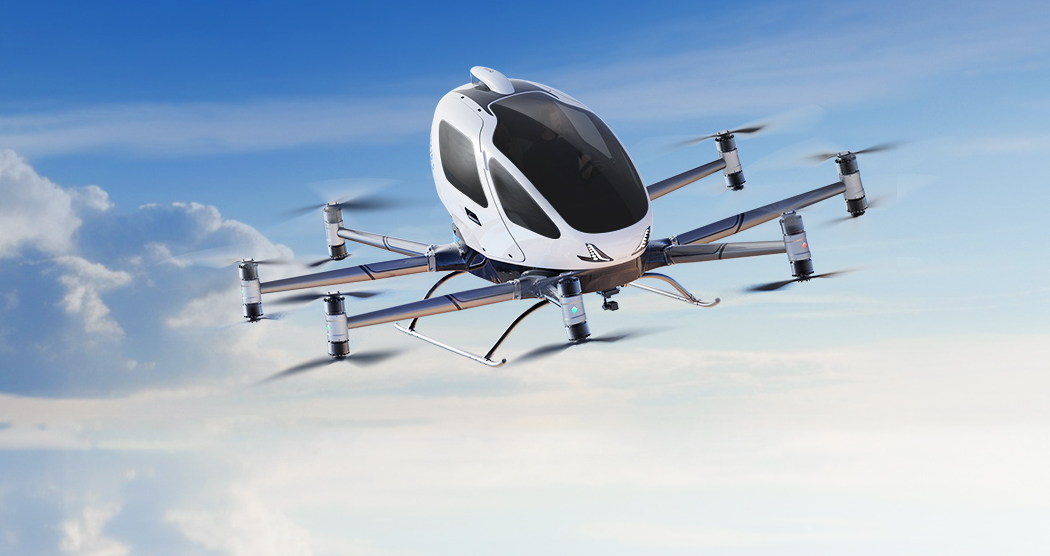
- EHang validated a 480 Wh/kg lithium-metal solid-state battery in an EH216 eVTOL completing a cross-sea flight.
- Flight endurance jumped about 60–90% versus liquid lithium-ion, with stable voltage and 60% charge after 18 minutes.
- Manufacturing cost, cycle life, and consistency remain barriers despite China eyeing 2026 mass production for flying cars.
Solid-state batteries have moved another step closer to commercialization, but the first major beneficiary may not be automobiles.
Instead, electric vertical takeoff and landing aircraft (eVTOLs) could be among the earliest sectors to adopt the technology.
According to China Central Television (CCTV), an EHang EH216-series aircraft equipped with a high-energy-density solid-state battery recently completed a cross-sea flight over the Qiongzhou Strait.
The mission marked one of China’s most significant real-world flight validations of solid-state battery technology in the eVTOL sector.
The aircraft used for the flight was powered by the “Falcon” lithium-metal solid-state battery jointly developed by EHang and Shenzhen-based Inx Energy.

The battery adopts a lithium-metal anode and oxide ceramic electrolyte architecture, delivering an energy density of 480 Wh/kg—more than double that of mainstream liquid lithium-ion batteries currently used in commercial applications.
During the flight, the aircraft operated under challenging conditions including strong sea winds and a complex marine environment.
Data showed that after approximately 18 minutes of flight across the strait, the battery still retained around 60% of its charge, while voltage and temperature remained stable throughout the mission.
Prior to the latest demonstration, the EH216-S equipped with the same battery system had already completed endurance tests lasting up to 48 minutes and 10 seconds.

Compared with conventional liquid-battery configurations, flight endurance improved by approximately 60% to 90%.
Battery requirements for flying vehicles are considerably more demanding than those for electric cars. In addition to energy density and range, safety remains a critical performance indicator.
By replacing flammable liquid electrolytes with solid electrolytes, solid-state batteries theoretically reduce the risks of leakage and thermal runaway, making them more suitable for aviation applications that require stringent airworthiness standards.
Despite the progress, large-scale commercialization remains some distance away. Challenges including manufacturing cost, cycle life and production consistency continue to be key areas of development for the industry.
From an industry perspective, 2026 is increasingly being viewed as China’s first year of mass production for flying cars.

GAC’s GOVY AirCab has already completed its maiden flight in Guangzhou.
The aircraft carries a pre-sale price of no more than RMB 1.68 million ($247,800), has secured nearly 2,000 intention orders, and is targeting certification and mass production before the end of this year.
Meanwhile, XPeng Aridge’s “Land Aircraft Carrier” flying vehicle has entered pilot production and formation flight-testing phases.

Its manufacturing facility is expected to be completed in the third quarter of this year.
According to the report, China’s flying-car industry has made substantial progress in routine flight verification, airspace management frameworks, commercial application scenarios and supporting infrastructure.
The sector is increasingly being viewed as a potential RMB 10 trillion ($1.48 trillion) market opportunity over the long term.
Discover more from ChinaEVHome
Subscribe to get the latest posts sent to your email.