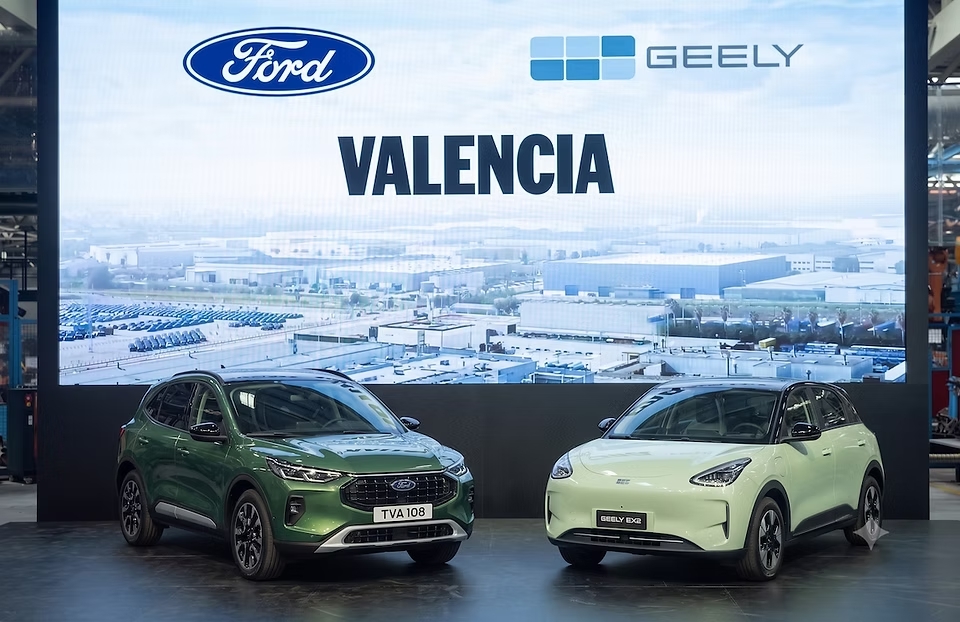
- Geely will take over part of Ford’s Almussafes plant to build its compact EX2 urban EV in Valencia.
- Production in Spain would let Geely circumvent some EU China tariffs by making EVs inside the bloc.
- Ford and Geely will co-develop a new Ford-badged crossover set for production at Almussafes in 2028.
Ford and Geely Holding have reached an agreement under which Ford will sell part of its Almussafes plant in Valencia, Spain, to allow Geely to produce electric vehicles at the site, according to Spanish newspaper ABC.
Under the reported agreement, Geely is expected to take over Body Shop 3 at the factory.
The Chinese automaker plans to manufacture a compact EV designed for urban mobility markets at the facility.
The model planned for production in Valencia is Geely’s strategic EX2, known as the Geely Xingyuan in China.

The company hopes the model will help it compete in Europe’s urban electric vehicle segment.
If the project moves forward, Geely will gain a production base within the European Union.
This would allow some vehicles sold in Europe to be manufactured inside the bloc, reducing the impact of EU tariffs on China-made electric vehicles.
Besides, an all-new Ford-badged crossover will be launched. Styled under Ford’s lead and co-developed with Geely, this model is also scheduled for production in 2028.
The Almussafes plant was once one of Ford’s key European manufacturing hubs, with a planned annual production capacity of 400,000 vehicles.
However, output has declined in recent years following the discontinuation of models including the Mondeo, S-MAX and Galaxy.
For Ford, allowing Chinese automakers to use part of its underutilized capacity aligns with its efforts to restructure its European manufacturing network and reduce transition costs.

For Geely, Valencia offers advantages including an established automotive supply chain, a skilled industrial workforce and proximity to major ports, providing logistical benefits for exporting vehicles to other European markets.
The cooperation also reflects a broader trend among Chinese automakers seeking to accelerate European localization by utilizing idle manufacturing resources across the region.
In May, Stellantis and Leapmotor expanded their partnership by adding a new production line at the Zaragoza plant in Spain to build an Opel C-segment electric SUV, which will be produced alongside the Leapmotor B10.
In June, SAIC Motor’s MG brand announced plans to manufacture electric vehicles in Ferrol, Galicia, Spain.
Earlier, Chery established a joint venture with Spain’s Ebro Motors, restarting a former Nissan factory and planning to produce new energy vehicles at the site.

Market data also shows that Chinese brands are gaining influence in Europe.
According to ANFAC data, Chinese automakers sold 38,663 vehicles in Spain in the first quarter of 2026, up 67% year on year, accounting for 12.86% of the market.
Across the broader European market, Chinese brands are also continuing to expand their presence.
ACEA data showed that Chinese brands accounted for 11.4% of new vehicle registrations in Europe in May 2026.
Among them, Geely Group remains one of the largest Chinese automotive groups in Europe, supported by multiple brands and channels including Volvo, Polestar and Geely.
Data showed that Geely-related brands recorded 33,877 registrations in Europe in May, up 12.6% year on year.
Sales for the first five months reached 176,676 units, representing a 6.8% increase from the same period last year.
Discover more from ChinaEVHome
Subscribe to get the latest posts sent to your email.