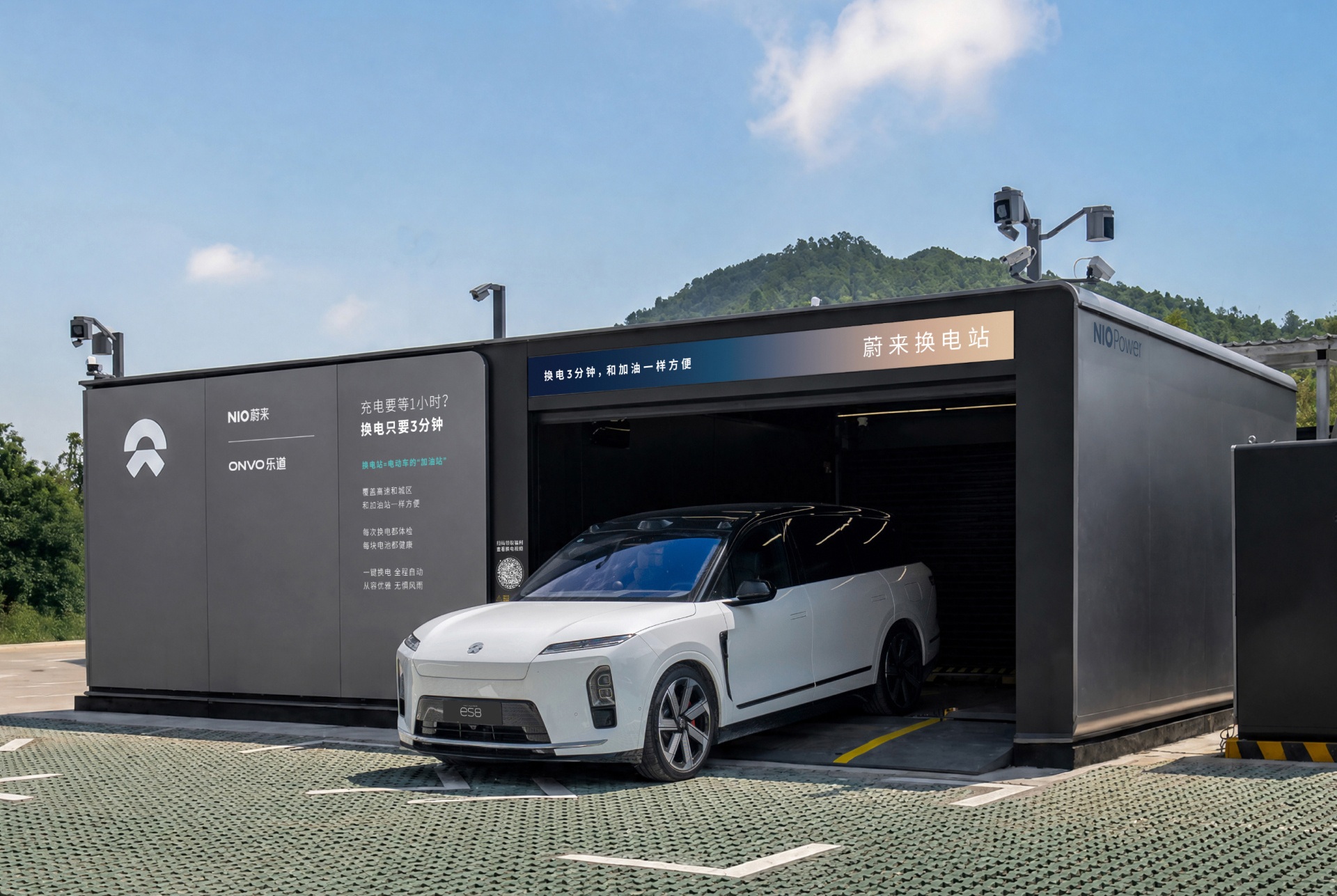
- NIO and state-owned China Huaneng expanded a cooperation pact to link battery swap stations into virtual power plants, reflecting pressure to monetize infrastructure and capture grid services revenue streams.
- By end-2025 roughly 860 swap stations and 26,000 charging piles were in demand-response and frequency-regulation markets, with NIO operating 9,372 stations and 30,467 charging piles and having invested RMB 20 billion (about $2.98 billion).
- Direct competition targets grid service markets alongside other VPP providers and utilities, but scaling risks include regulatory implementation, capacity validation, coordination with grids, and reliance on timely policy support.
On Sept. 18, NIO Power and the Marketing Department of China Huaneng Group Co., Ltd. signed a Virtual Power Plant Collaboration Cooperation Plan in Xiong’an New Area.
Under the agreement, the two sides will further cooperate in virtual power plants, electricity trading, green power and green electricity certificates.

The signing is not the first collaboration between the two sides. As early as 2024, NIO and Huaneng jointly built Unit 1 of a virtual power plant and connected 115 battery swap stations to the Zhejiang power grid to participate in secondary frequency regulation.
The project was validated through second-level control by the Zhejiang power grid and generated recurring frequency-regulation revenue that year.
NIO began developing a virtual power plant system based on “5G + AI” in 2021 and has been working to connect user-side energy resources through an integrated “vehicle-charger-station-cloud-grid” architecture.
As electricity-market trading and demand-response mechanisms continue to develop, equipment originally deployed for EV energy replenishment is gaining an additional role in grid regulation.

By the end of 2025, about 860 NIO battery swap stations and 26,000 charging piles were participating in demand-response, peak-shaving and frequency-regulation markets across 14 provinces and cities.
The policy environment is also pushing virtual power plants from pilot projects toward larger-scale deployment.
In July 2026, the State Council issued the Action Plan for Carbon Peaking During the 15th Five-Year Plan Period.
The plan calls for the maximum nationwide regulation capacity of virtual power plants to exceed 50 million kW by 2030, while electricity demand-response capacity is expected to exceed 5% of the country’s maximum power load.
This gives EV charging and battery-swapping infrastructure an opportunity to evolve from conventional transportation infrastructure into adjustable loads within the power system.

As of Sept. 18, NIO had built 9,372 charging and battery-swapping stations nationwide, including 4,090 battery swap stations, 5,282 charging stations and 30,467 charging piles.
Current industry reports put the latest Sept. 17 total at 30,431 charging piles, reflecting continued network expansion.
NIO has invested more than RMB 20 billion ($2.976 billion) in charging and battery-swapping infrastructure to date.
It’s cumulative battery-swap services exceeding 120 million and total charging and swapping services surpassing 200 million.
Discover more from ChinaEVHome
Subscribe to get the latest posts sent to your email.