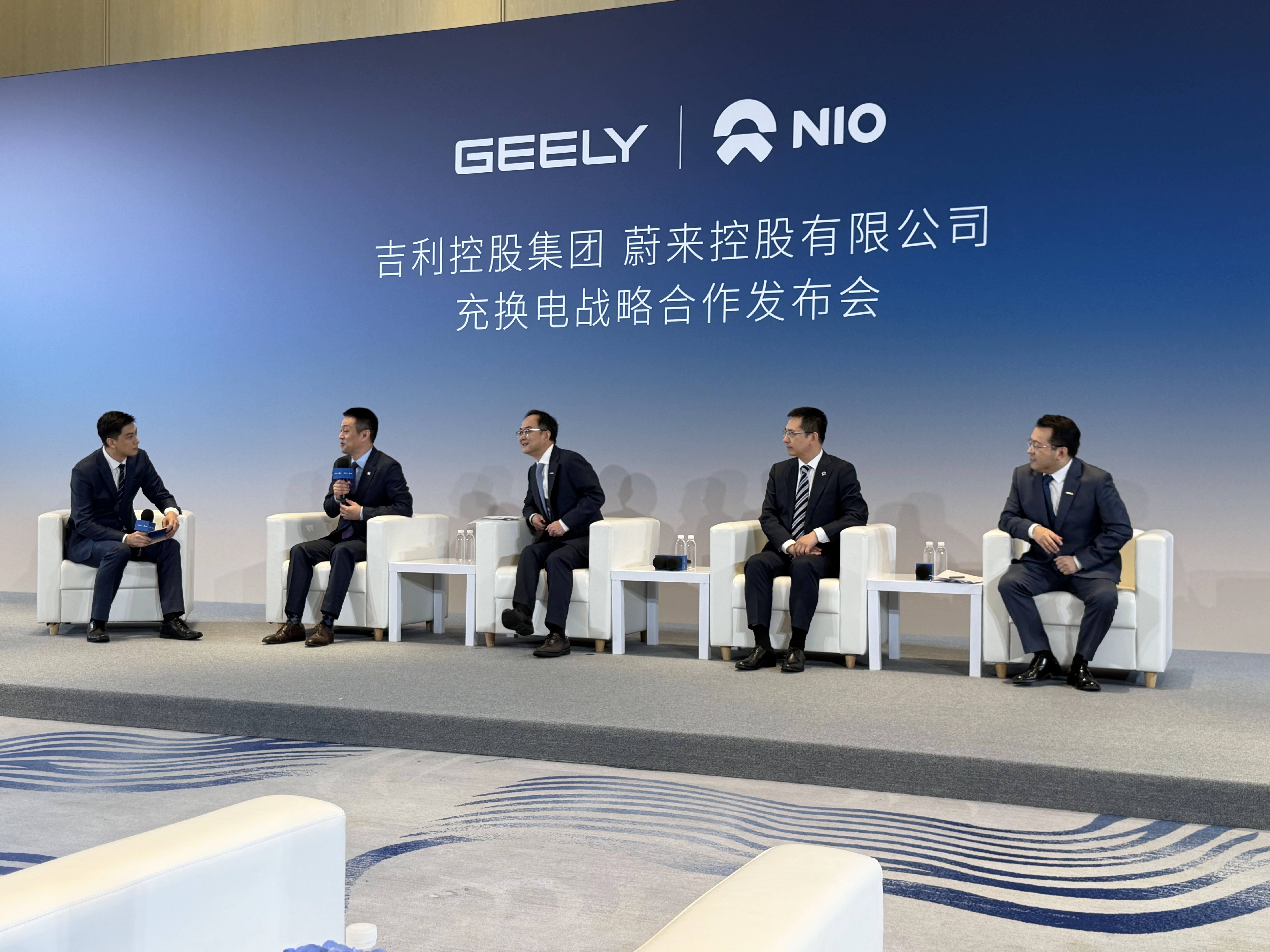
- NIO and Geely executed cross-shareholding as Geely buys 30.0% of NIO Power via Yiyi Internet plus RMB 640 million ($95.37 million), while NIO takes 10% of Haohan Energy, signaling consolidation of charging and swapping infrastructure amid intense price and share competition.
- NIO operates 4,126 battery‑swapping stations, 5,307 charging stations and 30,598 charging points, has invested over RMB 20 billion (about $2.98 billion) cumulatively, and plans 10,000 swapping stations by 2030.
- The tie-up targets mass-market rivals and ride‑hailing fleets but execution risks include few partner vehicles so far, network density strain if adoption surges, high per‑vehicle integration costs, and scaling capital requirements.
On the morning of September 29, NIO and Geely Holding announced a comprehensive strategic partnership covering battery charging and swapping.
According to a filing with the Hong Kong Stock Exchange, Geely will acquire a 30.0% stake in NIO Power through 100% ownership of Yiyi Internet plus RMB 640 million ($95.37 million) in cash, while NIO will acquire a 10% stake in Geely’s Haohan Energy. The two companies will fully connect and share their charging resources.
One of the goals of the partnership is to build a cumulative 10,000 battery-swapping stations by 2030, with annual electricity demand expected to exceed 10 billion kWh.
At Geely’s AI Smart Charging technology launch last Wednesday, September 23, the company said it planned to build more than 22,000 charging stations and more than 100,000 charging guns by the end of 2027. More than 15,000 of those stations and 50,000 charging guns would be Geely Smart Charging facilities.
The cross-shareholding and capital tie-up in charging and battery swapping reflect ambitions for energy-supply infrastructure that should not be underestimated.
It is a move that has been three years in the making.
As early as November 2023, Geely Chairman Eric Li and NIO CEO William Li sat down together and signed a strategic battery-swapping cooperation agreement under the banner of “joint investment, joint construction, shared resources and joint operations,” with plans to establish separate battery-swapping standards for private cars and ride-hailing vehicles.
Over the past three years, NIO has signed battery-swapping cooperation agreements with Changan, Chery and JAC, among others. Three years on, Geely has been the first to take the partnership to the equity level.
What impact will the partnership have on NIO, Geely and even the broader NEV industry? Geely CEO Andy An and William Li summed it up with two phrases: “Unity is strength” and “We need to stick together to survive.”
The partnership itself is also built around the idea of “unity.”
A Three-Year Leap
The words “battery-swapping alliance” have once again entered the public spotlight following the latest partnership.
The evolution of this ecosystem is worth revisiting, as the timeline helps clarify what this latest deal actually means.
On November 21, 2023, Changan Automobile signed an agreement with NIO in Chongqing, becoming the first automaker to join the battery-swapping alliance.
Eight days later, Geely signed up in Hangzhou, joining the “circle of partners.” Geely was represented at the signing by Liu Jinliang, CEO of Yiyi Internet, with Eric Li attending as a witness.

In January 2024, Chery and JAC joined the alliance. In May, GAC and FAW signed agreements in succession, with Lotus also joining. By mid-2024, the alliance had seven automakers.
In March 2025, CATL and NIO signed an agreement in Ningde while also moving forward with a strategic investment of up to RMB 2.5 billion ($373 million) in NIO Power.
It marked the first time capital had effectively voted for battery swapping.
The latest development came on September 28, 2026, when Geely announced that it would take a stake in NIO Power and the two sides would establish a comprehensive strategic partnership.
But there is another side to the story: over the past three years, not a single automaker has put a mass-production model on the market capable of connecting to NIO’s battery-swapping stations.
Agreements were signed, but no vehicles followed. The viability of the battery-swapping alliance has therefore once again come under scrutiny.
From chassis modifications and production-line precision to per-vehicle costs, the barriers are substantial.
Are automakers really willing to spend heavily to overcome these challenges and bet with NIO on a model whose feasibility has already been questioned?

Even Aion, which began introducing battery-swapping versions of its products last year, has opted to connect with CATL, whose resources are deeper, rather than NIO, despite having signed a cooperation agreement with NIO two years ago.
The practical rollout of the battery-swapping alliance has appeared stagnant to the public. Beyond high R&D costs, another critical factor is the density of the battery-swapping network.
NIO currently operates 4,126 battery-swapping stations, enough to meet the needs of its existing owners.
But once the corresponding battery-swapping models from all partner automakers begin connecting to the network, the resulting surge in demand could be difficult for those 4,126 stations to absorb at their current density.
So how many stations would the alliance need to become viable? XPeng CEO He Xiaopeng estimated in 2024 that the threshold was 5,000 stations.
Once the network exceeded that figure, he said, XPeng would seriously consider entering battery swapping.
In 2023, NIO built its 1,000th battery-swapping station in just 355 days. Given the company’s determination and speed in expanding the network, the 5,000-station threshold is now within reach.

In fact, NIO has continued working with partner automakers to deepen the alliance. William Li said at today’s event:
“Over the past three years, the two sides gradually reached a consensus, and finally decided to put our resources together and get the job done.”
He also noted that the fifth-generation swapping station can accommodate more than 95% of passenger-car body dimensions in the Chinese market.
The significance of today’s deal therefore lies in the shift from a strategic agreement to an equity-based commitment.
It not only signals Geely’s confidence in the future of battery swapping, but also represents a substantive step forward for the battery-swapping alliance itself.
Build the Moat First
Battery swapping has long been William Li and NIO’s obsession, and that description is not wrong. But there is another point to add: that obsession has gradually become one of NIO’s competitive moats.
When the NIO ES9 launched on May 27 this year, William Li disclosed that NIO had invested more than RMB 20 billion ($2.98 billion) cumulatively in charging and battery swapping over the previous 11 years.
On the map, that translates into 4,126 battery-swapping stations, 5,307 charging stations and 30,598 charging points built by NIO as of today.

The network includes 1,063 highway battery-swapping stations and covers more than 550 cities, forming a highway swapping network across “nine vertical, 11 horizontal routes and 16 major urban clusters.”
For NIO owners, the practical experience is a fully charged departure in three minutes, with the battery swap completed without leaving the vehicle.
NIO’s vehicle-battery separation model also gives users the flexibility to charge, swap or upgrade their batteries, while the long-life batteries supported by the swapping system can undergo a battery health check each time they are swapped.
For NIO owners, the network has supported more than 125 million battery swaps, taking battery swapping from something that “works” to something that is genuinely convenient.
Within the industry, meanwhile, battery swapping is becoming an increasingly crowded field.
Players range from Yiyi Internet, which targets business customers, to CATL’s more broadly applicable Chocolate battery-swapping system.

Battery swapping is no longer simply NIO’s own obsession. It is gradually becoming an option that other automakers can adopt.
NIO also took an open approach to energy replenishment from the beginning, hoping its infrastructure would serve more than just NIO owners.
For example, William Li revealed at today’s event that NIO’s charging points have been open to third-party users from the outset, with about 87% of the electricity delivered through them coming from non-NIO users.
The same principle applies to battery swapping. If the network serves only NIO owners, it will remain NIO’s own obsession, and gaining broader recognition will be difficult compared with fast charging.
But once it is opened to everyone, NIO is effectively building the roads for the industry.
That means as more people become accustomed to battery swapping and shared energy infrastructure, the foundation NIO has built over 11 years could become a barrier that later entrants cannot easily bypass. That, in turn, is part of what makes Geely’s investment possible.
Business vs. Private Users: A Fight for Stations?
For NIO owners, one of the biggest questions surrounding the NIO-Geely partnership is straightforward: Will I eventually have to share NIO’s battery-swapping stations with Geely’s commercial vehicles?
The answer is also key to understanding the deal.
Once the transaction closes, Yiyi Internet will be integrated into NIO Power, and NIO Power’s operating network will effectively be divided into two.
One will be the familiar consumer-facing network, which will continue serving NIO owners as well as owners of future Geely battery-swapping models aimed at private consumers.
The other will be the business-facing network brought in by Yiyi Internet, with NIO Power serving CaoCao Mobility vehicles, Robotaxis and other commercial fleets.
William Li made the distinction clear at the event: “B2B is B2B, C2C is C2C. The users on the two sides will not affect each other.”

These two networks have historically represented two very different businesses.
The consumer network primarily serves private-car owners. Its main role is to enhance the ownership experience and provide certainty; what it fundamentally sells is service.
That is evident from NIO’s messaging and service model around three-minute full-charge departures, long-life batteries, and the ability to charge, swap or upgrade batteries.
Whether a swapping station turns a profit is only one consideration. The network also carries the task of sustaining NIO’s brand premium and customer loyalty, making it an indispensable part of the brand-building effort whose cost is difficult to quantify.
The business-facing network, by contrast, serves commercial vehicles. What it sells is efficiency and utilization.
Commercial vehicles do not need the same level of detailed experience as private consumers. Every minute spent waiting for a charge is a minute in which another order could be lost. These users want shorter queues and more trips — in other words, efficiency.
The two networks therefore compete on different dimensions. One still relies heavily on intangible capabilities, with investment and returns difficult to fully quantify.
The other is judged by hard numbers: how many swaps a station completes per day and whether it can cross the break-even line.
The two networks have pursued their respective markets independently. Even though Yiyi Internet CEO Liu Jinliang signed a cooperation agreement with NIO on behalf of Geely in 2023, the two networks never truly connected.
Geely wants NIO’s nationwide battery-swapping network, the largest of its kind in China, as well as NIO’s operating experience.
NIO, meanwhile, wants the high-frequency demand generated by Yiyi Internet’s partner vehicles. This equity arrangement finally brings the two sides together.
First, consider how Yiyi Internet could fill one of NIO’s gaps.
According to Yiyi Internet’s website, its 3.0 Pro battery-swapping station can complete a mechanical battery swap in as little as 40 seconds and handle up to 540 swaps per day.

As of June 2025, Yiyi Internet had sold more than 103,000 battery-swapping vehicles, with average daily swaps exceeding 45,000.
Combined with the Robotaxi business, which began deploying 100 test vehicles in Hangzhou’s Binjiang district in February this year, the high demand for energy replenishment from commercial fleets could accelerate NIO Power’s path toward profitability.
Qin Lihong ran the numbers: Hangzhou’s built-up urban area covers 801 square kilometers. NIO Power has 80 stations in the city, while Geely has more than 20.
Together, they have more than 100 stations. With full connectivity and intelligent scheduling, the theoretical distance from any point in the urban area to the nearest swapping station would be just 1.5 kilometers, reachable within five minutes under normal traffic conditions.
For commercial vehicles, that could save 90 minutes a day in energy replenishment time.
Converted into revenue, that amounts to 15% to 20%, and when the vehicle-battery separation model is factored in, total lifecycle costs could fall by as much as 40%.
The resulting efficiency on the business side could address NIO’s weakness in station utilization. Higher-frequency swapping demand from commercial vehicles could help accelerate NIO Power’s path toward profitability.
Qin Lihong also posed a hypothetical: If one battery-swapping station in Hangzhou serves 100 vehicles, versus 100 stations serving 10,000 vehicles, which model delivers higher efficiency and a better experience? The answer, he said, is obvious: the latter.
That is precisely why he believes Geely’s participation will enrich NIO’s resources on the consumer side and accelerate station construction.
By combining the two networks through joint site selection and unified scheduling, the companies can separate user groups while accelerating construction and increasing network density.
Consumer users therefore not only have little reason to worry about competition for stations, but could actually gain access to a denser network.

NIO Power aims to build 10,000 battery-swapping stations cumulatively by 2030. NIO currently has 4,126 stations, while Yiyi Internet has 436.
The addition of more than 5,400 new stations in the future would give the growing consumer user base significantly more options.
What remains unclear, however, is how the 10,000 stations will ultimately be divided between the B2B and C2C networks.
Based on the information currently available, the deal appears economically complementary for both sides.
Each company fills a gap in the other’s network, while cross-shareholdings bring each into the other’s energy ecosystem and create a joint platform.
“Stick Together to Survive”
Geely and other members of the battery-swapping alliance are not interested in battery swapping without reason. Geely’s faster move into the field is being driven by two major forces.
The first is policy.
At the event, Andy An cited the “15th Five-Year Plan for the Development of the Intelligent Connected New Energy Vehicle Industry,” jointly issued by nine government departments including the Ministry of Industry and Information Technology on September 11. The plan explicitly calls for faster development of charging and battery-swapping infrastructure and the rational deployment of high-power charging facilities.
With the government entering the battery-swapping infrastructure market, NIO’s recent station construction provides an example of how the model could evolve.
NIO has been among the automakers involved in drafting national technical standards such as the “Communication Protocol for Quick-Change Battery Packs for Electric Vehicles” and the “Safety Requirements for Battery Swapping of Electric Vehicles.”
In August, NIO completed delivery of 36 battery-swapping stations in Wuhan. The assets of those stations are owned by Optics Valley state-owned capital, while NIO retains operating rights.
The model, which effectively separates asset ownership from professional operation, reduces the pressure on automakers to carry heavy infrastructure assets on their own balance sheets, allowing them to focus more on technology and operational capabilities.

The second is the state of the industry.
With vehicle manufacturers’ profit margins squeezed to just above 4% by the ongoing price war, few companies in an inherently asset-heavy industry can sustain years of fighting alone.
That is why more stories of “separation giving way to consolidation” have emerged this year.
Examples include Geely’s “One Geely” plan, reports of a potential merger between Deepal and Avatr, and rumors of product-line or departmental consolidation within emerging automakers such as Li Auto and XPeng. Automakers across the industry are looking for more efficient ways to operate.
William Li put it bluntly at today’s event: “In previous years, everyone was testing different technology routes independently.
Now we can converge, and reducing duplicated investment is also about reducing waste and improving each company’s operating efficiency. This is an important issue facing every Chinese automaker.”
Battery swapping is particularly capital-intensive and requires a long investment cycle.
Rather than having individual automakers burn money building energy infrastructure and maintaining battery assets alone, it makes more sense to share the burden and reduce costs.
The integration of NIO and Geely’s charging and battery-swapping infrastructure is clearly their response to that challenge.
The two lines Andy An and William Li delivered during the Q&A — “Unity is strength” and “Stick together to survive” — perhaps capture the real starting point of the partnership.
Of course, signing an equity agreement and confirming the partnership does not mean the two companies’ charging and battery-swapping cooperation is already a success.
Whether Geely’s battery-swapping models can reach mass production, how the B2B and C2C networks will be weighted, and whether the “socialized asset ownership” model represented by the 36 Wuhan stations can be replicated are among the many questions NIO and Geely still need to answer.
China has roughly 30,000 mature, large-scale filling stations. If NIO Power can genuinely reach 10,000 battery-swapping stations in four years, the idea that “recharging is more convenient than refueling” could move beyond a slogan and become a proposition that can actually be tested and anticipated.
Can NIO Power deliver on that target in four years?
Discover more from ChinaEVHome
Subscribe to get the latest posts sent to your email.