- NIO is reorganizing around enterprise AI by converting business activities into granular operating units and embedding AI agents to support frontline decision-making and incentives.
- NOMI Intelligence 4.0 will rebuild the in-car AI architecture using Cedar 2.0.0 and open-source LLMs, with regulatory filing in early December and wider updates in Q2 2027.
- Targeting premium EV owners and subscribers against incumbent and new Chinese rivals, execution risks include computing supply and cost constraints, regulatory approvals, and timely fleet-wide software rollouts.
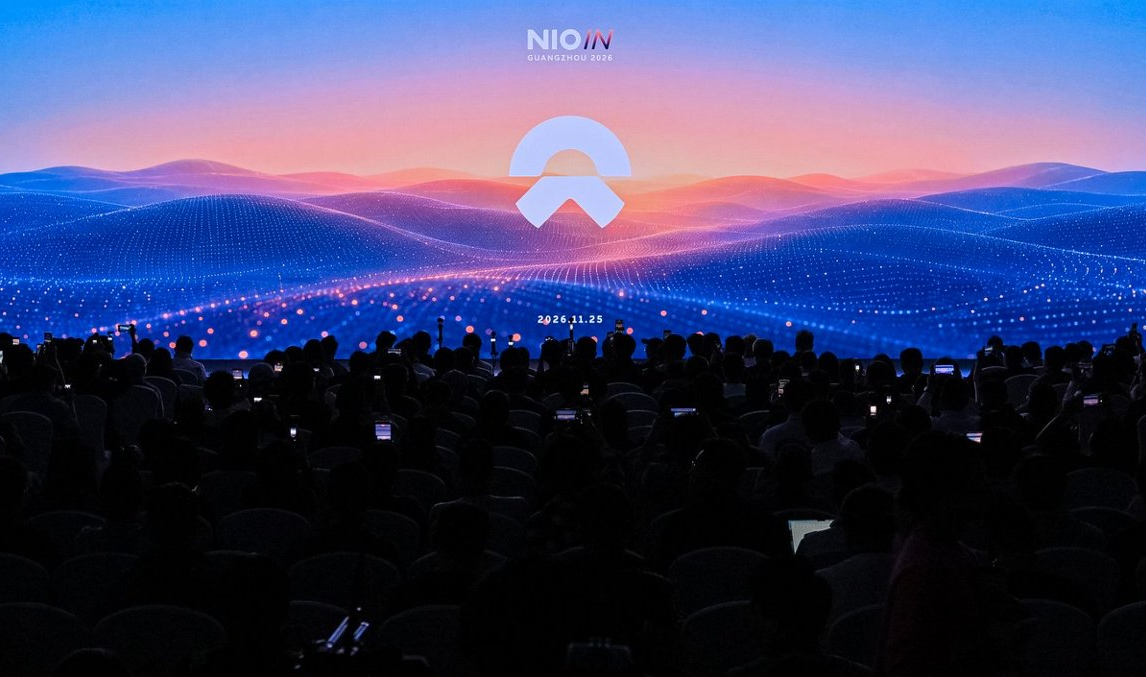
On November 25, the 12th anniversary of NIO’s founding, the company held its third NIO IN Innovation and Technology Day in Guangzhou, China.
After the event, NIO CEO William Li, head of intelligent driving R&D Ren Shaoqing, senior vice president of product experience Li Tianshu, and head of NIO Energy Qu Yu held a small-group media interview.

ChinaEV Home took part in the full interview. The following is a summary of the key points discussed.
An AI-native organization requires more than adopting new tools
At this year’s technology event, NIO expanded its discussion of AI beyond the smart cockpit and driver assistance to include corporate operations.
Li said smart electric vehicles are among the most valuable physical AI applications, while the automotive industry itself is large enough to absorb the changes AI could bring.
He estimated the global automotive industry is worth approximately $7 trillion to $9 trillion. If AI creates an additional 15% in value for the sector, the resulting commercial opportunity would exceed $1.2 trillion.
Building an AI-native organization was one of the topics Li discussed most extensively during the interview. NIO began pushing organizational changes and developing its AI capabilities in 2023.
In Li’s view, becoming AI-native does not simply mean having employees use AI to write documents or generate code.

It requires a fundamental review of organizational structures, business processes, incentive mechanisms and the allocation of responsibilities.
NIO is currently using its CBU (Chief Business Unit) model as a foundation for integrating business operations with enterprise-level AI capabilities.
The company is seeking to enable frontline employees to make decisions based on specific business units and operating targets.
Li cited NIO’s sales consultants, known as Fellows, as an example. Their performance is no longer measured solely by the number of vehicles sold.
Instead, they are expected to account for the revenue and costs they generate, as well as the lifetime value of the users they serve.
According to Li, tens of thousands of NIO employees are now using the company’s in-house AI tools. Fellows have improved their work efficiency by more than 8% with the help of AI agents.
The approach is also being extended to R&D and energy operations. NIO wants to break down business activities into more granular operating units and use models and agents to support frontline decision-making.
Li said that battery-swap station planning and operations, for example, previously relied largely on conventional planning methods.
NIO now seeks to calculate the investment returns of each station individually, including the indirect value that a station in a remote area may bring to users in other regions and to vehicle sales.
NOMI 4.0 shifts from feature updates to an architectural overhaul
Another major announcement at the technology event was NOMI Intelligence 4.0.
Li Tianshu said during the interview that the team had decided against continuing to patch the existing system. Instead, it is rebuilding NOMI at the system level by combining open-source large language models, development toolchains and NIO’s accumulated expertise in vehicle operating systems.
The work involves more than simply replacing legacy code. An in-car AI agent needs to call on the vehicle’s existing functions and system capabilities.
Close integration between the underlying tools and the vehicle architecture is therefore essential to improving the user experience.
Li Tianshu said the vehicle-level atomic capabilities NIO has developed over the past several years provide the foundation for deeper integration of NOMI into the vehicle.

Li emphasized that NOMI has always been designed as an emotionally engaging companion, rather than simply a screen for displaying information.
He said that even when users request functions such as displaying the time, the team needs to consider whether they fit NOMI’s intended role.
For NIO, product decisions are not just about whether a feature can be implemented, but also whether it is consistent with the system’s interaction logic and design principles.
Under the current rollout plan, the first version featuring NOMI Intelligence 4.0 will be based on Cedar 2.0.0 and submitted for regulatory filing in early December. It will be rolled out gradually after approval.
Cedar S and Banyan are expected to receive compatibility updates in the second quarter of 2027. NOMI 4.0 will also be extended to the Coconut and Coconut+ systems.
Smart driving: User subscriptions and accident rates as measures of value
Discussing intelligent driving, Li reiterated that NIO’s R&D priorities remain reducing the effort required from drivers and preventing traffic accidents, rather than simply showcasing autonomous driving technology.
In his view, intelligent driving should not be evaluated solely by demonstrations or industry rankings. Two more meaningful indicators are whether users are willing to pay for subscriptions and whether the technology actually reduces accident rates.
Paid subscriptions can show whether a product is addressing users’ needs, while accident data and recognition from insurance providers are important to validating its safety benefits.
Li revealed that most of NIO’s current paid intelligent-driving subscribers are used-car owners, while most new-car buyers are still within their free-use periods.

Using the monthly subscription fee of RMB 380 ($57) as an example, he said the cost works out to less than RMB 13 ($1.95) a day.
Whether users are willing to keep paying for the service is an important test of its practical value.
He also noted that intelligent driving is not a feature that can be developed once and then left unchanged. It requires continuous data accumulation, model training and product iteration. NIO’s long-term incentives for its intelligent-driving R&D team are closely tied to subscription revenue.
Li said that as feature complexity and R&D investment increase, a sustainable business model is necessary to ensure the company can maintain its long-term service commitments.
He also said during the interview that NIO is not currently making Robotaxi a major investment priority. Although some of the underlying technologies overlap, the company has chosen to prioritize services for owners of its own vehicles.
Computing costs emerge as a practical constraint on AI deployment
Computing capacity and costs were also raised as practical challenges during the interview. NIO said the supply of computing resources is currently constrained, while prices are under upward pressure.
For automakers, both intelligent driving and smart cockpits require sustained computing resources. Improving the efficiency with which each unit of computing power is used has therefore become an important consideration in R&D.
Li said NIO relies more heavily on rented cloud computing resources than on fully building its own infrastructure.

This approach allows the company to accommodate fluctuations in demand for model training.
He added that both the intelligent-driving and smart-cockpit teams are working to reduce computing requirements and improve the utilization of resources on both the vehicle and cloud sides.
In developing world models, NIO’s team said engineering optimizations have substantially reduced the computing power required to achieve the same level of performance.
Li said that with R&D resources limited, the efficiency of computing investment directly affects the cost and speed of technological iteration.
Energy business shifts from network expansion to more refined operations
On the energy business, Qu Yu discussed how AI is changing the way NIO operates its battery-swap stations.
NIO is moving away from its previous hierarchical management structure and giving frontline operations staff more decision-making authority and tools. AI is being used to support work-order processing, equipment maintenance and station operations, with the goal of improving response times and operational safety.
The battery-swap station site-selection model is not a recent development. Qu said its earliest version can be traced back to 2017, when NIO had already developed an internal simulation system for planning battery-swap station locations.
As the number of stations has increased and more operational data has accumulated, AI has accelerated the model’s development over the past year or so.

This shift is linked to NIO’s long-term plans for its energy business. At the technology event, the company said it expects to manage more than RMB 350 billion ($52.5 billion) in battery assets by 2030, operate more than 10,000 battery-swap stations and handle more than 10 billion kWh of annual charging and battery-swapping volume.
The model currently ranks proposed battery-swap station sites to help determine construction priorities. It also assesses return on investment by taking into account construction costs, operating expenses and potential revenue.
Qu said the model is still being refined. The next step is to introduce reinforcement learning and reward models to validate its predictions and improve the accuracy of site selection and ROI assessments for existing stations.
For station operations and maintenance, NIO wants to put frontline maintenance specialists at the center of its workflow, using AI tools to improve the safety and efficiency of work-order handling.
Qu revealed that staffing at individual battery-swap stations has fallen from approximately 0.8–0.9 employees per station to fewer than 0.4. The team hopes to bring the figure to 0.3–0.4 employees per station in 2027.
He said AI and more refined operating procedures can also help reduce human errors in day-to-day station management, allowing frontline staff to address equipment and operational issues more quickly.
The battery-swap station planning model will continue to be calibrated against actual operating data, rather than basing investment decisions solely on annual construction targets.
From vehicle-level AI to corporate operations, NIO’s transformation is still underway
From NWM 3.0 and NOMI Intelligence 4.0 to R&D management, store operations and the battery-swap network, the AI strategy NIO presented at the event extends well beyond individual vehicle features.
The central idea is to embed AI capabilities in vehicle systems and everyday business operations, allowing models and agents to participate in specific workflows.
However, Li repeatedly emphasized that organizational transformation cannot be completed in the short term.
Compared with developing a new vehicle, changing established management practices, resource allocation and performance evaluation systems is considerably more complex.
NIO began this work in 2023, but many aspects of its operations still need to be further broken down and adjusted.
Ultimately, whether AI delivers tangible value for NIO will be measured by improvements in user experience, operational efficiency and costs.
Discover more from ChinaEVHome
Subscribe to get the latest posts sent to your email.