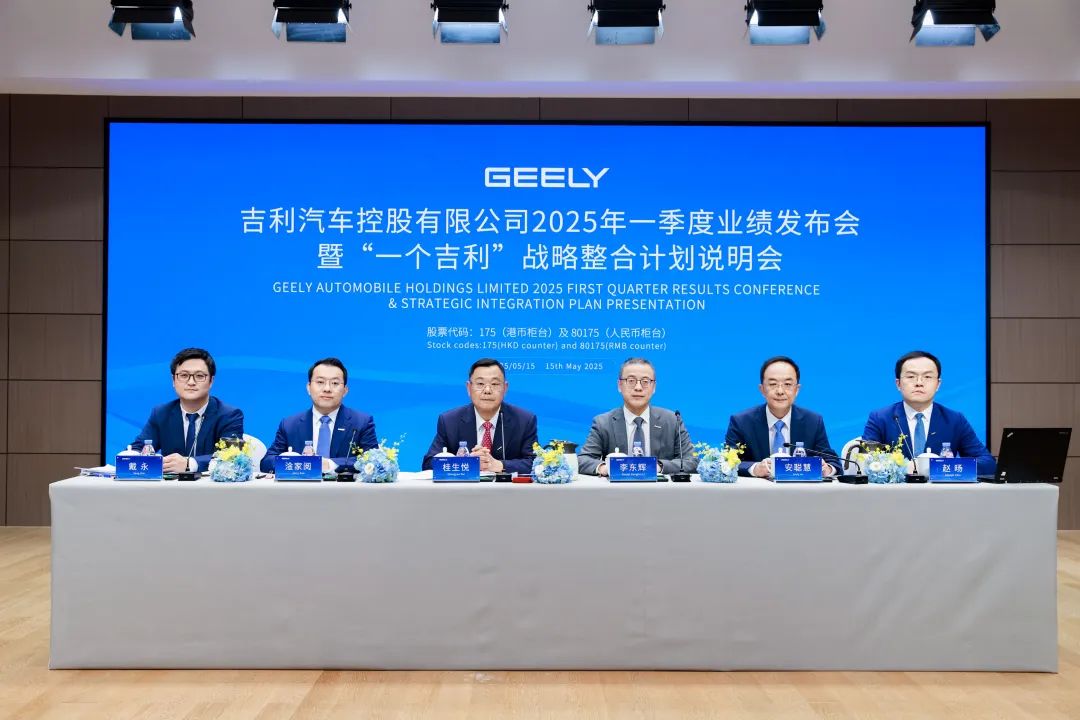
Geely has delivered an impressive quarterly report.
In the first quarter of 2025, Geely Auto sold a total of 703,800 vehicles, a year-on-year increase of 48%, of which new energy vehicle sales reached 339,000 units, up by 135% year-on-year; revenue reached 72.5 billion yuan, up 25% year-on-year; and the net profit attributable to the parent company’s shareholders was 5.77 billion yuan, up 264% year-on-year.(For full details, click here.)
At the performance meeting, Geely specifically stated that the 6.4 billion yuan non-cash gain from the integration of Lynk & Co into Zeekr was not included in the profit shown in the financial statements.
Zeekr Group delivered a total of 114,000 vehicles in the first quarter, up 21.1% year-on-year, of which the Zeekr brand delivered 41,000 units, up 25% year-on-year, and the Lynk & Co brand delivered 73,000 units, up 19% year-on-year; total revenue was 21.96 billion yuan, up 1% year-on-year, with a net loss of 763 million yuan, and the loss narrowed by 60.2% year-on-year.(For full details, click here.)
In terms of gross margin, Zeekr Group’s comprehensive gross margin was 19.1%, the gross margin of the vehicle business was 16.5%, and the gross margin of the Zeekr brand’s vehicle business reached 21.2%.
However, compared with this eye-catching quarterly report, people are more concerned about the reason why Geely Auto plans to privatize Zeekr.
Therefore, after the release of the first quarter performance, Geely held a performance report meeting that combined online and offline formats. In addition to reporting on the operating situation, it also explained the move to privatize Zeekr.
The uniqueness of this performance meeting, in the words of Gui shengyue, Executive Director and CEO of Geely Automobile Holdings Limited, is that “in the future, if there are no special circumstances, our quarterly reports will still be conducted online.”
Geely Auto plans to privatize Zeekr, which has just been listed for a year, which is another important measure of the “One Geely” strategy following the integration of Lynk & Co into Zeekr.
In addition to acquiring Zeekr, there have also been a series of personnel adjustments on the Zeekr side, as well as the rotating presidency system implemented by Geely since early March.
Since the beginning of 2025, Geely’s series of actions have raised many questions: what is the fundamental consideration behind Geely’s plan to privatize Zeekr? What positive changes will the rotating presidency system bring?

These changes are related to major matters concerning Geely’s future development. The following is the real-time record of this performance release meeting, transcribed from the recording. Due to the length of the content, the article is divided into two parts.
Q&A
Q1: Why did Geely merge Lynk & Co and Zeekr so quickly after completing the integration, and then proceed to merge 175 (Geely’s stock code) with Zeekr Technology Group?
Gui Shengyue: Faced with fierce market competition and an increasingly complex market environment, 175 must change the past phenomenon of having small, scattered, and disorganized brands. By conducting in-depth integration and consolidating the company’s resources into a single, powerful force, we may have a chance to succeed in the intense market competition.
On this point, Chairman Li Shufu and the entire Geely management team have a very clear understanding, and the shareholders also see this very clearly. During the recent shareholders’ meeting on the merger of Lynk & Co and Zeekr, the approval rate reached 99.99%.
This demonstrates the shareholders’ high recognition of our in-depth integration.
Integration, especially in-depth integration, is a very complex task. Over the past year, we have carried out a large amount of integration work in the supply chain, central research institute, and the integration of Lynk & Co into Zeekr.
As integration deepens and expands, especially since entering 2025, we have begun to integrate autonomous driving and intelligent cockpits. During the integration process, we have identified many issues.
There are many problems, and I will briefly report on two main aspects here.
The first aspect concerns the efficiency of integration and the cost of communication.
Although the aforementioned integrations are internal, they must also be carried out in accordance with laws and regulations.
175 and Zeekr are two independent publicly listed companies, and many things require approval from each respective listed company, resulting in slow progress, low efficiency, and very high communication costs. This is a very, very significant issue.
The second issue is the inconsistency of interests. Both 175 and Zeekr Technology Group have their own employee incentive mechanisms. Due to different incentive mechanisms, there is a problem of inconsistent interests.
As long as this problem exists, even though the integration work can be completed on the surface, in actual operations, there will inevitably be situations where each team tries to tilt the interests towards their own company. This will greatly discount the overall effect of the integration.
It can be said that as development progresses, the above two problems will become more and more prominent. To truly achieve complete integration and to make the integration show its real effects, we must solve these problems from the root. The method is obvious, that is, to completely merge 175 and Zeekr and return to a single Geely.
Today’s merger is a must-do. Why so fast? Time waits for no one. The Chinese market today, for Geely Auto, no longer allows room for error.
Therefore, we must quickly solve problems and quickly improve the company’s competitiveness through integration.
Q2: After the integration of Geely and Zeekr, how should we look forward to the cost reduction and expense control from the perspective of management and internal collaboration?
Li Donghui: Geely Holding Group is comprehensively promoting collaboration in basic technology, product research and development, manufacturing, and procurement. However, in the past, 0175 and Zeekr were listed on two different capital markets and had two separate management teams, with marketing also being conducted separately.
This has created certain limitations in the intensity, speed, and effectiveness of the integration.
Moving forward, with a unified management team, while maintaining the separate customer focus of the two brands, the back-end operations can be greatly and maximally coordinated.
Therefore, in terms of research and development, based on internal estimates, and ultimately taking the data in the 0175 shareholders’ circular as the main reference, it can be said that R&D can achieve annual savings of tens of billions of yuan.
In joint procurement, last year’s initial attempts even created additional procurement savings of several billion yuan. In manufacturing, as well as in various management departments such as human resources, finance, and legal affairs, I believe there will be significant effects on management and marketing expenses.
Gui Shengyue: The merger has not yet been completed, so many things cannot be stated too clearly at this point. However, you can refer to the goals that President An (Eric) mentioned during the merger of Lynk & Co and Zeekr.
These include several aspects: the production cost reduction target should be greater than 3%; the R&D optimization target should reach 10-20%; and the management efficiency improvement target should also reach 10-20%.
After this major merger, the effects will certainly be further amplified based on what was previously mentioned. This is self-evident.
As I said in my opening remarks, the communication barriers between the two companies will be eliminated, and communication efficiency will be greatly improved. I believe this will have a very positive impact on the overall synergistic effect.
Q3: We have also seen the implementation of the rotating presidency system at the holding company level. Could you analyze the reasons for implementing this system from a strategic perspective and how we should view its impact on 0175 (Geely’s stock code)?
Li Donghui: Gui Shengyue will continue to serve as the Chief Executive Officer (CEO) and Executive Director of Geely Automobile Holdings Limited;
Gan Jiayue will take up the position of CEO of the merged Geely Automobile Group, which will consist of the Geely Galaxy business group and the Zeekr Technology business group, with Gan Jiayue still serving as an Executive Director of Geely Automobile Holdings Limited;
Eric will become the CEO of Geely Holding Group, taking full responsibility for the operational management of the group, and will continue to serve as the CEO of Zeekr Technology Group until the merger is completed;
Li Donghui will assume the role of Deputy Chairman of Geely Holding Group, responsible for the day-to-day management of the board of directors and group investment and financing management, and will play a role in capital operations and major external cooperation projects.
Meanwhile, in order to cultivate young, versatile senior management talent, Dai Qing was appointed as the rotating president of Geely Holding Group on March 29, 2025, reporting to the CEO of Geely Holding Group.
Q4: What are the specific follow-up progress of the merger, and regarding the incentives for the core management team of Zeekr, as well as any adjustments to Zeekr’s organizational structure?
Gui Shengyue: I understand that your first question is about the progress of our upcoming merger. I believe you are asking about the procedures for the merger.
The general process for the merger of two companies is as follows:
Firstly, on May 8, 175 sent a non-binding offer letter to Zeekr proposing the privatization of Zeekr. After receiving the offer letter, Zeekr Technology established a special committee composed of independent directors, representing Zeekr and 0175 to negotiate various merger terms, including the privatization price, etc. The terms mentioned in our offer letter will be negotiated with the Zeekr special committee.
Once a consensus is reached through negotiations, a contract will be signed, followed by a shareholders’ meeting of Zeekr. Since it is a Cayman company, it will be approved in accordance with Cayman law, and the major shareholders have voting rights on this matter.
After this is completed, 175 will issue a shareholders’ circular, reporting to all shareholders the specific terms of the merger and the prospects of 175 after the merger. Similar to the previous merger of Lynk & Co and Zeekr, 175 will also hold a shareholders’ meeting. Of course, in accordance with Hong Kong law, our major shareholders will not be allowed to vote.
If the shareholders’ meeting is approved, the merger process can begin to be settled.
Gan Jiaye: In fact, since the “Taizhou Declaration” in September last year, Geely still needs to adhere to the five major strategic measures of strategic focus, strategic integration, strategic collaboration, strategic stability, and strategic talent to promote a larger Geely. The main focus is still to reach a consensus on product strategy, to further focus on resource integration, and to further collaborate.
In fact, just now President Gui has already briefly elaborated on the necessity of integration and the future benefits of integration.
I think the most important points I want to make here are that after the merger, the entire structure will be under a unified management structure, which will greatly improve the efficiency of resource allocation for a larger Geely. In the future, we will eliminate duplicate investments.
In fact, from the merger of Zeekr and Lynk & Co, we have already felt a very significant benefit. This benefit can be seen from the profitability of Zeekr Technology Group in the first quarter. We have recognized that such a merger will bring huge effects.
Next, as Zeekr Technology further integrates with 0175, I believe the target for growth benefits will be even greater. We have set some preliminary targets: the growth benefits after the merger should reach more than 5%; the internal targets for R&D/management/marketing cost efficiency hope to reach around 15% to 20%.
Of course, there are challenges, but I believe that through everyone’s concerted efforts and by focusing resources more, these targets can definitely be achieved.
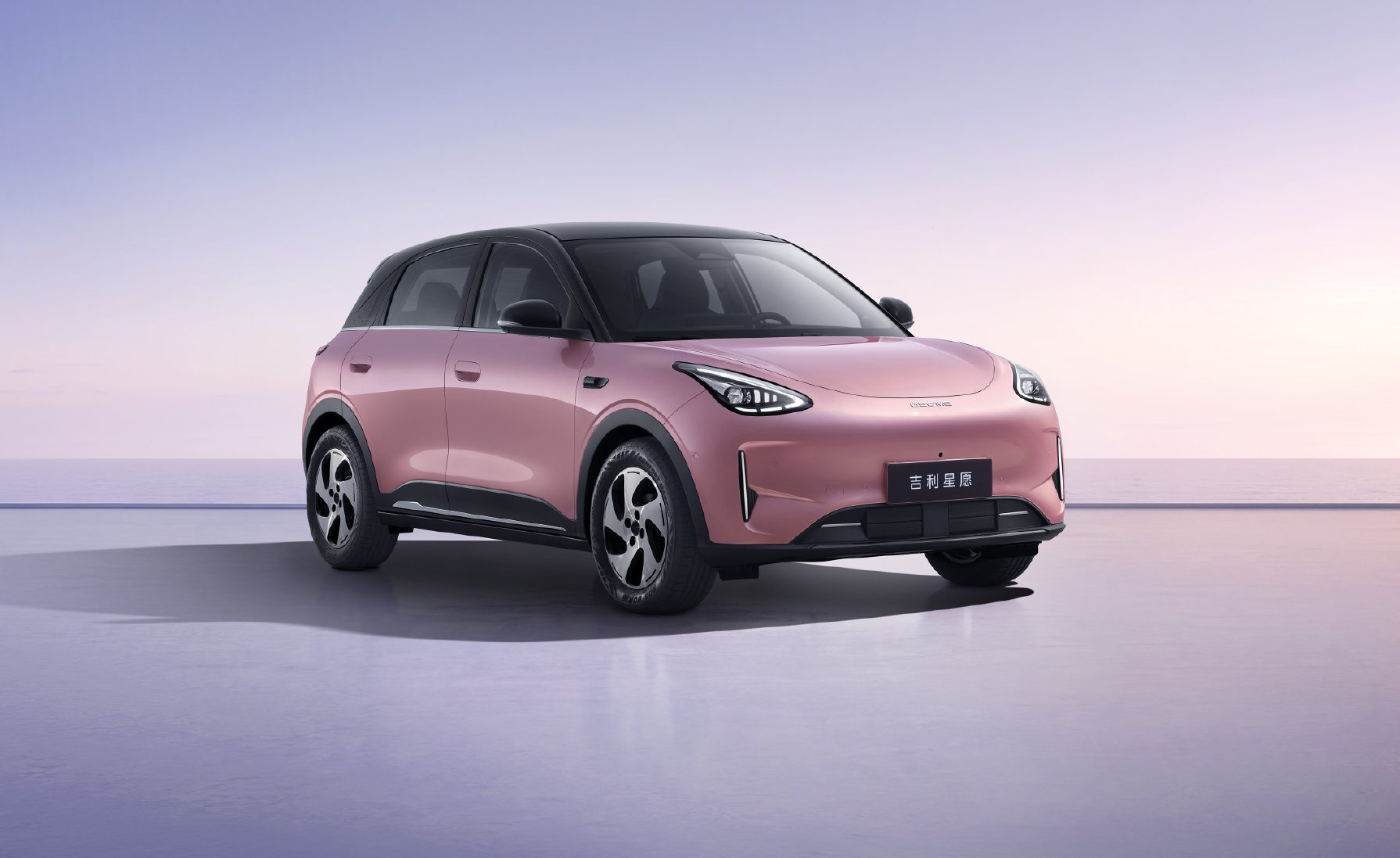
Secondly, after the integration, there will be a greater emphasis on the differentiation of each brand. We aim to build an ecosystem of four major brands. Zeekr will continue to be positioned as luxury and ultimate; Lynk & Co will be positioned as trendy, youthful, sporty, and fashionable; Galaxy will be positioned as a high-value mainstream new energy brand; and China Star will focus on energy-saving and intelligent fuel vehicles.
So these four major brands will have a very clear positioning to meet the comprehensive needs of the market and customers. At the beginning of this year, President An (Eric) in Harbin announced the “two horizontal and seven vertical” strategy. In the future, we will continue to focus on this strategy to promote organizational integration and efficiency.
Regarding the future changes in the organization, my view is that where the business is, the organization should be; where the organization is, the talent should be.
We must develop the capability to create blockbuster products in every market segment. This capability isn’t about a single product—it’s about building a system and a methodology.
Only by establishing this framework can we consistently produce multiple hit products across various segments, making sustained success increasingly achievable.
Q5: At the beginning of the year, we saw the industry promoting intelligent driving parity. Just now, President Gui also mentioned that the Ministry of Industry and Information Technology has introduced new regulations on assisted driving in April. I would like to ask whether Geely’s strategy for intelligent driving has changed? And regarding the pace of intelligent driving in the market below 150,000 yuan, are there any specific developments that can be shared with everyone?
Eric: In fact, everyone has seen that after the merger of Lynk & Co and Zeekr, we are comprehensively promoting a platform-based strategy in technology.
At the same time, Zeekr Technology is also highly coordinated with Geely Auto in the cockpit and intelligent driving aspects. In March, we launched the Qianli Haohan intelligent driving system for the entire Geely group.
To put it simply, it is a single system, a single intelligent driving system to meet the needs of different brands and different products.
I believe that this plan and strategy will be more resolute in the future.
Q6: Regarding Zeekr’s integration, has there been any change in the positioning of the Qianli Haohan platform and its future business aspects?
Gan Jiaye: Speaking of intelligence, in April this year, the safety of intelligent connected vehicles welcomed the strictest new regulations ever. I would like to talk about Geely’s overall plan for intelligent driving here.
For Geely, we have always believed that the premise of assisted driving functions is safety. Safety parity is the foundation and base of assisted driving. Without safe assisted driving and intelligent driving, it is just a castle in the air. Therefore, Geely has always adhered to the principle of regarding safety as the bottom line.
In March this year, we launched the Qianli Haohan assisted driving in Hainan. We will unify all the group’s intelligent driving under one brand and one organizational structure in the future. However, under this organizational structure, we will match different customer usage scenarios and different computing power needs according to different product levels.
In fact, from 1/3/5/7/9, there are two main categories in total: one is the high-level intelligent driving solution, and the other is the high-value intelligent driving solution.
For these two sets of solutions, Geely has basically achieved universality from the hardware foundation. On the software side, we will continue to gradually move towards a more unified approach in the future, but this will take a process because intelligent driving technology is constantly iterating and progressing.
With the further development of artificial intelligence and VLA technology, we believe that in the future, as long as the hardware is standardized and unified, there will be an opportunity for software to become unified.
After unification, according to different computing power, different configurations will be formed on the vehicle terminal side based on different computing power capabilities. Combining large models and vertical large models on the vehicle terminal, a relatively unified intelligent driving solution will be formed in the future.
At present, we have formed a Qianli Haohan intelligent driving solution for high-level and high-value. In the future, we will build the entire intelligent driving capability through the ability of large models.
(You can click here for Part 2.)
Discover more from ChinaEVHome
Subscribe to get the latest posts sent to your email.

[…] The following is the real-time record of Geely Auto’s Q1 2025 Earnings Call, transcribed from the recording. Due to the length of the content, the article is divided into two parts. (You can click here for Part I.) […]