XPeng unveils futuristic, sporty P7 interior with triple-axis screen, touchpad controls, HUD display, and reimagined steering wheel.
Just ahead of its official launch, Xpeng has showcased part of the interior design of the new P7 through a promotional video and a series of marketing materials.
While the full cabin hasn’t been revealed, we now have a look at select elements such as the driver’s seat, center console, and door panels. These glimpses provide insight into the design philosophy behind the new P7’s interior.

XPeng appears to be crafting a “sci-fi + sporty” atmosphere using ambient lighting and screen layouts, while still retaining familiar user interaction logic.
Let’s take a closer look to see if the XPeng new P7’s interior design suits your taste.
Familiar Layout, Enhanced Functions
In addition to the official video, XPeng’s Weibo account posted six images highlighting the primary interior upgrades in the new P7.
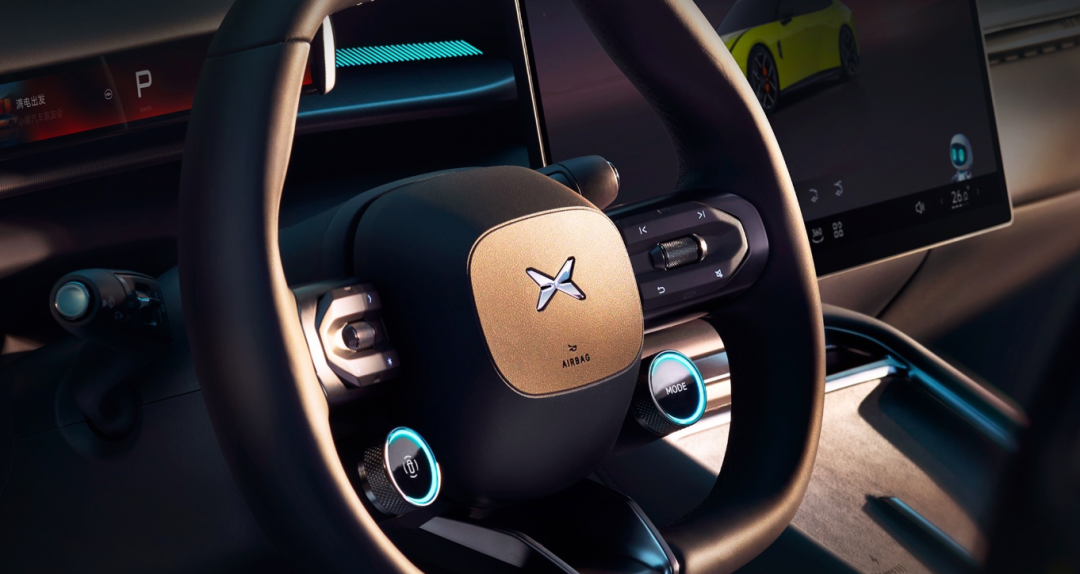
Starting with the steering wheel, it has been redesigned from the two-spoke layout used in the P7/P7i to a three-spoke configuration. Its shape has also been subtly adjusted, resembling more of a sports car design.
Some netizens commented that the new steering wheel appears “too large,” raising concerns about how it may affect handling. Perhaps after in-store test drives become available, interested users will be able to judge for themselves.

The most noticeable update is the addition of two circular buttons at the bottom of the steering wheel, referred to in official materials as “dual satellite knobs.” These likely serve to activate the XNGP assisted driving system and switch drive modes, while also allowing for some customization.
The new shape and added buttons strengthen the “sporty” feel of the driver’s seat area.
Additionally, even with the AR-HUD installed, the new P7 still includes a “sports instrument display screen.” Though compact, this screen displays key information such as intelligent driving status, speed limits, current speed, and driving modes.

Another new feature in the cabin is the main central control screen, which supports three-axis movement. XPeng describes it as being able to “glide and nod.”

From the promotional images, we can see that when the voice assistant is activated by the driver, the screen rotates from its default horizontal position toward the upper right—angled toward the driver. This level of flexibility is far beyond what’s typically offered by conventional central control screens.

HiPhi is one of the few automakers offering even more flexible screen movement, using a “universal joint” that theoretically allows free rotation in any direction.
Most other new energy vehicles have fixed central screens. Some BYD models support 90-degree rotation around the center, while brands like Zeekr and Deepal allow minor side-to-side tilts, sometimes referred to as “sunflower screens.”
Thus, the new P7’s high-mobility screen could be a feature with strong emotional appeal, akin to the “NOMI” assistant in NIO vehicles.
However, while NOMI requires an additional ¥4,900 ($686) as an optional upgrade, it’s not yet known whether XPeng’s “three-axis dynamic screen” will also cost extra.
After examining the center console, attention turns to the driver’s side door panel. XPeng has added a set of touch-sensitive shortcut controls called the “Touch Pad Smart Control.”

According to official posters, these touch-sensitive buttons can control a range of functions including seat heating, ventilation, massage, opening the front trunk, tailgate, and charging port cover—all with a single button. How such a compact panel enables so many controls remains to be explained at the upcoming launch event.
Finally, XPeng briefly introduced the new P7’s seating. A highlight is that the driver’s seat includes 30mm of lateral support.
Taken together, although the new P7 introduces a number of fresh tech features, its overall interaction logic and design style don’t deviate far from users’ existing expectations.
This presents an intentional contrast with the car’s highly distinctive exterior design.
Bold Styling Brings Challenges
The new XPeng P7 will make its “China debut” on August 6, though the official launch is only stated to occur sometime in Q3.
Previous filings with the Ministry of Industry and Information Technology (MIIT) have revealed basic specifications for the new P7: body dimensions of 5017×1970×1427 mm and a 3008 mm wheelbase. An active rear spoiler appears to be standard, while scissor doors may be optional.
At 1427 mm in height, the car sits quite low for an all-electric sedan, suggesting the new P7 may be a performance-oriented EV.
Still, the design of the new P7 remains its most talked-about feature. Enthusiasts say its extreme lines give it a strong futuristic appeal, making it stand out among EV sedans. Critics argue the design is too unconventional and deviates from mainstream aesthetics.

This debate undoubtedly brings pressure to XPeng and introduces uncertainty regarding its sales performance after launch.
Therefore, choosing a more stable interior design—rather than something overly radical—may have been a deliberate effort to balance the controversy stirred by the bold exterior.
That said, based on the current promotional materials, XPeng’s cabin still offers a fresh and novel user experience when compared to mainstream interiors. Curious consumers are eager to learn more—what magical features does the Touch Pad really offer? How refined is the three-axis dynamic screen in everyday use?
These seemingly minor details may ultimately serve as breakout highlights in the P7’s user reputation—just like the “phone holder” and “UV-blocking glass” helped make the Xiaomi SU7 go viral last year.
Of course, to become a true hit, the new XPeng P7 will need more than just good looks and tech-laden interiors. Especially now, with Xiaomi SU7 already earning a strong reputation and competition in the EV sedan space intensifying, what edge does the new P7 have?
We may find out on August 6.
Discover more from ChinaEVHome
Subscribe to get the latest posts sent to your email.