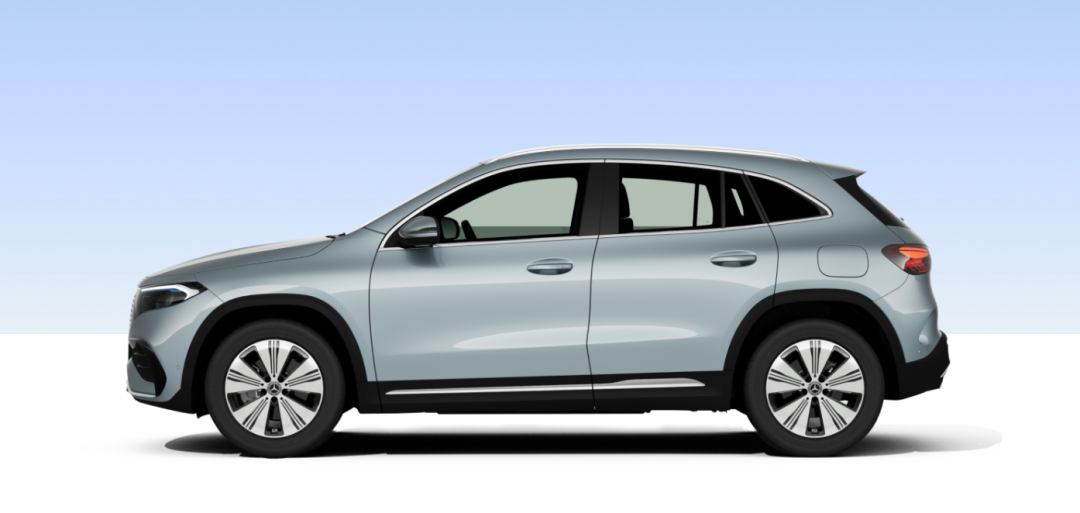
Mercedes plans 10 new EVs in 2025, phasing out EQ line, launching new models across entry, core, and luxury segments.
According to the media outlet Motor1, recently disclosed investor documents once again reflect Mercedes-Benz’s strong commitment to electrification: at least 18 new models are scheduled for release next year, including 10 electrified vehicles (pure EVs and hybrids).
Mercedes describes this as its “biggest product launch program in history.”

The product rollout will span from entry-level to high-end markets, with electric and fuel-powered vehicles launched in parallel. In the premium segment, where Mercedes dominates, EVs are now given equal status to ICE vehicles—five models on each side.
In the “entry” market, in addition to the known fuel and electric versions of the CLA Shooting Brake, Motor1 predicts Mercedes will launch a brand-new ICE model and two all-new EVs. For the “core” product range, four new models will debut, split evenly between fuel and electric.
Since the start of 2025, Mercedes has been accelerating the upgrade of its electrification strategy.
Earlier this year, the company announced it would stop releasing standalone “EQ” series models and merge them into the main product line. In March, the all-electric CLA was officially unveiled in China, not only revealing core specs but also confirming a year-end launch.
By June, the brand publicly adopted a “dual-track strategy” of advancing both ICE and EV lines simultaneously. Combined with this latest roadmap, it’s clear that Mercedes is fully prepared for at least the next two years of global product deployment.
Where is Mercedes’ EV transformation heading? Let’s examine this product plan.
The Biggest Product Launch Program in Mercedes History
Next year, Mercedes will launch five new vehicles in the entry-level segment. Besides the CLA Shooting Brake, available in both ICE and electric versions, there will be one new ICE model and two new EVs.
According to Motor1, those two entry-level EVs are likely to be the electric versions of the GLA and GLB, positioned to replace the EQA SUV and EQB SUV.

It’s worth noting that the EQA and EQB SUVs were discontinued in September 2023, making them the earliest EQ series models to exit production.
In the core market, Mercedes plans to launch two new ICE and two new electric models. These are expected to be mid-cycle facelifts, each offering both ICE and EV variants. Motor1 predicts these will be the new C-Class and GLC, each available in both powertrains.
In the high-end market, Mercedes intends to release four new ICE vehicles and five new EVs, likely including mid-cycle updates for the S-Class and EQS. Among the high-end EVs, Motor1 also notes the probable inclusion of the long-rumored “little G-Class EV”, expected to be priced below the “big G-Class EV.”

Mercedes may also launch a pure-electric supercar in 2026, potentially the production version of the “AMG GT XX” concept, previously shown at several international auto shows such as in Munich, though no firm production date has been announced.
By 2027, Mercedes plans to slow down its EV rollout slightly. There will be no new entry-level EVs, only one new model in the core segment, and five models in the high-end segment. Overall, 2027 is seen as a transitional year, with fuel vehicles taking the lead.
Compared with the plan shared in Mercedes’ 2024 financial meetings—seven ICE and seven EVs for 2027—the new roadmap now shows eight ICE vehicles and six EVs, marking a slight shift in balance toward combustion engines.
This shift clearly reflects the updated strategic direction: “dual-track ICE and EV development.”
But considering Mercedes has now clarified its next-gen electrification architecture, and factoring in the latest rumors, we can begin to evaluate the true competitiveness of its upcoming new energy models.
Rapid Progress
Mercedes’ NEV push falls into two main categories: pure electric and plug-in hybrid.
Pure Electric: New Platforms, Enhanced Base Experience
The competitiveness of Mercedes’ EVs now hinges largely on the new MMA platform—and the best reference point is the all-electric CLA, already unveiled in China.

Expected to launch in China this fall, the long-wheelbase electric CLA will feature an 86kWh battery, offering a CLTC range of 866km, outperforming many domestic rivals.
Mercedes also emphasizes that the vehicle achieves 10.9kWh/100km consumption, and in a real-world 120km/h highway test, it clocked 572km of actual range.
These figures suggest that the CLA EV matches leading Chinese EVs in powertrain performance and stands out in real-world range—meaning “range anxiety” may be less of an issue.
On the smart tech side, the CLA EV uses Mercedes’ self-developed MB.OS, with a 10.25-inch instrument panel, 14.6-inch central screen, and a 14-inch passenger display. It is also equipped with ByteDance’s Doubao AI assistant.

Its driver assistance system, co-developed with Momenta, uses a single Orin-X chip offering 254 TOPS, enabling full-scenario intelligent driving support.
Thanks to localized production and a China-exclusive long-wheelbase variant, the pricing may be more affordable than imported ICE versions. The starting price could be around ¥250,000 ($35,000), directly competing with the Model 3 and Xiaomi SU7.
Another standout EV model is the pure-electric GLC, expected to launch in 2026.

Officially, the EV GLC will debut at the IAA show this September. It will share a similar appearance with the ICE version but gain significant upgrades: an 800V platform and 320kW fast charging—far faster than the current EQC’s 110kW, able to recharge 300km in just 10 minutes.
This dramatic charging leap is due to the GLC EV being built on the MB.EA platform, launched in 2021 alongside MMA. It’s a major improvement over the older EVA platform and supports 800V high-voltage architecture.
The GLC EV will use a 94.5kWh battery, with a WLTP range of over 400 miles (644km) and an EPA rating estimated at over 300 miles (483km).
If launched on schedule, and using the current ICE GLC starting price of ¥427,800 ($59,892) as a reference, the GLC EV will likely start at no less than ¥400,000 ($56,000).
Plug-In Hybrid: Partnering with Geely Lotus, 1100km Range?
Lastly, Mercedes’ plug-in hybrid strategy is showing signs of transformation.
According to a late-July report by 36Kr, Mercedes is planning to launch a long-range plug-in hybrid specifically for the Chinese market, using Geely’s technology.
Specifically, Mercedes is looking to adopt Lotus’ “Luyao” PHEV system, announced in November 2024. This system supports 900V electric voltage and claims a combined range of over 1100km.

However, Lotus has not disclosed detailed specs or confirmed which models will carry the system.
Mercedes has not officially confirmed this plan either, so it’s unclear whether this rumored “Geely-powered PHEV Mercedes” is part of the so-called “largest-ever product release”.
Overall, with its next-gen platforms and potential large-scale tech collaborations, Mercedes’ new EVs seem poised to overcome the weaknesses of earlier products, regaining competitiveness across different price tiers.
ChinaEVHome once discussed in a previous article that joint-venture brands—especially luxury names like Mercedes—can rebound fast once they fill key product gaps and leverage their global scale. This makes Mercedes’ next 2–3 years of EV plans genuinely worth anticipating.
With stronger fundamentals in place, Mercedes’ “largest-ever product launch campaign” is no longer just a slogan.
If priced right—would you reconsider buying a Mercedes EV?
Discover more from ChinaEVHome
Subscribe to get the latest posts sent to your email.