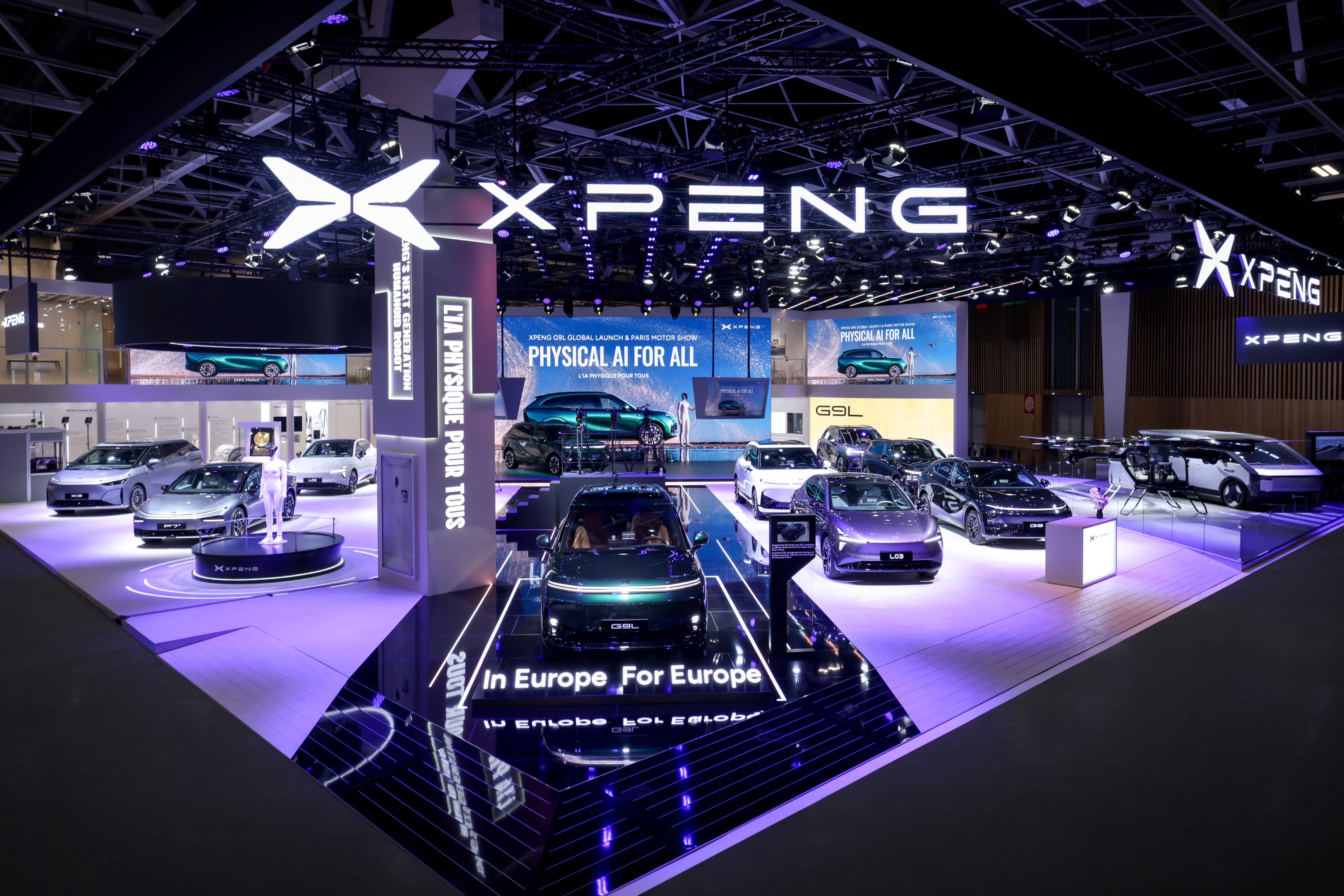
XPeng reinvents P7 with bold design, enhanced intelligence, no price revealed yet, targeting global market and smart EV leadership.
As one of XPeng’s two most important models in 2025, the Next P7 reflects both caution and boldness from the company.
The caution lies in the fact that during its debut in China last night—with pre-orders opening—the Next XPeng P7 did not reveal its expected price, did not disclose the official launch date, and kept two-thirds of its capabilities under wraps.
XPeng has left plenty of suspense. Even though the pricing competition between Tesla’s Model 3 and Xiaomi’s SU7 has given the public a rough idea of where the Next P7 might land, XPeng has opted to reserve both the price and more key features for its official launch event later this month.
On the other hand, XPeng is also bold—not only because the Next P7 overlaps in positioning with the highly anticipated Xiaomi SU7, which will likely compete directly, but more so because XPeng has essentially rebuilt the P7 from the ground up.
From exterior to interior, from space to intelligence and EV technology, the Next P7 is completely revamped compared to the previous P7 and P7i.
Among these updates, what people perceive most strongly is its futuristic look: a rear end full of sharp angles, dramatic A-pillar contours, and a distinctive “H”-shaped front light design.

This avant-garde styling has raised some questions: The first-generation P7 and P7i have proven widely popular over the past five years. So why did XPeng go to such lengths to change the Next P7’s appearance? What expectations is the Next P7 carrying?
Let’s look at what XPeng Chairman and CEO He Xiaopeng, and XPeng Design Center General Manager Wang Tan, had to say.
From Pioneer to Challenger
Throughout the group interview last night, He Xiaopeng deliberately shifted the spotlight to Wang Tan and the vehicle’s original design. But interestingly, neither of them commented when repeatedly asked about the design of Xiaomi’s SU7.
Of course, it’s rare for auto execs to directly comment on rival products during public interviews, as it can easily spark controversy. Still, the contrasting design approaches of XPeng and Xiaomi highlight the evolution of XPeng’s position in the industry over the past five years.
Let’s rewind a bit: What major NEV (new energy vehicle) models were popular in 2020?
Most would probably say: Tesla Model 3, NIO ES8, Li ONE, BYD Han, and of course, XPeng P7.
At that time, Tesla’s famed FSD (Full Self-Driving) wasn’t available in China. Many early adopters purchased it more for future promise than immediate functionality. XPeng’s first-gen P7 filled a real gap for forward-thinking Chinese consumers.

It was one of the first electric sedans to combine sleek coupe styling, advanced driver assistance (early highway NGP), and over 700km range—making it a benchmark EV in its segment.
XPeng’s image of “building smart cars for young people” was cemented by the first-gen P7, proving the market value of smart electric sedans.
But as He Xiaopeng noted in the interview: “The auto industry’s cycle has shortened from 7 years per generation to 2 years for a minor refresh and 5 years for a major one.” Technology is evolving fast, and the competitive landscape has been reshaped.
In China, success breeds imitation. The P7’s achievements naturally made it a blueprint for others.
In recent years, nearly every mainstream NEV maker, whether new startups or legacy automakers, has emphasized intelligent features and design in their core models.
As a result, the P7’s “uniqueness” quickly faded. The idea of “building smart cars for young people” became an industry-wide mantra, and in some cases, other brands overtook XPeng in the public’s perception.
Today, “style + intelligence” is just the baseline. In the ¥200,000–¥300,000 ($28,000–$42,000) price range for EV sedans, there’s a flood of contenders.
The battlefield is crowded, but technological breakthroughs take time. So now, many products offer similar features and similar marketing messages, diluting XPeng’s once-clear edge—especially with Xiaomi and Huawei’s aggressive entry.

A “tech-first” label alone is no longer enough. XPeng must shore up its weaknesses in design and commercial strategy.
While commercial execution has been widely discussed—Q4 profit goals, organizational changes, easing production issues—the deeper shift is in XPeng’s rethinking of product design and positioning.
Hence He Xiaopeng’s quote: “If there’s a fight between style and tech, style wins—sorry.” In other words: Appearance first, then tech leadership.
The moat established by the first P7 is no longer enough. XPeng’s path forward is built on original design and renewed focus on smart features.
Climbing Dimensions
Like most recent XPeng models, the Next P7 is a “no-weakness” product.
It’s not just a smart electric coupe with 0–100 km/h in 3.7s, top speed of 230 km/h, and standard dual-chamber air suspension. It also features up to 820km CLTC range, three Turing chips for full-scenario driver assistance, and a 5C ternary lithium battery.
More importantly, it addresses space and comfort pain points common to EV coupes: adjustable front seat posture during turns, 575L trunk space, 8-inch rear entertainment screen, and 120mm rear knee room—tackling the P7’s old weaknesses head-on.

“No weak points, high average across the board, and a few standout areas” That’s the Next P7’s product strategy.
XPeng continues to double down on intelligence—its traditional strength—but is now placing unprecedented importance on original design.
This is directly tied to its global strategy and the P7’s new positioning.
To many in China, the original P7’s styling was already top-notch. A modest update—upgrading software and tweaking the rear—should have been enough. But XPeng chose a more complex and uncertain path.
This reflects XPeng’s “break to rebuild” mentality—but it also raises the bar significantly.
Throughout the group interview, XPeng made clear that the Next P7 is meant to not just look good, but deliver that immediate “wow” factor—while still holding up after 10+ years of ownership. The goal: unify the brand’s futuristic tone with forward-looking product language.
Wang Tan described this as XPeng’s upgraded understanding of automotive design.

And this “upgrade” isn’t just an evolution of the first-gen look. It’s a bold attempt to break new ground in design language, reflecting XPeng’s “dare to pioneer” spirit.
In Wang’s view, the future is undoubtedly tech-driven—but blending emotion into technology will be a key industry trend.
One example: the Next P7’s AR-HUD includes “road rage emojis” to help users express emotions—technology infused with emotion.
With bold linear design, hidden mmWave radar, a floating license plate frame, and minimalistic lines, the Next P7 aims to reconnect with early adopters who appreciate the daring and different.
For the global push, He Xiaopeng noted that “Chinese aesthetics haven’t yet influenced global design norms.”
He shared a “failed case”: The first-gen P7 was already exported, but overseas users didn’t think it looked good. European customers, in particular, prefer practicality—no matter how stylish, the car must be family-friendly. They want to shop for a whole week, and need big trunks. They also expect air suspension.

So abroad, the P7’s good looks didn’t drive buying decisions.
These kinds of insights have led XPeng to reconsider the importance of exterior design: If companies spend ¥2 billion ($280 million) a year on smart driving, why not invest more in styling, a top-4 car buying factor?
To that end, XPeng has rented two buildings in Shanghai for its design team, elevated their internal priority, and given them top-tier resources to co-develop new models alongside product teams.
Meanwhile, XPeng’s push for intelligence continues as always.
The Next P7 will feature three Turing chips—two for driver assistance, one for the smart cabin. These chips support the entire smart driving and intelligent ecosystem.
With dual VLA (vision-LiDAR architecture), XPeng aims to deliver “a safer driver and a smarter assistant.”
Now covering assisted driving, smart cockpits, embodied AI—and with He hinting “Robotaxis are coming soon”—XPeng expects to own 30,000 compute cards by year’s end. Their bet on intelligence is long-term.
But will the new, bold look of the Next P7 resonate with both domestic and international users? Can it, as a smart electric coupe, really meet the spatial and comfort demands of its target audience?
We’ll have to wait for the official launch of the Next P7 to see the full picture—and judge whether XPeng’s bold bet will pay off.
Discover more from ChinaEVHome
Subscribe to get the latest posts sent to your email.