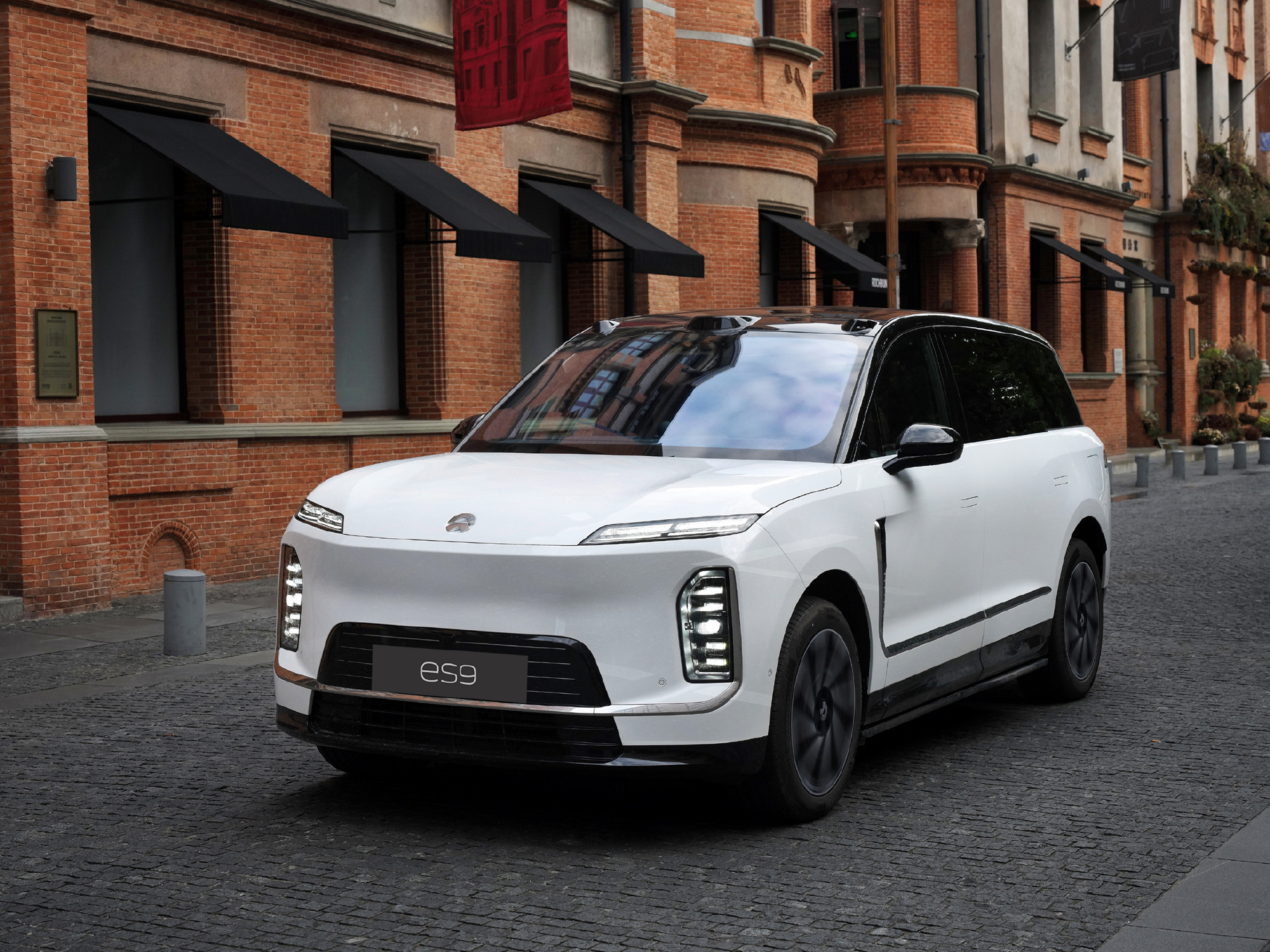
The third-generation ES8 may be priced from ¥528,000 ($73,920), with standard 100kWh battery, 3 LiDARs, and partial SkyRide chassis adoption.
With just over two weeks to go, the third-generation NIO ES8 is set to make its official debut.
According to NIO CEO William Li, the Gen-3 ES8 will be unveiled at the Chengdu Auto Show and formally launched during NIO Day in September, following the same rhythm as the ONVO L90—“delivery upon launch.”
On August 6, Yang Bo, Head of NIO User Operations, posted on RedNote, announcing: “Live stream on August 8, the King Returns: All-New ES8!” signaling the start of the ES8’s pre-launch promotion phase.

That means today’s article might be our last “prediction” before the official release.
The ES8 is NIO’s soul model, witnessing every major breakthrough and milestone over the past decade.
On the other hand, Chinese brands have fully cracked the ¥500,000 ($70,000)-class market. As one of the pioneering premium domestic EVs, the ES8 now must prove its legacy still shines with strength.
Despite only having fragmented information, we can already piece together a good idea of what the Gen-3 ES8 will look like. Today, we’ll go bold and try to answer two key questions:
- What will the Gen-3 ES8 cost?
- How much of the ET9’s DNA will it carry?
The $70,000 Segment: A Defining Line?
A widely circulated screenshot on August 6 shows Yang Bo saying in a WeChat group: “¥500,000 ($70,000)-class, standard 100kWh, 3 LiDARs.”

These three key details already tell us a lot.
First, “¥500,000 ($70,000)-class” and “standard 100kWh battery” together suggest that those who’ve been hesitating can now start thinking seriously—because the Gen-3 ES8 price is now more or less calculable.
The 2024 ES8 was priced from ¥498,000 ($69,720) with the 75kWh battery, and ¥556,000 ($77,840) with the 100kWh pack. Under the BaaS model, the unified price dropped to ¥428,000 ($59,920).
As the NT2-era flagship SUV, the ES8 symbolized NIO’s technological prowess and premium status, warranting top-tier materials and specs, along with a flagship MSRP.
However, with the ET9 already delivered and the ES9 still veiled, the ES8 might now go for a more “battle-ready” strategy.

If the new model comes standard with the 100kWh battery, NIO has two options: One is to elevate the ES7/EC7 position and retain the current ES8 pricing. Li has already said in a group chat, “There will be a 7, and we’ll push hard.”
The second is to adopt a more aggressive pricing strategy like this year’s broader NIO lineup, potentially bringing the new 100kWh ES8 down to around ¥528,000 ($73,920), close to the old 75kWh model’s level.
That would place the BaaS version just over ¥400,000 ($56,000).
This would position the Gen-3 ES8 directly between AITO’s M8 Electric Max+ and Ultra versions in BaaS mode, and between the M9 Max and Ultra in buy-out pricing.
Using the BaaS model to hit varied competitor price points remains NIO’s unique weapon—it all depends on how they choose to use it.
But here’s the more tantalizing idea: what if the “¥500,000 ($70,000)-class” price turns out to be ¥508,000 ($71,120)? Then the BaaS version would be even more competitive.
Configuration Clues from Tire Width
Since the first ES8 teaser poster, one hotly debated detail has been: “Why 265mm tire width?”
That’s not a NIO tradition. While the past three ES8 versions did top out at 265mm, the ONVO L90 already features aggressively wide tires and excellent space-suspension balance. There’s no reason for NIO’s flagship to regress.

Unless the ES8 has something else as standard that takes up rear-axle space—something with great sales value.
Let’s consider some interesting benchmarks: Mercedes-Benz EQS (non-AMG): 10° rear-wheel steering, max tire width 265mm; XPeng X9: ±5° rear-wheel steering, max tire width 235mm.
The logic is simple: combining rear steering, air suspension, spaciousness, and wide tires on a BEV platform still pushes engineering and cost to the limit.
Even the cost-no-object EQS AMG only expands the rear tires to 275mm, making it the narrowest rear tire setup among AMG, M Power, and RS counterparts.
As a six-seat quasi-flagship, the ES8 obviously doesn’t enjoy AMG-level budgets or ET9’s built-in luxury latitude, which can afford to skip a third row entirely.
That’s why we’re sincerely hoping rear-wheel steering + steer-by-wire will be standard on the ES8.
What else might be standard?
Yang Bo mentioned “standard 3 LiDARs,” which implies the ES8 could be a full-fledged Cedar configuration—meaning twin NX9031 “Shenji” chips with a combined sparse inference computing power of over 2000 TOPS.
That would make it the highest currently usable computing power in the industry for assisted driving—though nothing’s confirmed yet. It’s possible the 9-series NIOs keep twin Shenji chips exclusive, just like how Tesla Model S/X have a dedicated GPU.
On a personal note: I’ve always loved the integrated fender design of the Gen-2 ES8, which merges the ADAS camera into the front body line. But I accept the trade-off if three LiDARs offer more flagship credibility.

Still, 8 and 9 remain distinct.
By NIO’s conventions, all screen- and chip-related configurations are typically unified across platform models. For example, ONVO now standardizes a 17.2-inch central screen, and NT2’s final update included single Shenji + OLED center console.
Thus, we can imagine the Gen-3 ES8 cabin: similar to ET9, with far-screen, center display, HUD, rear entertainment screen, and a six-seat layout up front.

The clear visual differences between ES8 and ET9 likely come down to luxury versus ultra-luxury.
For example, the “SkyRide” chassis.
SkyRide comprises steer-by-wire + active suspension + rear-wheel steering. For a 5.3-meter SUV like ES8, rear steering is nearly mandatory. So how much of the rest will remain?
Another point of divergence: the audio system.
ET9 comes standard with the Lrya 8.2.4.8 system: 35 speakers and 2800W output. It’s likely this setup will be an optional extra on ES8 to keep the pricing under control.
Regardless, Gen-3 ES8 is undoubtedly NIO’s most important SUV this year. It must delicately balance family positioning within the lineup and push deeper into the lucrative luxury segment.
So, how much do you think Gen-3 ES8 will cost?
Discover more from ChinaEVHome
Subscribe to get the latest posts sent to your email.