Geely Galaxy A7 launches as aggressive $14k mid-size sedan with 2,100km range, targeting BYD dominance in China’s EV market.
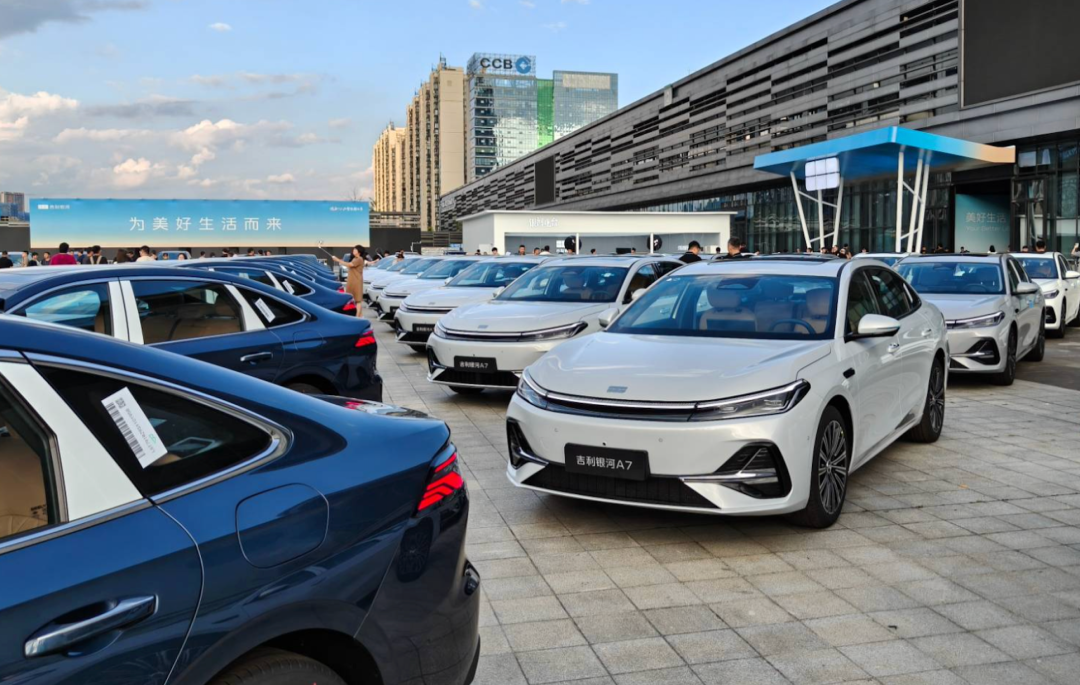
On the evening of August 8, the Geely Galaxy A7 was officially launched.
Compared to the previous pre-sale price of RMB 97,800 ($13,692), the official price has dropped to a certain extent, with the lowest starting price now at RMB 81,800/$11,452 (including an additional RMB 8,000/$1,120 limited-time trade-in benefit).
Here’s the full price list:
- 70 km Luxury Edition: RMB 89,800 ($12,572);
- 70 km Voyage Edition: RMB 95,800 ($13,412);
- 70 km Exploration Edition: RMB 105,800 ($14,812);
- 150 km Premium Edition: RMB 105,800 ($14,812);
- 150 km Long Range Edition: RMB 111,800 ($15,652);
- 150 km Exploration+ Edition: RMB 117,800 ($16,492);
- 150 km Starship Edition: RMB 125,800 ($17,612).

With the size of a “mid-size sedan,” a range of 2,100 km, and certain versions supporting the “G-Pliot H3” assisted driving system, combined with such pricing, the Geely Galaxy A7 epitomizes the fierce competition in China’s new energy vehicle market.

But is this level of product capability enough for the Galaxy A7 to become the new king of the RMB 100,000 ($14,000) family sedan market, especially against BYD in direct competition?
Perhaps we should watch the full launch event and fully understand the A7’s product capabilities before making a judgment.
A New Benchmark for “Entry-Level Family Sedans”?
Geely Auto Group CEO Gan Jiayue opened the launch speech by introducing the A7’s dimensions and space.
The Geely Galaxy A7 measures 491819051495mm with a wheelbase of 2845mm; Geely specifically mentioned that the rear legroom reaches 950mm. In terms of dimensions, the Galaxy A7 already matches or even exceeds traditional B-class sedan measurements.

However, in recent years, the dimensions of domestic new energy vehicles have expanded rapidly. A 2.8m wheelbase is not rare in the slightly over RMB 100,000 ($14,000) market. To win over users with rear space, automakers must pay more attention to seat design, the sense of openness, and convincing consumers during test drives.
Inside, Geely stated that the A7’s front seats are equipped with ventilation, heating, and massage as standard across the lineup, which is commendable.
Gan then shifted to discussing the Galaxy A7’s powertrain. According to him, the A7 improves energy efficiency through two main methods.
First, on the mechanical side, the A7 is equipped with the NordThor hybrid-dedicated engine with a thermal efficiency of 47.26%, claimed to be “the highest in the industry.” The hybrid-dedicated electric motor achieves 93.1% drive efficiency.
In addition to outstanding engines and motors, Geely has introduced an AI large model to calculate the optimal operating state under different conditions. The Xingrui AI Large Model 2.0 can allocate energy according to road and usage conditions, resulting in lower fuel consumption.

The official figure is a fuel consumption of 2.67L/100km when running on a depleted battery, with a total range exceeding 2,100km.
So far, in the RMB 100,000 ($14,000) price range, only a few models like the BYD Qin L DM-i and Chery Fulwin A8L offer a total range above 2,000km. It is clear that “a range exceeding 2,100km” will be one of the Galaxy A7’s core selling points.

After “space” and “energy efficiency,” the next topic is the A7’s driving performance.
The chassis uses a front MacPherson and rear multi-link suspension—a “standard configuration” for a RMB 100,000 ($14,000) entry model. Thanks to refined tuning and upgraded parts, its moose test result reaches 80.2 km/h on dry pavement.
Acceleration from 0–100 km/h takes 7.1 seconds, and Geely claims acceleration degradation in low battery mode is only 0.03 seconds. The 100–0 km/h braking distance is 34.4 m.
In terms of safety, Geely emphasizes three themes: oil-electric separation, structural safety, and safety of battery, motor and electric control. The A7 also features “night safety” measures, with high beams capable of ensuring sufficient illumination on poorly lit roads.

Regarding “intelligence,” there are two main aspects: the Flyme Auto in-vehicle infotainment system and the “G-Pilot H3” assisted driving system.
Flyme Auto is known for being stable, smooth, and intuitive. In the A7, a notable feature is broader “smartphone-to-vehicle connectivity” supporting platforms such as HarmonyOS, Android, and iPhone.
The “G-Pilot H3” assisted driving supports pure-vision, map-free highway navigation nationwide without the need for city-by-city activation.

In urban scenarios, while full navigation is not supported, the “commuting mode” with memory navigation is sufficient for most users. The inclusion of remote parking features is a plus considering the A7’s price point.
Accelerating into the $14,000 Family Sedan Market
The RMB 100,000–150,000 ($14,000–$21,000) segment has always been a fierce battleground for automakers. Since BYD’s rise in 2021, its Qin and Song series have dominated this range.
With the Qin PLUS dropping to the RMB 70,000 ($9,800) market, BYD has established dominance in the RMB 70,000–150,000 ($9,800–$21,000) range.
Data makes this clearer: in the past six months, in the RMB 70,000–150,000 ($9,800–$21,000) range, BYD held four of the top ten spots. The Seagull ranked 2nd, Qin PLUS 7th, Qin L 8th, and Song Pro 10th.

For Geely Galaxy’s entry models, the Xingyuan performed well as the sales champion in this range. But aside from that, no other Galaxy model made the list.
Especially in sedans, previous products like the Galaxy E8 and Galaxy L6, though selling “reasonably well,” could not directly challenge the Qin PLUS or Qin L in the top ten.

Against this backdrop, it’s clear why the Galaxy A7’s product and pricing strategies are so “aggressive”—it is both Geely Galaxy’s new hope in entry-level family sedans and a key product for reaching its million-unit sales target this year.
Looking back at the Galaxy A7, public discussions show that the contrast between its size and price has drawn attention online.
“B-class car at an A0 price” is the Galaxy A7’s core strategy.

As for “intelligence,” it does not create a major gap with main competitors like BYD.
Especially as BYD pushes “mass adoption of smart driving” this year by adding the “God’s Eye” system to the Qin PLUS and Qin L series, both brands’ systems offer similar core highway NOA capabilities.
Ultimately, with such heavy feature stacking and aggressive pricing, the Galaxy A7 has no “way back.”
Whether Geely can beat BYD in the “entry-level family sedan” race depends on this move. Could the Galaxy A7 become a dark horse in the market?
Discover more from ChinaEVHome
Subscribe to get the latest posts sent to your email.