Which do you have more confidence in — a pure vision solution or one with LiDAR?
In the technological exploration of the autonomous driving field, there has always been a technical debate between LiDAR and pure vision systems.
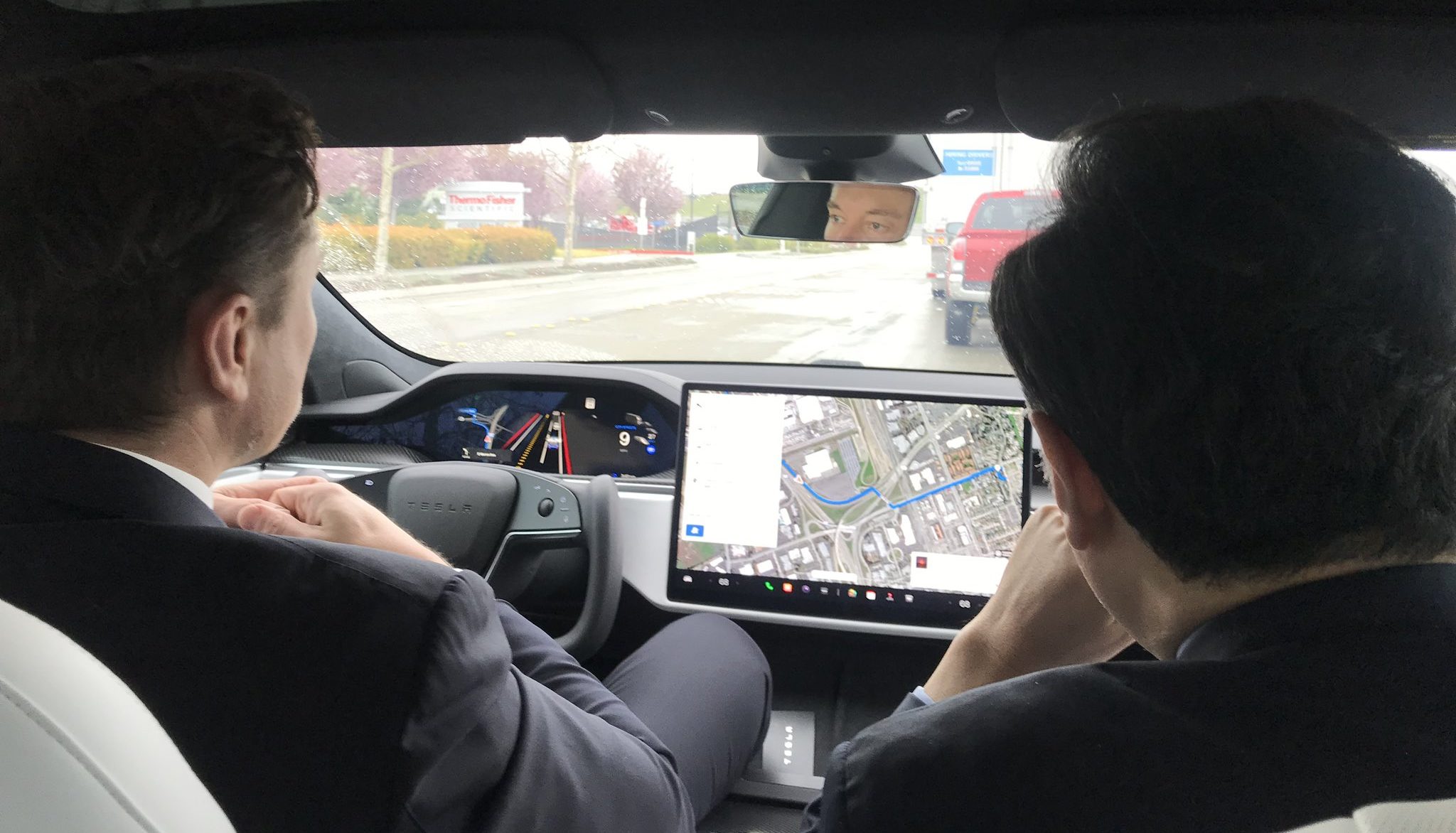
Recently, Tesla CEO Elon Musk stated again on X that sensors like LiDAR are not necessary for achieving autonomous driving, and using LiDAR introduces higher risks.

This discussion originated from an interview video featuring Uber CEO Dara Khosrowshahi.
In the interview, Dara Khosrowshahi expressed that he still tends to believe the approach adopted by Google’s self-driving company Waymo—equipping vehicles with LiDAR and radar—is a necessary condition for achieving superhuman-level safety in autonomous vehicles.
He mentioned: “The cost of solid-state LiDAR is only $500 (approximately RMB 3,578), so why not use LiDAR to achieve superhuman-level safety? All our partners use a combination of cameras, radar, and LiDAR. I personally think it’s the right solution, but I could be proven wrong.”
In response to the above view, Musk rebutted that LiDAR and radar reduce safety due to sensor contention. “If LiDARs/radars disagree with cameras, which one wins? This sensor ambiguity causes increased, not decreased risk.”

This exchange has also sparked discussions among new energy vehicle enthusiasts in the Chinese market. Within China’s NEV sector, the autonomous driving technology path is similarly divided into two major camps.
Taking XPeng as an example, it is currently a staunch supporter of the pure vision route.
As early as 2021, the XPeng P5 model was equipped with LiDAR, first bringing this feature into vehicles priced under 200,000 yuan, making it a key contributor to the “popularization of LiDAR.” By 2025, however, the new G6 and G9 models, along with the upcoming all-new P7, have all confirmed the removal of LiDAR, switching to AI Eagle-Eye cameras as the primary smart driving sensors.
XPeng Motors CEO He XPeng stated that when computing power, data, and algorithms are sufficient, “cameras are enough to see a nail on the road, while LiDAR instead increases system coupling risks.” Yuan Tingting, Senior Director of Autonomous Driving Products at XPeng, argued from three dimensions—physical characteristics, environmental adaptability, and information processing efficiency—that LiDAR’s long-range capability is actually a “false proposition.” Test data shows that in heavy rain, LiDAR’s effective detection range plummets to within 30 meters, with near-field noise increasing fivefold.

In contrast to XPeng’s “clean break,” brands like Li Auto, Huawei’s HI model series (e.g., AITO), NIO, and Leapmotor remain firm adherents of the LiDAR approach.
For instance, Huawei’s ADS 4.0 system increased the number of LiDAR units in the AITO M9 from 1 to 4, creating a 360° full-coverage point cloud wall. Wang Jun, President of Huawei’s Intelligent Automotive Solution BU, stated plainly: “For L3 and above, redundancy must be maximized. LiDAR’s role in rain, fog, against glare, and in pitch-black tunnels is currently irreplaceable.”
This same philosophy is seen in vehicles ranging from the 700,000 yuan-level NIO ET9 down to the 120,000 yuan-level Leapmotor B10, both treating 1-3 LiDAR units as a “safety baseline.”
Li Auto CEO Li Xiang previously quipped: “If Musk had driven late at night on Chinese highways, Tesla would also keep LiDAR.”
Li Xiang believes Chinese automakers retain LiDAR due to different road conditions: driving at night in China, one might encounter large trucks with broken taillights, or even such trucks stopped directly on the main road. Cameras can only see about 100 meters ahead in the dark with no light, whereas LiDAR can see 200 meters without any light, which aids in enabling Automatic Emergency Braking (AEB) at speeds of 130 km/h.

This technology route debate has another focal point—cost. Uber CEO Dara Khosrowshahi mentioned that the cost of solid-state LiDAR has dropped to $500 and should be widely adopted.
In reality, the decline in LiDAR cost has far exceeded expectations. The price of the main LiDAR unit used for L2 intelligent assisted driving, from leading manufacturer Hesai Technology, has now fallen to around $200 (approximately RMB 1,434). Compared to prices of 200,000–300,000 RMB ($27,900–$41,800) just three to four years ago, LiDAR costs have fallen by over 99.5%. This steep decline has shifted the debate over LiDAR from a technical consideration to a commercial one.
Regarding the future direction of the technology routes, some industry experts point out that if costs eventually converge, the two routes could consider integrating and developing synergistically, starting from different application scenarios.
The year 2025 has already become a watershed moment in China’s smart driving sector. Major automakers’ intelligent driving systems are moving away from the “modular stacking” approach, transitioning from rule-based algorithms to end-to-end large models. Regardless of the chosen route, safety remains the paramount principle guiding the evolution of smart driving technology.
Discover more from ChinaEVHome
Subscribe to get the latest posts sent to your email.