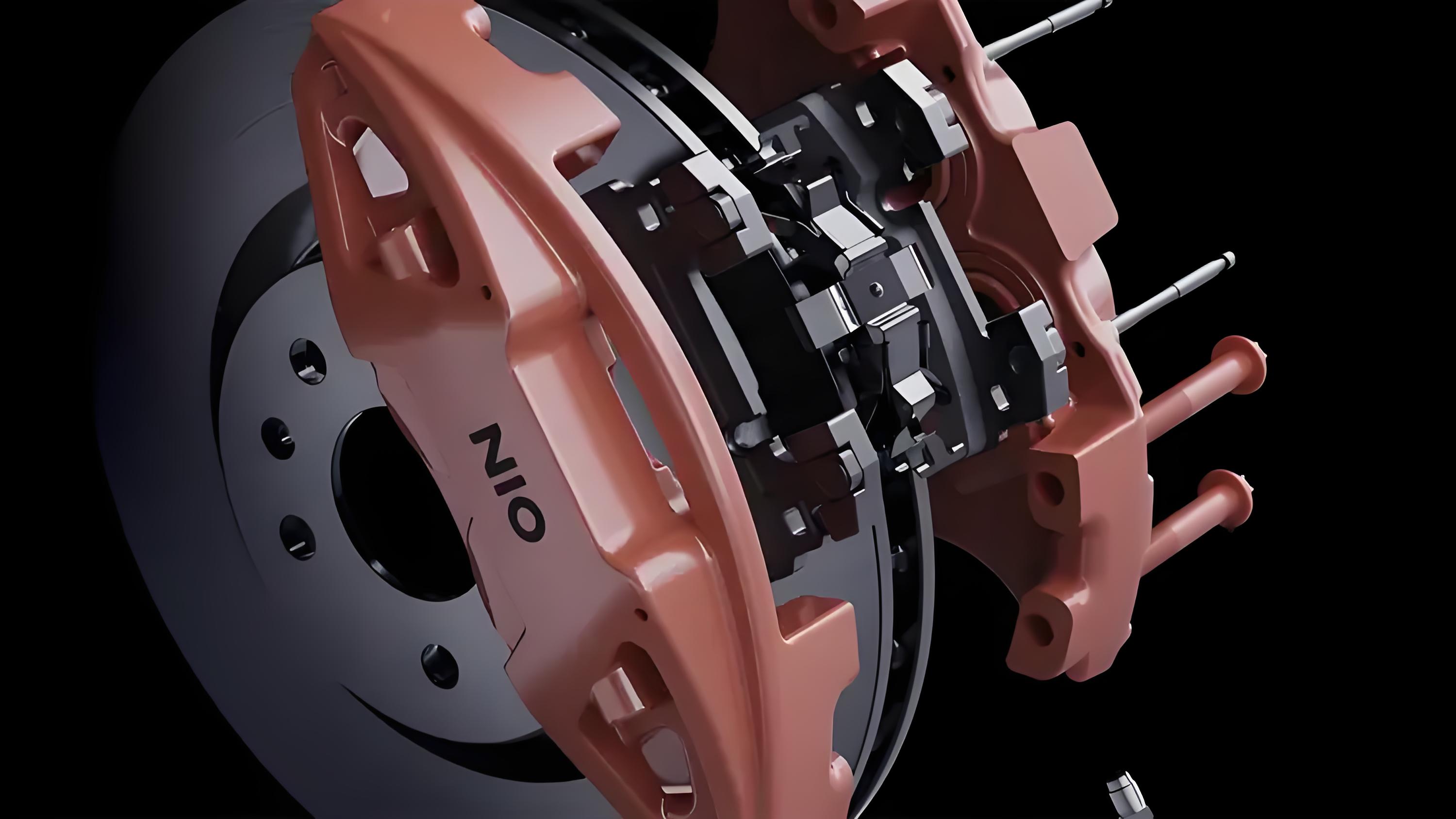
The aluminum-ceramic brake disc achieves a 40-60% reduction in weight, effectively improves the vehicle’s vibration characteristics, and contributes to overall automotive lightweighting.
On August 28, according to information shared by automotive blogger @Jsport_三汽, NIO has completed comprehensive performance verification and analysis of its aluminum-ceramic brake discs across three areas: bench testing, on-road vehicle testing, and corrosion resistance testing.
The tests were conducted using a first-generation ES8. Results demonstrated significant advantages in multiple aspects, including high-temperature applications, comfort and environmental adaptability, wear resistance, and corrosion resistance.
Feasibility in High-Temperature Applications
Based on test results from AMS, AK, thermal fatigue, and Heigu Valley long downhill tests, the aluminum-ceramic brake discs demonstrated excellent performance under high-temperature conditions (≤500 °C).
In the AK test, even at 400 °C, the friction coefficient remained above 0.28, and it stabilized around 0.25 near 500 °C. During the Heigu Valley long downhill road test with energy recovery turned off, the maximum temperatures of the front and rear aluminum-ceramic brake discs were 83°C and 108°C lower, respectively, compared to cast iron brake discs.
The aluminum-ceramic brake discs can withstand temperatures as high as 500 °C, significantly exceeding previously reported usage or test temperatures, while also exhibiting superior heat dissipation characteristics.
Therefore, not only can aluminum-ceramic brake discs be fully applied to the rear axle, but they can also be used on the front axle of non-competitive vehicles (the specific application temperature limits should be determined based on actual operating conditions).

Excellent NVH Performance and Environmental Adaptability
Test results from Huangshan road tests and the “Four Highs” tests indicate that the aluminum-ceramic brake discs perform well in terms of noise and vibration. During noise testing, the noise occurrence rate was only 0.07%.
The comprehensive vibration evaluation score was 9 points. The disc thickness variation (DTV) before and after testing was 4 μm and 6.5 μm, respectively, with a maximum increase of only 3.4 μm.
After testing under complex environmental and road conditions, the disc surfaces remained uniformly bright, with no abnormal wear or performance degradation, demonstrating outstanding environmental adaptability and reliability.

Excellent Wear Resistance
Test results from Huangshan road tests demonstrate that the aluminum-ceramic brake discs exhibit exceptional wear resistance. The average wear amount for the front axle was 0.015 mm, and for the rear axle, 0.017 mm.
The predicted lifespan is 940,000 km for the front axle and 1 million km for the rear axle. Its outstanding wear resistance also helps reduce particulate emissions caused by wear.

Bottom: Surface Condition of Aluminum-Ceramic Brake Disc After Enhanced Corrosion Testing
Excellent Corrosion Resistance
Test results from environmental chamber experiments on samples and real-vehicle corrosion resistance tests show that after 720 hours of salt spray corrosion, the aluminum-ceramic brake disc surface exhibited only minor pitting corrosion, demonstrating exceptional corrosion resistance. For new energy passenger vehicles with reduced braking frequency and intensity, aluminum-ceramic brake discs can effectively prevent disc-pad adhesion.
Compared to cast-iron brake discs, aluminum-ceramic brake discs exhibit superior friction coefficient stability under various operating conditions. This is highly beneficial for future noise matching and the development of braking-related control systems such as ABS, ESP, and AEB, significantly reducing workload. Extensive bench tests and vehicle trials have confirmed that aluminum-ceramic brake discs are technically feasible for installation and can meet normal driving braking requirements.
The aluminum-ceramic brake disc is a silicon carbide particle-reinforced aluminum matrix composite. It combines the high strength, high thermal conductivity, and rust-free properties of aluminum alloy with the high-temperature resistance and wear resistance of ceramic particles, making it an optimal solution in the field of braking materials.
Additionally, compared to traditional cast iron brake discs, the aluminum-ceramic brake disc achieves 40%-60% weight reduction, effectively reducing the vehicle’s unsprung mass, improving vibration characteristics, and contributing to overall vehicle lightweighting.
Discover more from ChinaEVHome
Subscribe to get the latest posts sent to your email.