Why is listing so important for Chery, and can it become a “booster” for expanding its overseas territory?
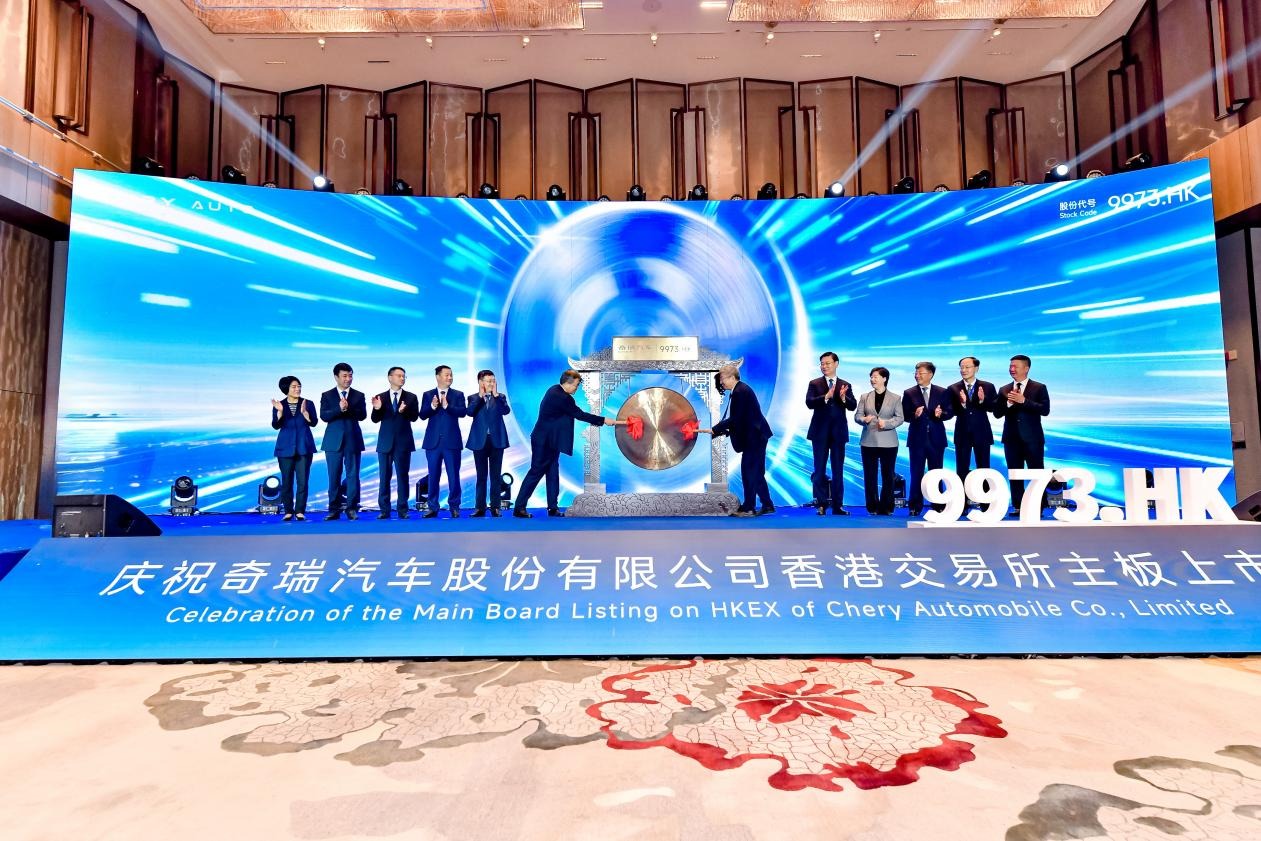
On the morning of September 25, 2025, Yin Tongyue, who “rang the gong” at the Hong Kong Stock Exchange (HKEX), showed a joyous expression unlike any he had at previous new car launch events.

Chery Automobile successfully listed on the HKEX at an issue price of HK$30.75 per share ($3.93 per share), raising a total of approximately HK$9.145 billion ($1.17 billion). This marked the largest IPO by a carmaker in Hong Kong so far in 2025. A total of 13 cornerstone investors were brought in, including many leading supply chain enterprises in the automotive industry.
After listing, Chery Automobile’s share price rose by 11.2% from the issue price on its first day, reaching HK$34.2 per share ($4.38 per share), with a total market value approaching HK$200 billion ($25.64 billion) (specifically HK$197.2 billion, equivalent to $25.28 billion).
Perhaps most people did not expect that as one of China’s leading automakers, Chery had spent 21 years pursuing an IPO, submitting a total of 7 listing applications. It was not until September 7 this year that it formally passed the HKEX’s listing hearing and crossed the “finish line”.

At the same time, for Chery, this is also a new starting point.
In June this year, Yin Tongyue mentioned Chery’s listing aspirations in a public occasion, stating, “Chery hopes to take Hong Kong as a new starting point for entering the international capital market. In the future, Hong Kong will become Chery’s global financial center, logistics center, and a highland for capital and innovation.”
Analysts from outside the company believe that with its mature overseas business, absorbing overseas capital is a crucial step for Chery to further expand into the global market. Additionally, listing in Hong Kong as “China’s top export automaker” leaves more room for imagination regarding its subsequent overseas moves.
Why is listing so important for Chery, and can it become a “booster” for expanding its overseas territory? Furthermore, what impact will it have on China’s automotive industry?
To answer these questions, it is helpful to start with Chery’s current situation.
Catching Up Late
As a former sales champion in China, Chery achieved remarkable success in the era of fuel-powered vehicles. However, entering the new energy vehicle (NEV) era, Yin Tongyue himself summed up the situation as “starting early but falling behind”.
The so-called “starting early” refers to Chery establishing a “new energy vehicle project team” as early as 1999 to begin researching and developing technologies related to NEVs. Given this early start, Chery had every opportunity to gain an advantage in the NEV sector.
Nevertheless, in the current NEV market landscape, Chery’s performance is merely “passable”—barely meeting expectations.
In the 2024 NEV market, BYD took a commanding lead with 4.27 million units sold. Chery ranked sixth among Chinese automakers with 583,600 units sold, falling behind competitors like Geely and Changan, while also facing pressure from new forces such as Li Auto and Seres (AITO).
While ranking sixth in China may seem impressive, for Chery, only the top spot can satisfy Yin Tongyue’s ambition.
Chery’s prospectus, submitted in February 2025, also provides some clues.
From 2022 to 2023, Chery undoubtedly delivered a strong performance: its revenue grew from RMB 92.618 billion ($12.99 billion) to RMB 163.205 billion ($22.89 billion), and its profit increased from RMB 5.806 billion ($814 million) to RMB 10.444 billion ($1.46 billion), representing year-on-year growth rates of 76.2 % and 79.9 % respectively.
In the first three quarters of 2024, Chery’s revenue exceeded the full-year 2023 figure, reaching RMB 182.154 billion, a year-on-year increase of 67.7%; its net profit stood at RMB 11.312 billion, a year-on-year growth of 58.5%.
However, this growth was largely driven by fuel-powered vehicles. The proportion of fuel-powered vehicles in Chery’s total revenue was 75.9% in 2022, 87.8% in 2023, and 74.8% in the first three quarters of 2024.
The latest data shows that in the first three months of 2025, thanks to the rising sales of NEVs, the proportion of fuel-powered vehicles in total revenue further decreased but still remained at 63%.
Comprehensive analysis of the above data reveals that in the increasingly important NEV market competition, Chery still lags behind the “first tier” and has significant room for improvement in sales scale and revenue performance.
Since the beginning of 2025, Chery has further expanded its NEV product lineup, launching the “Fengyun” series equipped with “Kunpeng” plug-in hybrid (PHEV) powertrains, covering the mainstream price range of RMB 100,000 to RMB 200,000. ($14040-$28080)

The Chery Fengyun series has indeed produced some “hit models”. For example, sales of the Fengyun A9L exceeded 10,000 units in August, while the Fengyun T9 achieved monthly sales of over 4,400 units.
Of course, from an overall perspective, the Fengyun series cannot yet be described as a “great success”. To maintain market competitiveness, continuous capital investment is indispensable.
Against this backdrop, Chery’s capital moves become easier to understand. When Yin Tongyue submitted the listing application in February this year, he mentioned that the funds raised after the IPO would be used for “R&D of passenger vehicles, enhancement of core technologies, and expansion of overseas markets”.
“R&D of passenger vehicles and enhancement of core technologies”—especially NEV-related technologies—are essential needs. As for “expansion of overseas markets”, Chery’s statements on this front currently carry more weight.
Export Champion
Since 2003, Chery has been the “export champion” among Chinese brands for 22 consecutive years. In 2024, its export sales exceeded one million units for the first time, reaching 1.145 million units, a year-on-year increase of 21.4%.
Entering 2025, Chery’s overseas momentum remains strong. From January to July, its export sales reached 669,400 units, including over 40,000 units in the European market, a year-on-year surge of 942%. Its business covers 110 countries and regions worldwide, with more than 3,000 sales and service outlets, and it claims to have accumulated over 4.5 million users.
In terms of production and R&D, Chery’s prospectus mentions that it has established 8 global R&D centers and 10 production plants. In summary, Chery has a comprehensive overseas layout; in addition to sales, it also has independent production capabilities, marking a transition from “product export” to “factory construction export”.
According to Yin Tongyue, Chery’s next phase is “technology export”, particularly bringing core NEV technologies such as “Kunpeng” to overseas markets.
Currently, the performance of overseas markets has become an important part of Chery Group’s overall revenue and sales. In 2024, overseas revenue accounted for 37.4% of Chery’s total revenue, and overseas sales accounted for 44% of total sales.
Among its product lines, the “Tiggo” series is the main driver of overseas sales. In 2024, overseas sales of the Tiggo 7 series exceeded 200,000 units; the “OMODA” series also performed well, with sales of 161,000 units.
While highlighting Chery’s outstanding overseas achievements, it is also necessary to pay attention to the problems hidden behind a series of data reports.
In terms of markets, Chery has formed a certain degree of dependence on Russia, resulting in relatively weak risk resistance in its overseas business.
As Chery’s largest overseas market, Russia accounted for 28.4% of its sales in 2024, reaching 325,000 units. In terms of revenue, based on 2023 data, its turnover of RMB 49 billion($6.8796 billion) accounted for 61.6% of its total overseas revenue (RMB 79.5 billion, $11.1618 billion).
In the first quarter of this year, Chery’s sales in Russia fluctuated significantly, with export volume dropping by 17% year-on-year. Additionally, Russia is planning to introduce new policies to increase import tariffs and scrap taxes, which may further impact Chery.

To reduce its dependence on the Russian market, Chery urgently needs to expand into other overseas markets, especially the “EU region” outside Russia.
As a forefront of the global NEV transition, EU countries have clearly stated that they will completely ban the sale of fuel-powered vehicles by 2035. Coupled with policy restrictions such as emission regulations, there is no doubt that “NEVs” are the best “passport” to enter European countries in the EU region.
However, similar to the domestic market situation, Chery’s export product composition also has the problem of over-reliance on fuel-powered vehicles. Among the 1.145 million vehicles exported in 2024, 860,000 were fuel-powered vehicles, accounting for 75%.
In this case, if Chery wants to maintain its position as the “export champion” under pressure from domestic competitors such as BYD and Geely Group, it needs to solve the two aforementioned problems: “excessive reliance on a single market” and “high proportion of fuel-powered vehicles”.
Expanding into more markets requires establishing cooperation with more partners or building factories directly; increasing the proportion of NEVs requires accelerating the R&D of new products and technologies to achieve the next phase of “technology export” as envisaged by Yin Tongyue.
Implementing any of these “solutions” means requiring more capital investment.
At the same time, Chery’s own financial situation is not optimistic. According to the prospectus, Chery’s asset-liability ratio as of September 2024 was 88.64%, with a net liability of RMB 3.401 billion; its gross profit margin in 2024 fell to 13.5% compared to the previous year, and further dropped to 12.4% in the first quarter of 2025. All these figures indicate that Chery Group is “short of cash” and facing pressure on its capital chain.
Is “Listing” a Panacea?
Overseas Ambitions
“Listing” may not be a panacea, but it can obviously address the “urgent need”. Especially given the large amount of capital required for further overseas expansion, listing on the HKEX and raising HK$9.1 billion ($1.17 billion) can greatly ease Chery’s financial pressure in deploying its overseas market strategy.
Chery’s prospectus clearly states that 25% of the funds raised from the capital market will be used for “R&D of new vehicle models and technologies”, and 20% for “overseas market expansion”, with the combined proportion of these two areas reaching 45%.
In particular, the latter—”overseas market expansion”—offers greater room for imagination.
Chery adheres to the concept of “In somewhere, for somewhere” in overseas markets. As mentioned earlier, Chery has transitioned from “product export” to the “factory construction export” stage. The extensive experience it has accumulated in overseas operations has also made Chery aware of the importance of localized channels and services.
Yin Tongyue described this “localization” thinking as “you are a guest, not a host”. When entering an overseas market, one should not only focus on “sharing the cake”, otherwise it will “arouse resentment”.
Therefore, Chery’s overseas activities place particular emphasis on the word “cooperation”.
For example, in the Brazilian market, Chery established a joint venture “CAOA Chery” with CAOA Group, the largest local automobile manufacturing and sales company, and the two parties jointly manage production bases and sales channels.

For specific markets, Chery adopts the “Knocked Down (KD) kit assembly” method for overseas expansion, transporting parts to overseas locations for assembly and roll-off. Through this model, Chery does not need to rebuild the supply chain locally and can avoid certain import tariff regulations.
More importantly, building assembly plants in overseas markets can create employment opportunities for the local area, which is often welcomed by relatively underdeveloped markets such as Southeast Asia. Whether building complete vehicle factories or KD assembly plants, Chery can better enter and integrate into the local market and meet policy and legal compliance requirements.
With more funds obtained through listing, Chery will naturally be able to launch large-scale overseas market expansion.
Regarding product R&D, Chery plans to launch more than 60 new versions or completely new vehicle models in 2025, including many overseas products. At the same time, the R&D of intelligent technologies, especially integrated driving assistance functions, also requires substantial capital support.
In addition, listing on an international platform like the HKEX can bring two hidden benefits to Chery.
The first is related to brand influence. The HKEX itself can provide strong brand endorsement for Chery. For global investors, a successful listing means that the company’s structure, management system, and financial status meet more stringent international standards, conveying positive signals such as stability and credibility.
At the beginning of this year, when Yin Tongyue was interviewed by domestic media about the value of an IPO, he stated, “After the IPO, Chery will become a public company, which will enhance attention to the brand. Of course, it will also attract some capital, and the conditions for refinancing will be very favorable. The company will become more flexible, enabling more investment in innovation and the layout of the international market. This is of great value.”
From another perspective, listing on the HKEX can make Chery’s promoted “global operation” strategy logically consistent and provide soft power support for the ultimate “global expansion”.
The other hidden benefit is related to geopolitical and policy risks. Operating in the global market as a listed company allows Chery to have more flexible operational space.
The most direct example is the European tariff challenge. Chery’s cooperation with its Spanish joint venture partner has led to a one-year delay in the planned October 2025 production launch of the Omoda 5.

In response, Chery’s solution is “localization and binding with local enterprises”—procuring parts and building production facilities locally so that Chery’s joint venture products can be regarded as “European cars” to avoid tariffs.
After becoming a “listed company” with more fundraising channels, Chery may be able to respond more calmly to similar issues. Moreover, with the status of a “listed company”, the difficulty of Chery carrying out cooperation around the world may be reduced accordingly, which essentially lowers the cost of complying with local policies and regulations.
Looking back at the 21-year journey towards listing, Chery’s successful “gong-ringing” in 2025 is the realization of its goal after “repeated attempts and setbacks”, but more importantly, it is a natural outcome when “the time is ripe”.
Compared with the past, Chery has reached its “peak” in terms of market influence, brand recognition, and product strength. Listing at this stage is more likely to maximize benefits and market value.
From the perspective of market competition, “listing” itself is an opportunity for Chery to “strengthen its strength”. With overseas markets as a growth driver, Chery may truly have the opportunity to challenge larger automotive groups such as BYD and Geely, thereby forming a positive business cycle and improving its financial situation.
Can China’s automotive “export champion” ultimately have the last laugh? Will “listing” be a turning point for Chery? We can only wait and see.
(End)
Discover more from ChinaEVHome
Subscribe to get the latest posts sent to your email.