Every industry harbors an uncompromising set of standards.
It is true that the times are constantly changing, and demands are becoming increasingly diverse. Consequently, some people inevitably regard such standards as merely “abstract” or even belittle them, dismissing them as futile struggles.
However, the more one learns about these standards—forged through a century of refinement—the deeper one understands why they have become the cornerstone [of their respective fields].
As the tides of the era grow ever more turbulent, earlier this month, China EV Home was invited to Stuttgart, Germany, for an in-depth visit to the Sindelfingen Plant—one of Mercedes-Benz’s largest and most crucial manufacturing facilities worldwide.

Over the course of a full day, we toured three laboratories, witnessed crash tests up close, test-rode the all-new all-electric CLA, got an exclusive first try of the brand-new interactive sound effects (to be equipped in the upcoming all-electric GLC and GLA), and experienced 11 cabin scenarios. By the end, we placed an order for an all-electric GLA that will soon launch in China.
Our decision to order stemmed from two reasons: on one hand, we were impressed by the vehicle’s demonstrated sense of sophistication in interactivity and its unwavering adherence to standards; on the other hand, we recognized that only by owning one could we truly see how it would continue to “Mercedes”—to keep pushing forward with the brand’s legacy.
900 Tests

The Mercedes-Benz Technology Center for Vehicle Safety (TFS) in Sindelfingen is the world’s most advanced crash test center.
This massive facility spans 5,500 square meters, with its longest acceleration track stretching 200 meters. Its construction consumed 7,000 tons of steel (equivalent to the amount used in one Eiffel Tower) and 36,000 cubic meters of concrete, supported by 500 concrete foundation piles—the deepest of which reaches 18 meters.
The entire crash test area is extremely spacious. Beyond three crash runways, the center features a pillar-free crash test hall larger than a football field.

Each year, Mercedes-Benz conducts 900 full-vehicle crash tests and 1,700 bench tests here, supporting over 70 crash scenarios. These include replications of offset collisions, side impacts, rear-end collisions, rollovers, and multi-angle vehicle-to-vehicle collisions (with adjustable angles ranging from 0° to 180°).
During our visit, Mercedes-Benz specially demonstrated a crash test for global media, including China EV Home: a 100% frontal collision of a fuel-powered GLC at an approximate speed of 56 km/h.
The most vivid impressions from the collision were the thunderous impact sound and the intense flash of light.

After the collision, we descended into the test area for a close-up inspection:
- All four doors could be easily opened from the outside;
- The crumple zone was littered with glass shards and small structural parts, yet the entire A-pillar remained intact without visible deformation.

As for the crash test dummy—this time, the driver’s seat was occupied by a female adult dummy standing around 1.4 meters tall. Curious, we asked how many dummies the center had in total.
The answer was over 120, covering different genders, ages, and body types. Each dummy is equipped with 220 measurement points across the chest, abdomen, shoulders, head, and pelvis. The most expensive dummy costs approximately 10 million yuan—the world’s most advanced and costly frontal crash test dummy, “THOR.”
Before and after the crash test, we also examined the anatomical physical structure of the all-new all-electric GLC. We paid special attention to the safety crumple zone of the ultra-wide display: beneath this 99.3 cm screen (spanning between the two A-pillars), there are honeycomb-shaped connecting components on both sides. Their function is to crumple first in the event of a collision, pushing the screen away from the driver and passengers.
Speaking of crumple zones, here’s a supplementary fact: Mercedes-Benz was the first to develop the buffered crumple zone.
In Mercedes-Benz’s official account: In 1951, Béla Barényi—the “Father of Automotive Safety”—pioneered the rigid passenger compartment with buffered crumple zones, laying the groundwork for the modern safety-focused vehicle body.
As for the all-electric CLA we ordered (which hasn’t even launched yet), Mercedes-Benz has already crashed 180 units of it in testing.
Another unique detail worth mentioning is the intense flash of light during the collision.
Engineers showed us that the collision point is equipped with 360° all-around lighting and high-speed cameras capable of 1,000 frames per second. Additionally, there is a 5-meter-deep underground filming shaft beneath the test area.
Furthermore, Mercedes-Benz now uses X-ray pulses to visualize the real-time internal structures of the vehicle and dummy during collisions, capturing 1,000 images per second. This turns previously invisible deformation and processes into something transparent and observable.
Light and Sound
However, what ultimately prompted our “impulsive” decision to order was the beauty, sophistication, and intelligent integration of Mercedes-Benz’s light and sound interactivity showcased this time.

Let’s start with light: the all-electric GLC features a unique design—the sunroof, adorned with numerous three-pointed star emblems (the Mercedes-Benz logo).

I was already drawn to this small detail at the Mercedes-Benz Open Space exhibition area on the eve of the Munich Motor Show.
It wasn’t just the presence of light that appealed to me, but also the shape and spacing of the stars, as well as how they shifted in tandem with the cabin lighting. It’s hard to put into words the impression it left, but it was undoubtedly sophisticated and beautiful.
At the acoustic laboratory in the Sindelfingen Plant, German engineers from Mercedes-Benz’s headquarters demonstrated over a dozen personalized cabin themes for the all-electric GLC.
These themes, built on Mercedes-Benz’s all-new MB.OS architecture, excel in meticulous detail.
The diffused ambient lighting—whether around the air vents, door panels, or the edge of the center console—seamlessly integrates with the high-saturation MBUX ultra-wide display. It even syncs with the three-pointed star sunroof to create a cohesive cabin theme.
Personally, I was particularly fond of the “Campfire” theme: it is vibrant yet not overwhelming, and it even links to the seat heating function.
Behind this lies a significant enhancement in MB.OS’s ability to coordinate various vehicle domains, embodying the kind of “atomic-level” capability one would expect from a digital ecosystem.
Regrettably, during our laboratory visits, we were required to “seal” our cameras and mobile devices, so we can only describe that experience in words.
This makes the next part even harder to write—because it involves sound.
From the sound of opening and closing the doors, to the prompt tones when plugging in or removing the charging cable, to the two specially designed pedestrian warning sounds, and the dynamic sound effects during acceleration—every detail of these carefully crafted sounds, along with how they vary with distance and proximity, truly moved me to say, “I want to order a CLA and try it out.”

Often, a sudden feeling of “liking” stems from something tiny—something that is exquisitely executed.
Before boarding the vehicle at the Mercedes-Benz internal test track, one can notice from the pedestrian warning sound that it exhibits sound interactivity that adjusts according to the distance (from pedestrians) and the vehicle’s speed.
There is also a recording of the mobile phone navigation guidance during a test drive at the Mercedes-Benz test track, which features a variety of different sound effects—including those of a gentle breeze in nature and the distinctive sound of a futuristic outer space spacecraft.

Later, when checking official materials, we learned that Mercedes-Benz offers six interactive simulated sound profiles for the all-electric CLA. Here they are:
- Silver Waves
- Vivid Flux
- Serene Breeze
- Roaring Pulse (exclusive to AMG models)
- Fractal Fusion
- Granular Fuzz
If you get the chance, listen to “Serene Breeze”—its sound is quite evocative of Chinese landscapes. Personally, my favorite is the more futuristic “Fractal Fusion,” which always reminds me of The Matrix.
Valley of the Wind
The final stop was Mercedes-Benz’s wind tunnel laboratory.
We were astounded by the technological capabilities it showcased—particularly its massive air blower, composed of 18 huge blades, capable of generating winds up to 265 km/h. Walking beneath those enormous blades, we couldn’t help but marvel at human ingenuity in manufacturing.

This massive concrete structure is one of three owned, multi-functional wind tunnels by Mercedes-Benz worldwide (by comparison, China currently has approximately 10 wind tunnels of various types used in automobile manufacturing). The internal air temperature here is constantly controlled between 23 and 24 degrees Celsius.
Additionally, before the air—accelerated by the blower—reaches the test section through the nozzle system, it passes through rectifiers and screens to eliminate unwanted turbulence and eddies. Comprehensive sound insulation measures are also in place, allowing for accurate measurement of the vehicle’s internal and external wind noise.
As the official description states: “Even when the wind speed reaches 140 km/h, the air flowing through the test section is as quiet as a whisper.”
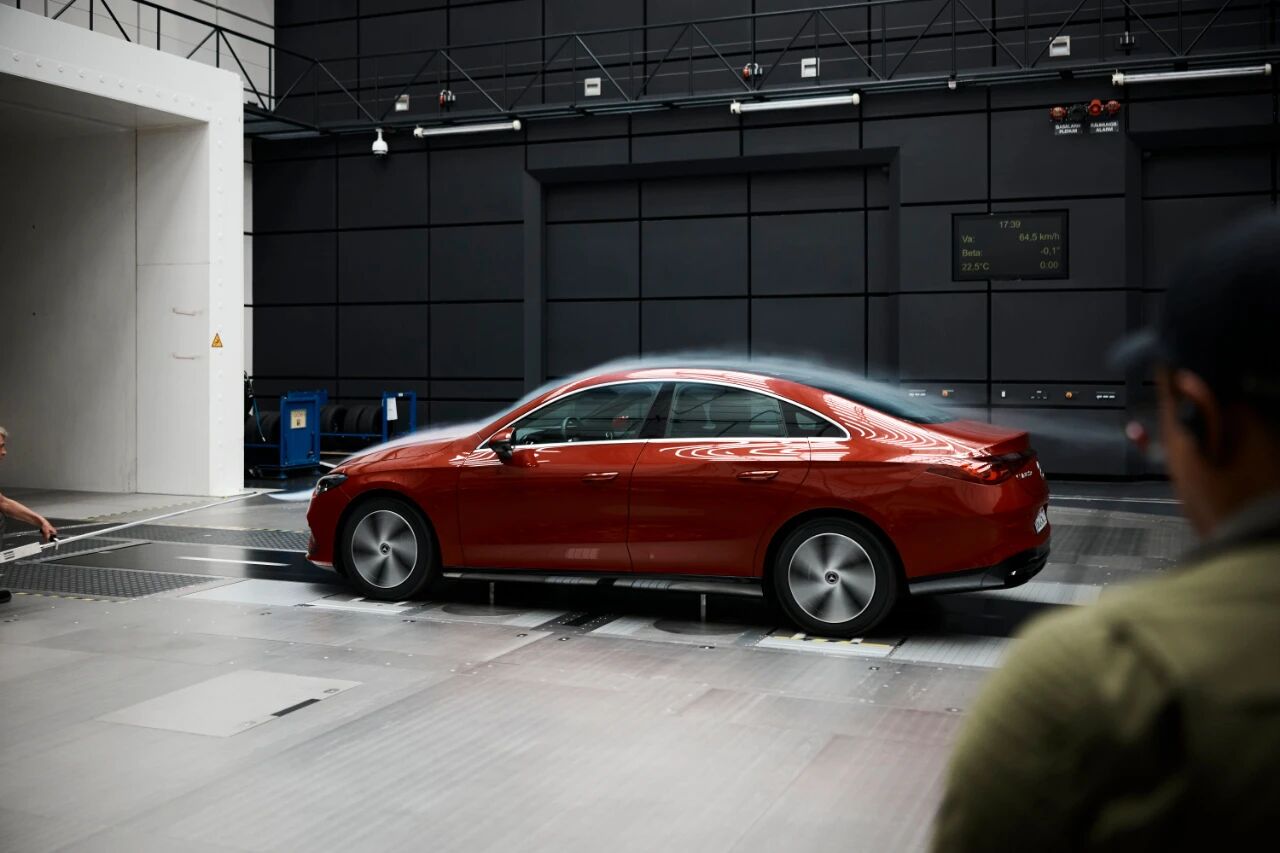
Perhaps the most critical part of the entire wind tunnel is the test hall. At first glance, it seems unremarkable—yet it is quiet and free of turbulence. Under each wheel of the CLA placed in the center, there is a small rotating drum conveyor belt. Between the wheels, there is an additional central rotating drum conveyor belt, 9 meters long and over 1 meter wide.
The speed of these 5 drum conveyors is synchronized with the wind speed, enabling precise simulation of road conditions at speeds of up to 265 km/h.
Another technical highlight is the ultra-sensitive balance used to secure the vehicle. Mercedes-Benz officially states that its weighing accuracy can reach just a few grams.
Data measured by this aerodynamic balance is used to calculate the drag coefficient, lateral forces and lift on each axle, as well as the pitching, rolling, and yawing moments of the vehicle body.
During the final segment of our visit, an engineer took out a hair dryer and gradually increased the wind speed. We watched as the airflow formed an arc along the hood, was disrupted around the wheels and underbody, and created fluid dynamics along the sides of the car. In that moment, the word “rigor” suddenly became tangible.


Conclusion
To sum up: If the acoustic laboratory represents sophisticated taste and aesthetics, the crash test laboratory symbolizes respect for the preciousness of life, then the wind tunnel laboratory embodies Mercedes-Benz’s profound history and its determination to forge ahead amid the tides of change.
And to circle back to our core point: It is only by refusing to compromise that one can truly “Mercedes”—that one can keep moving forward with excellence.
(End)
Discover more from ChinaEVHome
Subscribe to get the latest posts sent to your email.