Xpeng’s 2025 AI Day highlighted breakthroughs in Physical AI, showcasing innovative products like the 2nd-Gen VLA and humanoid robot IRON.
Yesterday afternoon, Xpeng CEO He Xiaopeng hosted a launch event at Xpeng’s new headquarters — but the event felt far removed from a traditional auto show.
The event can be summed up in four words: Physical AI.
Every exciting breakthrough on stage was anchored in Physical AI: 2nd-Gen VLA end-to-end assisted driving, Small-Road NGP, navigation-free roaming Super LCC, the second-generation IRON humanoid robot, factory-pre-installed mass-produced Robotaxi, and more.
Three days earlier, He teased on Weibo:
“When the ingredients of technology accumulate to a certain threshold, once-isolated technical bottlenecks suddenly connect.”
For Xpeng, that threshold lies in fully linking the physical world with silicon via foundation models — and then watching the world open up.
Xpeng was among the earliest Chinese automakers to pursue AI. Back when onboard computing was only about 30 TOPS, He was already convinced that assisted driving would be humanity’s core path toward AI endgame.

Today, onboard computing in smart EVs has crossed into four-digit TOPS territory, and Xpeng sits in the first tier of self-developed compute among mass-production models.
With this launch, Xpeng has begun projecting more than ten years of R&D into real-world scenarios.
Boosted by physical-world foundation models, the event’s highlights arrived in an “explosive” cascade — echoing its theme: Emergence.
As Xpeng continues to hit record deliveries, will this era of emergence and breakout propel the company into the next technology epoch?
A recap of the event reveals the outlines of He Xiaopeng’s AI universe.
Physical AI Opens a New World
We begin at the source of Xpeng’s “emergence”: What exactly is Physical AI?
While the term lacks rigid academic definition, several commonly accepted criteria include:
- Multi-modal input processing (covering images, video, radar, temperature, pressure, IMU, etc.);
- Temporal modeling and prediction (learning historical states to predict future ones, like vehicle trajectories);
- Self-supervised learning (training via prediction/contrast/reconstruction without heavy manual annotation);
- Embodied-intelligence support (for robots, autonomous driving, and other embodied systems).

In other words, physical-world foundation models ultimately move toward true embodied intelligence — AI cognition blended with the real world, where a digital brain made of 0s and 1s interacts with reality at human-level fidelity.
The industry now broadly agrees that mastering these physical-AI foundation models is the key to competing in the next technology age.
Today, He Xiaopeng showcased this key — opening a door to explosive breakthroughs.
In his view, Physical AI marks the fusion of digital and physical worlds and signals a future where machines will understand, interact with, and reshape the real world.

At Xpeng’s new global headquarters, He unveiled four major products — each an embodiment of Xpeng’s physical-world foundation model, signaling a coming decade of drastic change in mobility.
2nd-Gen VLA, More Drivable Worldwide
For general consumers — particularly current and prospective Xpeng customers — the most tangible leap is the first product He introduced and the one closest to mass production.
Xpeng formally released the second-generation VLA model, built on physical-world foundation models.
The core upgrade from Gen-1 is that the “L” in “V-L-A” — Language — has been effectively broken or largely removed.

The VLA path was rooted in the need for interpretability: Vision → Language → Action, a two-step translation.
But translation takes time. It introduces latency, and each handoff loses information.

He posed the industry’s long-standing question: “Can we remove ‘Language’ from the loop?”
Xpeng’s answer arrived: the new “innovative VLA,” targeted for beta rollout in late December.
Removing the language layer means no scene “description” (manual or auto annotation). The model directly understands the physical world — like how humans simply see the road rather than rely on someone reading it out loud.
But that also means stepping from large-language models into physical-world models — a difficult, pivotal leap.

He said the autonomous-driving team only made a major breakthrough in 2nd-Gen VLA during Q2 this year. Only then did Xpeng accelerate 2nd-Gen VLA development and discontinue Gen-1.
Even that half-step led He to believe 2nd-Gen VLA has already opened a new paradigm for physical-world modeling.

He acknowledged that this year’s AD upgrades were conservative, because with the new VLA, “an entirely new door is opening — very likely to become a more universal solution for autonomous driving.”
His confidence stems from efficiency:

Removing intermediate translation lowers latency, increases reaction speed, and boosts frame rates — ultimately raising the safety ceiling.
Physical-world modeling also leads He to a new AI methodology: “AI fuel.”

If foundation models are the AI engine, then data is the fuel — working alongside electric power for chips to propel Xpeng’s new AI phase.
For innovative VLA, Xpeng consumed nearly 100 million video clips — the industry’s first publicly announced nine-digit training dataset for mass-production AD models, equivalent to about 65,000 years of extreme driving scenarios.
Running VLA onboard is powered by three self-developed Xpeng Turing chips, delivering 2,250 TOPS peak compute.
From vehicle-side inference to cloud-side training, 2nd-Gen VLA reflects the same “digital firepower.”

A 30,000-GPU Alibaba-Cloud cluster and a 72-billion-parameter foundation model enable full-stack iteration every five days.

The 2nd-Gen VLA is deemed the “little brain” of smart EVs — an operating system of physical motion. Once past the translation bottleneck, capability emerges rapidly.

For example, 2nd-Gen VLA will launch with a new Small-Road NGP mode and seamlessly integrate highways, cities, and smaller internal-road environments, while better adapting to European road conditions.

Meeting global regulations, the Super LCC navigation-free assisted driving, human-machine shared driving, countdown-based creeping through traffic lights, gesture-based “wave-to-stop,” and other capabilities illustrate its vast potential.

The emergence is strikingly humanlike: A trained driver doesn’t need “highway NOA” or “city NOA” plug-ins. Humans learn by observing and inferring.

“When you push model, compute, and data into a new domain, emergence begins. Solve one problem, and suddenly many previously impossible problems also fall into place.”
The 2nd-Gen VLA will also benefit the wider industry.

Xpeng will open-source 2nd-Gen VLA and deepen collaboration with Volkswagen to deploy the model and Turing chips in VW-brand vehicles.

Xpeng Robotaxi to Launch in 2026
The next major product under the Physical-AI umbrella is Xpeng’s Robotaxi.

With the Physical-AI system unlocked, He announced a major move: Xpeng will launch three Robotaxi models in 2026.
The specific naming and positioning remain unknown, but all will leverage 2nd-Gen VLA and Turing chips to deliver L4 services.

Each standard Robotaxi will feature four Turing chips with 3,000 TOPS of compute; one chip serves as redundancy.
Redundancy extends to compute, steering, perception, energy, braking, and communications.

With the VLA + VLM stack, Xpeng’s Robotaxi also gains stronger external-interaction ability: it can better understand pedestrians — and pedestrians can understand it.

Interestingly, the three Robotaxi models will include B-to-B fleet models and C-to-C models for private buyers seeking L4 capability “for personal use.”
Robotaxi becomes the top tier of Xpeng’s AD product matrix:
- Max = single Turing / dual Orin
- Ultra = triple Turing
- Robo = four Turing + full redundancy

He explained the business model:
“For quite a long time, many people won’t choose purely shared L4. They’ll prefer to buy a private car with L4 hardware/software but share it within their family — a ‘private-sharing’ model.”
He argues that transitioning from L2 OEM to L4 operator offers cost and generalization advantages, including wider operation ranges and lower factory-install costs.

“To scale Robotaxi commercially and expand globally, automakers must participate directly,” said He. As a full-stack hardware-software developer, Xpeng is naturally positioned.

Xpeng’s driverless-mobility pilot service will begin in 2026, starting from Guangzhou and expanding nationwide — and potentially overseas.

Xpeng’s AI Universe: Robotics Comes Full Circle
Driverless mobility and humanoid service — these words summarize how AI will reshape everyday life.

The latter refers to robots.

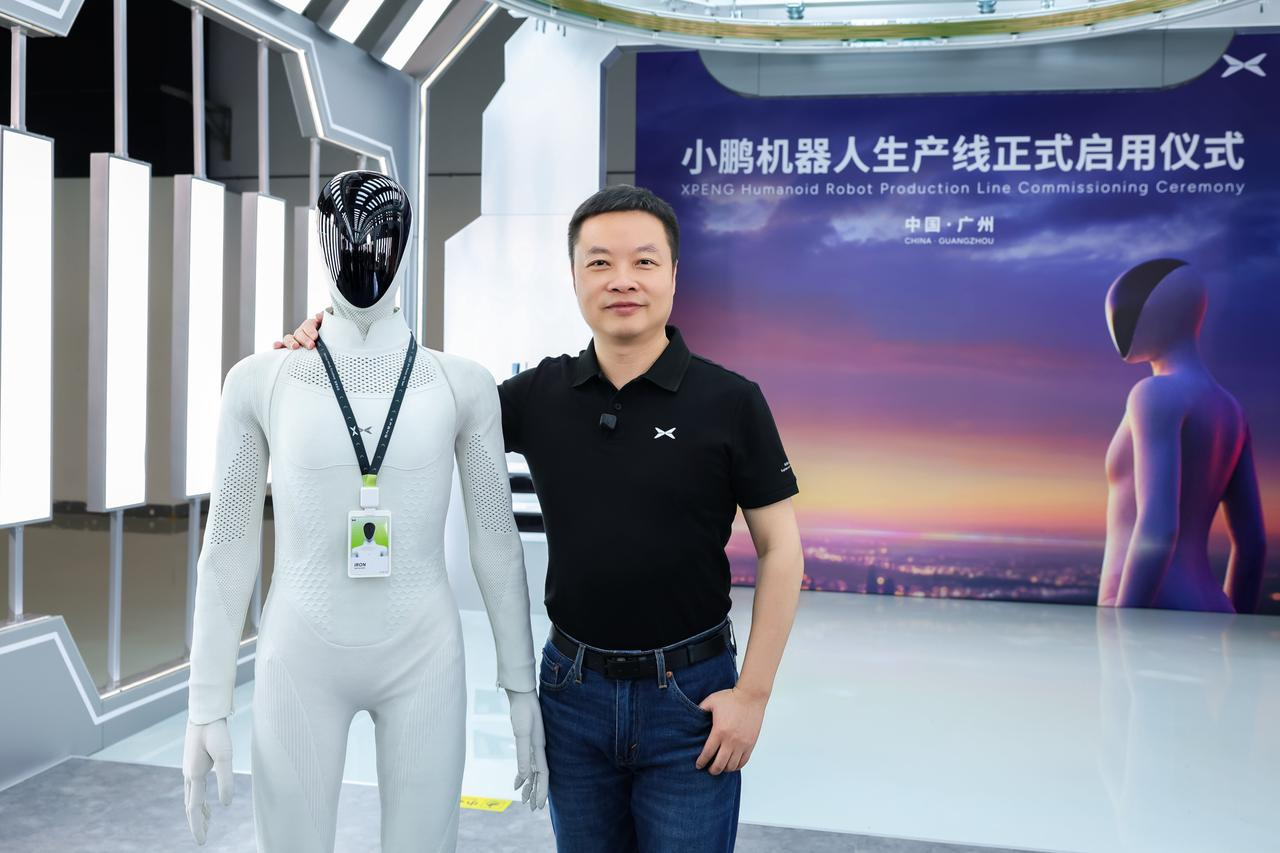
This marks the seventh iteration of Xpeng’s robotics roadmap. He unveiled the most humanlike robot Xpeng has built: the new IRON.

The new IRON signals Xpeng’s firm commitment to humanoid robots. Data thinking in the AI era strongly influenced this choice:
If not humanoid, you cannot collect meaningful human-space data for training.

Start-ups are always a series of choices.
Xpeng is not the only automaker entering robotics. But without deep hardware/software integration, data loops, and large-model capability, traditional OEMs will find that — unlike auto, where suppliers dominate software — “robot software suppliers essentially are robot manufacturers.”

Choosing the humanoid path enables Xpeng to gather real human-environment data and leverage its data-loop advantage.

Back to IRON: it embodies a long list of “humanlike” elements — even mimicking a skeletal–muscle–skin construction.

A compact skeletal frame, lattice materials acting like muscle, seamless haptic-capable skins, and a large 3D curved head display are among the components.

The new IRON drew huge applause — not only for its lifelike form but also for improvements in posture and gait over the previous generation.

Human biology is the pinnacle of natural science. Recognizing this, Xpeng has invested heavily to replicate subtle human details.

Examples include a bio-inspired spine, 1:1 human-hand structure, 22-DOF dexterous hands (vs. 27 for humans), shoulder shrug and chest-folding motions, and a new shoulder-back structure inspired by automotive chassis systems.

As embodied intelligence, IRON is also notable in specs.

Powered by three Turing chips with 2,250 TOPS, IRON debuts the VLT model.

T here refers to Task and Thinking — indicating deeper reasoning and autonomous decision-making.

No need to worry about sci-fi scenarios. He, a former engineer, expanded Asimov’s famous three laws with a fourth:

A robot shall not disclose human private data unless such disclosure conflicts with the First Law.
Beyond software safety, hardware safety is also prioritized.

IRON is the first announced humanoid robot powered by all-solid-state batteries. He believes humanoid robots could drive mass adoption of solid-state cells because service robots operate in intimate spaces where safety is paramount.

IRON is in final mass-production prep. He’s timeline: by end of Q1 next year, software and hardware will enter consolidated mass-production prep.

He predicts that robot-related shifts in employment — like robot training or guiding — could begin the following year.
But he argues that IRON is not well-suited for “bolting parts,” a commonly imagined use case. Instead, initial roles will be in consulting, guiding, and patrolling.

If IRON enters scaled mass-production by the end of next year, He says Xpeng will undergo a major dimension shift.
Emergence and Execution
He grew increasingly animated on stage — a founder electrified by technological leaps after a decade in China’s EV start-up arena.

The 100-minute event was densely packed; many highlights remained unspoken.

For example, Xpeng HT Aero introduced a new six-seat, tilting-fixed-wing flying vehicle A868, powered by Physical AI + 2nd-Gen VLA, now in test flight. The ground-carrier vehicle will enter mass production in 2026.

Such broad-scope, forward-looking announcements inevitably bring a common question: “Why announce now?”

This question has followed He and the EV start-up wave for a decade.

In 2019, he said, “The essence of smart EVs is operations, and software is the core of operations.” Today no OEM can ignore software-hardware integration.
At 2023 AI Day, he said OEMs would need to invest billions to expand compute. Today, every OEM is asked: “How many GPUs do you have?”

The 2020s belong to AI and driverless mobility. He believes in trends — and trends require ignition points.
This year’s theme was “Emergence,” built on Physical AI. The ignition points are the products Xpeng unveiled.

Will this emergence help Xpeng seize the next lead?
Mass production will give the answer.
Discover more from ChinaEVHome
Subscribe to get the latest posts sent to your email.