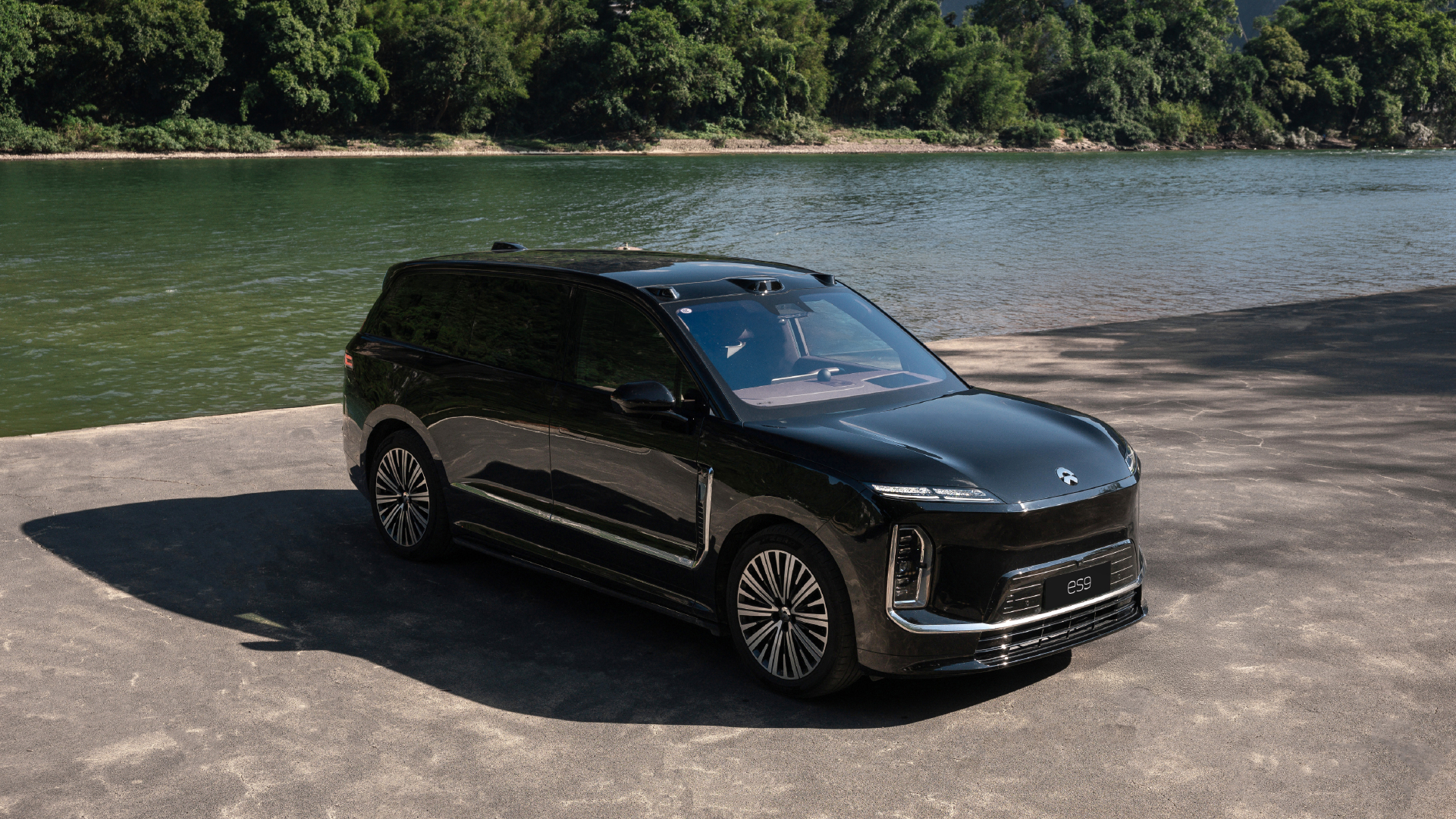
On the afternoon of June 18, one day before the Dragon Boat Festival holiday, NIO began rolling out a new version of its World Model system.
Internally, the update is referred to as World Model 2.5. The company has not publicized the label, as it is still considered part of the second-generation framework.
According to internal expectations, a third-generation system may arrive in the second half of the year.
This NWM 2.5 release introduces two notable changes.
First, it adopts a new architecture built on a full “world model + supervised fine-tuning + closed-loop reinforcement learning” three-layer training framework.
It also marks what NIO describes as the first domestic implementation of an intelligent driving system that directly outputs steering and acceleration/braking control signals, rather than generating sampled trajectory paths.
This distinction is significant.
It represents, according to NIO, the first domestically deployed end-to-end kinematic modeling approach of its kind.

The company argues that direct control signal output reduces path length and latency, improving responsiveness and producing a more human-like driving experience through finer vehicle control.
NIO describes this as “the underlying control foundation for the next-generation intelligent driving system.”
Second, the update is being pushed to around 700,000 users across platforms and vehicle models. In practical terms, this includes NT2.0 vehicles that began deliveries four years ago, such as the 2022 ET7.
NIO characterizes this capability as a “one-brain, multi-use” system enabled by cross-platform and cross-model generalization, without requiring retraining or fine-tuning.
In the author’s recollection, large-scale cross-platform deployment of this kind is also a first in China’s automotive sector.

The rollout began around 10 a.m. on June 18. Feedback gradually emerged across NIO owner communities, and by the afternoon of June 19, responses were largely positive.
While some users remained critical, the dominant sentiment in community discussions was that “momentum is building, and praise for the updated system is spreading across all groups.”

Looking back to June 17, NIO held a technical media briefing at its NIO House in Zhongguancun, Beijing, focused on its intelligent driving system engineering stack.
Senior Vice President Shaoqing Ren led the session, joined by two engineering and product PhDs, Shaoxiao Li and Wei Lin.
The team covered topics ranging from sensors and chips to in-house compiler design, followed by a two-and-a-half-hour Q&A session.
After the intensive presentation, Ren—who appeared visibly exhausted and even briefly emotional during the Q&A—prompted a broader reflection:
Ren Shaoqing’s foresight and persistence have brought NIO to what now appears to be a potential breakthrough moment in intelligent driving.
This article, similar to a prior deep dive five months ago on NIO’s algorithm evolution—Exclusive: Inside NIO’s World Model 2.0 and the Paradigm Shift in Autonomous Driving, is intentionally technical and detailed.
Readers are advised accordingly.
NIO’s “Foresight”
The story begins with the ET7, a vehicle first unveiled at NIO Day in January 2021.
It initially sparked controversy and ridicule. One defining feature was its “watchtower-style” lidar mounted on the roof, which at the time was highly unconventional.

Internally, NIO evaluated three possible lidar placements:
- On the bumper, minimizing design impact
- Inside the cabin, with performance and cost trade-offs
- On the roof, offering best performance and lowest maintenance cost, but challenging vehicle design
NIO chose the roof-mounted approach.
Ren recalled that internal debate was even more intense than external criticism. Ultimately, CEO William Li made the final call.
Li reportedly argued that if this direction was technically optimal and aligned with long-term development, it represented an opportunity to break conventional automotive design boundaries.
He emphasized that creating breakthrough industrial design in automotive history is extremely difficult, and NIO should seize the opportunity.
Six years later, Ren said the decision had a profound impact on him, especially as he had only recently joined the company at the time.
He summarized the philosophy:
If a direction is correct and aligns with a 5–10 year trajectory, short-term issues should not prevent execution. Time will validate the decision.
Today, roof-mounted lidar has effectively become an industry standard, with even derivative “pseudo-watchtower” designs appearing across competitors.

The ET7 also faced skepticism for deploying four Nvidia Orin chips, compared with the industry norm of two.
Critics questioned whether this reflected inefficiency or unnecessary overengineering.
Even by 2023, despite NIO’s discussions around “collective intelligence,” such skepticism persisted.
The same applied to sensors.
NT2.0 vehicles such as the ET7 adopted seven 8-megapixel cameras. At the time, lower-resolution cameras were more common due to cost and processing constraints.
Ren explained that NIO’s assumption was that highway navigation was only the first stage, and urban driving would soon become the dominant scenario.
Urban environments require higher-resolution sensing to capture traffic lights, distant signage, and subtle lane-level details.
The conclusion was clear:
Sensor quality and resolution would become structurally important over time.

NIO therefore chose to front-load hardware capability and wait for software to catch up.
This was not “over-specification,” Ren argued, but a deliberate decision focused on long-term user experience.
He described automotive hardware as inherently a 5–10 year lifecycle asset. The challenge is extending the usable life of electronic systems within a vehicle architecture.
NIO’s target, he said, was to ensure usability across at least two product generations.
This is also why today’s system update can still support vehicles delivered four years ago.
The Cost of Long-Term Thinking
Such forward-looking strategies inevitably faced resistance.
Between 2023 and 2025, NIO’s intelligent driving team, including Ren himself, came under significant external and internal pressure.

Competitors such as Huawei promoted nationwide availability, XPeng advanced end-to-end models, and Li Auto popularized “point-to-point” assisted driving.
NIO’s full-scale rollout of NOP+ only began in April 2023, leading to frequent criticism that it had fallen behind.
Rumors of organizational restructuring in 2024 further intensified scrutiny, including claims of internal friction around its end-to-end transition.
Ren did not detail those conflicts publicly, but described a “painful phase” during which the organization transitioned from a highly standardized pipeline structure to a more innovation-driven system.

He framed the evolution in four stages of technological development:
- Unclear objectives and evaluation metrics
- Clear direction but no convergence of technical path
- Converged architecture competing on scale and resources
- Late-stage optimization focused on product refinement
By 2023, the industry appeared to be in stage three. However, NIO believed the field had reverted to stage two, reopening space for architectural innovation.
This led to the World Model approach.
In late 2023, NIO began internal development of its World Model system.
At the time, industry attention was focused on end-to-end driving, large multimodal models, and emerging VLA frameworks.
NIO’s goal, Ren said, was to build a self-supervised system capable of unified multimodal representation without extensive labeling requirements.
However, the decision came with trade-offs.
Between 2024 and 2025, as performance lagged behind competitors, the team faced sustained criticism from both external observers and internal stakeholders.
Even after the World Model 1.0 rollout in May 2025, frustration peaked among some users.
Only after World Model 2.0 launched in January 2026—introducing large-scale closed-loop reinforcement learning into production—did user sentiment begin to shift.
The latest update further refines the system into a three-layer framework combining world models, supervised fine-tuning, and reinforcement learning, with positive feedback beginning to dominate.
At the Zhongguancun session, when asked about rumors of his departure, Ren smiled and said:
“The people who said I was leaving have already left.”
Compilers, Bandwidth, and Compute Architecture
Ren’s June 18 briefing focused less on algorithms and more on system infrastructure: compilers, chips, and data architecture.

In-house AI compiler
NIO began developing its AI compiler in 2020, when industry practice relied heavily on Nvidia’s toolchain and manual operator optimization.
Ren described the inefficiency as engineers repeatedly rewriting code whenever algorithms changed.
NIO instead built a compiler capable of automatic operator optimization and cross-layer integration.
Results included:
- Model development cycles reduced from 1–2 weeks to 1–2 days
- Inference performance improved by over 20%
- Deployment cycles reduced from days to under two hours
One engineer noted that unlike traditional companies, NIO had no dedicated operator optimization team—only a compiler team, which initially appeared unconventional.
By 2023–2024, however, the industry began discussing similar approaches.

Memory bandwidth strategy
In 2022, during early development of Nvidia’s Orin platform, NIO anticipated a shift from CNN-based models to Transformer-based architectures.
The key difference, Ren said, is not compute but memory bandwidth requirements—Transformers demand 8–70 times more bandwidth than CNNs.
Based on this assumption, NIO’s in-house chip design targeted over 500 GB/s of memory bandwidth, roughly twice current flagship levels.
Ren illustrated this using a language model analogy involving a 7B parameter model requiring ~500 GB/s bandwidth under ideal inference conditions.
By the time the chip entered mass production in 2025, Transformers had become dominant in autonomous driving architectures.

Data system and compute loop
Ren illustrated a nonlinear relationship between data and performance:
- +3% performance requires 10x data
- +6% requires 100x
- +18% requires 1,000,000x
While this ensures continuous improvement, it is economically unsustainable.

NIO’s solution is a “fleet intelligence validation system,” using hundreds of thousands of production vehicles instead of dedicated test fleets.
Each NT2 and NT3 vehicle can contribute idle compute resources for simulation and corner-case discovery.
This system improves validation efficiency by 2.4x compared to isolated platform testing, with over 40 million km of monthly safety validation.
Ren summarized:
Data is not replication—it is compute.Because the truly valuable data is not the raw video collected by vehicles, but the corner cases relevant to a specific model.
Identifying those cases requires continuously running models on vehicles and constantly filtering for meaningful scenarios. That is why Ren refers to it as a “vehicle-side compute orchestration system.”

Ultimately, all three of these efforts point toward the same objective: building the foundation.
Only by establishing a robust underlying foundation can a company continue to validate and identify the right algorithmic architectures amid the rapid technological shifts and architectural iterations that have defined the intelligent driving industry over the past three to five years.
A strong foundation is what enables new algorithmic frameworks to be deployed, tested, and refined at scale as the technology landscape evolves.
End-to-End Control and System Integration
Earlier in January, Ren described intelligent driving evolution in three stages:
- Code 1.0: rule-based systems
- Code 2.0: data-driven learning
- Code 3.0: reinforcement learning in simulated environments
The latest NWM release marks the first domestic implementation of direct control signal output—steering and acceleration/braking commands—rather than trajectory sampling.

The next step, Ren said, is integration with the chassis domain.
This is not merely signal forwarding. Traditional architectures introduce latency through multiple abstraction layers between systems.
True integration requires real-time sharing of suspension state, steering angle, and braking pressure directly into the driving model’s control loop.
This is only possible with full in-house control of both chassis and intelligent driving systems.
NIO’s goal is to eliminate translation layers and reduce latency at the system level.In hindsight, NIO product manager Niu Meimei foreshadowed this as early as May 29.

While responding to doubts raised by an automotive blogger at the time, NIO’s social media account @AD 我是牛梅梅 laid out three core points:
- The current model no longer generates steering, acceleration and brake pedal inputs by “translating” pre-planned driving trajectories. Instead, steering, acceleration and brake commands can collectively generate a corresponding trajectory. Put differently, trajectories used to serve as the intermediate process, whereas they are now an end outcome. There is no contradiction between the model outputting control signals and trajectory-based fallback safeguards.
- NIO’s in-house developed intelligent chassis features universal interfaces for upper-level control systems. Signals generated by the NWM are transmitted to vehicle-wide application software via these standardized interfaces, with the intelligent chassis system completing chassis and vehicle adaptation tailored for different vehicle models. This exemplifies the advantages of NIO’s full-stack in-house R&D and full-domain integration: all teams develop under a unified digital architecture and vehicle-wide operating system with seamless internal communication and no interoperability barriers.
Most critically, her third point read: “We now bypass trajectory planning to output direct driving commands directly. Could we move toward even more fundamental, lower-level outputs down the line? Who can tell?”
Sources speaking to ChinaEV Home also indicate that NIO will roll out a major version upgrade for its NIO World Model in the second half of this year.
Closing Notes: Two Questions on the Future
At the briefing, Ren addressed two key questions.
On VLA versus world models, he acknowledged that VLA delivers short-term gains and ecosystem compatibility but argued it remains a “limited path” far from fully mapping real-world data into model capability.
On Tesla’s FSD entering China, he said it would strengthen confidence among Chinese firms:
“It is beneficial for rational evaluation of our own technological confidence… it shows we can compete with the best globally.”
Ren also noted he still drives an NT2 ET7 and considers it meaningful that a four-year-old vehicle can still receive state-of-the-art software.
Perhaps, he reflected, this long-term persistence is finally beginning to be validated.
The rollout includes over 700,000 users, including early ET7 owners.
This, he said, is what “worth it” looks like.

In his post on the NIO App announcing the rollout of the new software version, Ren opened with this line:
“Customers who bought their vehicles as far back as four years ago can now experience our newest, most advanced technological achievements.”
It was clearly something he had long wanted to say. Rewind four years to the ET7’s launch: its roof-mounted LiDAR became the butt of internet memes, people repeatedly debated whether its four Orin chips represented good value for money, and the World Model was dismissed as nothing more than an empty promise.
Today, the Watchtower sensing setup has become an iconic intelligent driving design, the World Model has emerged as a mainstream autonomous driving algorithm, and vehicles four years old are receiving cutting-edge software updates.
Ren remarked: “Once we decide a direction is the right one, we should forge ahead even if there are existing issues and conflicts. Time will prove everything.”
That said, amid widespread recognition for this new version, there has also been no shortage of criticism.
That explains the framing of our headline: NIO has caught a glimpse of hope for victory..
Discover more from ChinaEVHome
Subscribe to get the latest posts sent to your email.