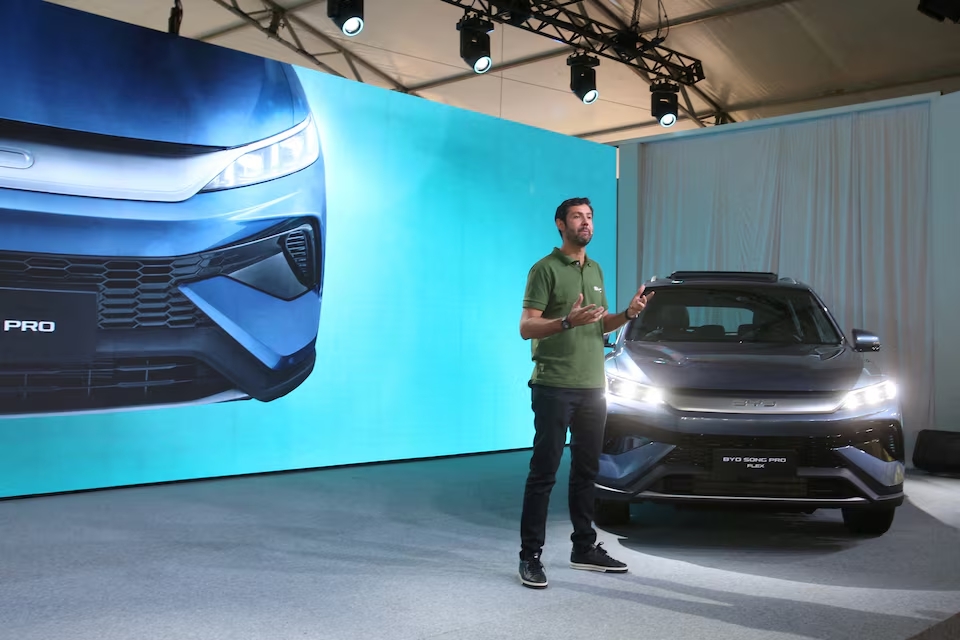
- BYD launches Song Pro Super-Hibrido Flex Fuel, Brazil’s first locally made flex‑fuel PHEV.
- Model runs on electricity, gasoline, and ethanol with 60–120 km electric range across trims.
- Camaçari plant hits >50% local content, backing BYD’s $1.07B investment and 180,000 annual capacity.
BYD has officially launched the Song Pro Super-Hibrido Flex Fuel, the company’s first locally produced flex-fuel plug-in hybrid vehicle in Brazil, according to a Reuters report.
The model is also BYD’s first passenger vehicle developed specifically for the Brazilian market that is compatible with three energy sources: electricity, gasoline and ethanol.
According to Alexandre Baldy, Senior Vice President of BYD Brazil, the vehicle took two years to develop with total investment of approximately 100 million Brazilian reais ($19.6 million).

The entry-level GL variant offers an all-electric driving range of 60 km, while the higher-spec GS version extends the electric range to 120 km. The model began arriving at dealerships across Brazil on Wednesday.
Unlike conventional plug-in hybrids sold in most global markets, the Song Pro DM Flex Fuel has been specifically adapted to Brazil’s energy infrastructure.
Brazil has one of the world’s most mature ethanol fuel markets, where ethanol-powered vehicles have long accounted for a significant share of sales.
The new model is therefore engineered to operate on ethanol as well as gasoline and electricity.
Production takes place at BYD’s Camaçari plant in Bahia state in northeastern Brazil.
More than 50% of the vehicle’s components are now sourced locally, meeting BYD’s previously announced localization target.

The company has already localized procurement of components including tires and plans to add battery production and additional component manufacturing lines at the facility.
BYD entered Brazil’s passenger vehicle market in 2021, initially relying on semi-knocked-down (SKD) assembly.
After the Camaçari plant officially began operations in October 2025, the company accelerated its localization strategy.
The move is intended not only to meet Brazil’s local industrial policy requirements but also to establish the country as a key manufacturing and export hub for South America.
Baldy said that although the ethanol-compatible Song Pro was developed specifically for Brazil, the model could eventually be introduced in other overseas markets, including India, as ethanol fuel adoption expands globally.

BYD has invested a total of 5.5 billion Brazilian reais ($1.07 billion) in the Camaçari plant.
The facility is expected to reach an annual vehicle production capacity of 180,000 units this year.
Baldy said BYD is targeting sales of approximately 200,000 vehicles in Brazil this year, with around 150,000 units expected to be supplied by the Camaçari plant.
BYD continues to post strong sales growth in Brazil. According to data from ANFAVEA, the company sold 23,465 vehicles in July, up 142.4% year-on-year.
This hit a record high since entering the Brazilian market, with market share rising to 9.1%, making BYD the fourth-largest automaker in Brazil.
Among its models, the Dolphin GS sold 5,861 units during the month, making it the best-selling retail passenger vehicle in the Brazilian market.
Discover more from ChinaEVHome
Subscribe to get the latest posts sent to your email.