- Aion launches Ray7 as first car with new logo, targeting mid-to-high-end sedan buyers.
- Ray7 integrates Huawei DriveONE motor system, CATL battery and Aion’s Magazine Battery for up to 700 km CLTC.
- Car packs 27 sensors, 192-channel LiDAR and WeRide-derived algorithms for advanced driver assistance.
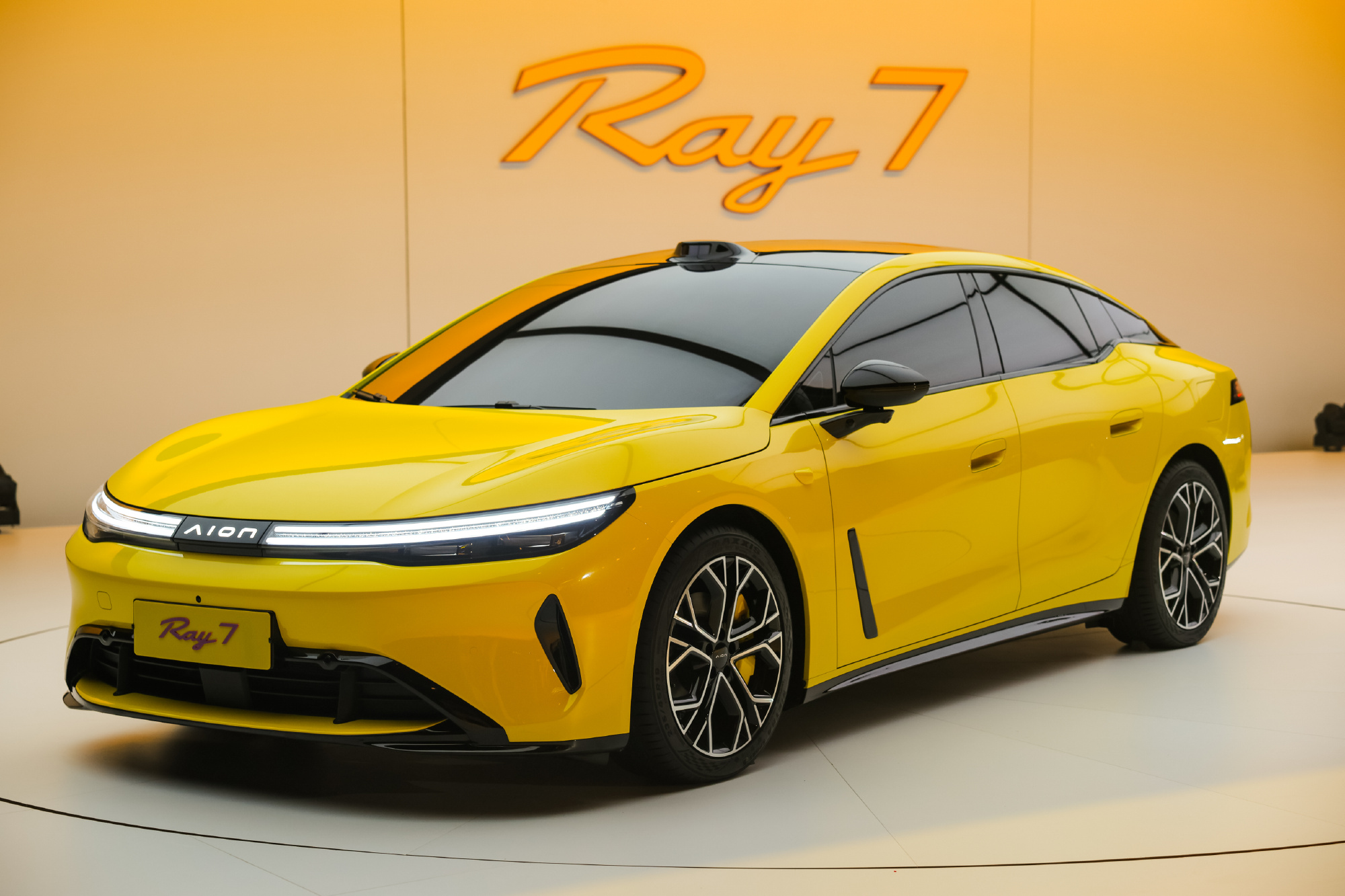
Aion unveiled the Ray7 on Aug. 19 at its “Super Electric Launch Night,” making it the first model to carry the brand’s new logo.
The Ray7 is positioned as a midsize-to-large battery-electric sedan and the first model under Aion’s new Ray series.
Zhang Xiong, president of GAC Group’s Hyptec-Aion BU, said the Ray series will eventually span multiple segments, including sedans and SUVs.

The Ray7 adopts a new family design language, featuring a “Quantum Star Ring” front-end design, a full-width light bar and an illuminated logo positioned at the center of the nose.
The car uses semi-hidden door handles and full-width taillights, and will be offered in Lightning Yellow and Midsummer Purple.
Compared with the more recognizable design cues of previous Aion models, the Ray7 places greater emphasis on a younger and sportier appearance.
The Ray7 measures 4,960 mm in length, 1,900 mm in width and 1,455 mm in height, with a wheelbase of 2,920 mm.

Unlike some previous Aion models that relied primarily on the company’s in-house technology, the Ray7 adopts Huawei’s electric-drive technology.
The model is equipped with Huawei DriveONE integrated electric drive system, combined with Aion’s new thermal-management system and 28-in-1 thermal-management module.
The Ray7 uses a CATL battery paired with Aion’s second-generation Magazine Battery technology, delivering a CLTC-rated range of up to 700 km.
Advanced driver-assistance technology is another key feature. The Ray7 comes with 27 automotive-grade sensors and a 192-channel LiDAR.

The algorithms also share with a foundation model derived from the technology used in WeRide’s L4 Robotaxi system.
The Ray7 will target China’s roughly RMB 200,000 ($29,700) battery-electric sedan segment, with potential rivals including Xiaomi’s SU7, Zeekr 007 and SAIC Z7.
For Aion, the Ray7 also plays a role in reshaping the brand’s product portfolio.
Hyptec-Aion BU’s retail sales reached 34,987 units in July, up 31.74% year on year, extending its year-on-year growth streak to five consecutive months.
At the same time, the mainstream Aion brand needs new product lines to expand its presence in the mid-to-high-end market.
Discover more from ChinaEVHome
Subscribe to get the latest posts sent to your email.