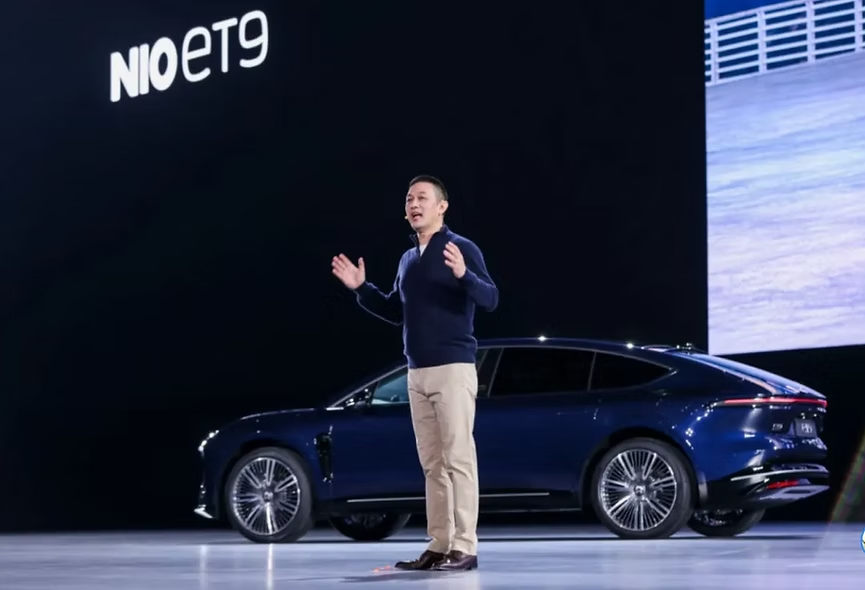
On the afternoon of March 23, NIO conducted a closed-door executive briefing at Beijing’s Haidian Rongke Information Center.
Founder and CEO William Li engaged in a three-hour strategic dialogue with select media representatives from over a dozen financial and industry outlets. The session focused on addressing critical market concerns regarding NIO’s organizational restructuring initiatives, Q4 profitability roadmap, and operational transformation strategies.

The following is the full record of the meeting and Q&A, with some content omitted.
Profitability a Must in Q4
William Li:
The increase in sales is mainly driven by several key engines.
First, it’s a product-driven year. The auto industry relies heavily on products. Without good ones, nothing else matters. If the product is right, other shortcomings are tolerable. The ET9 will be delivered on March 28th. The 2025 models of the “5566” (ET5, ET5T, ES6, EC6) will follow from May to June. In the fourth quarter, NIO will launch another significant model.
Honestly, from 2022 to 2024, during the second – generation product cycle, we learned a lot.
For the third – generation product, we’re China – market – focused. We’re making the car bigger and adding visibly valuable features.
This Q4 new product has a competitive definition and cost – setting, and features our latest tech. Among NIO’s six new models for this year, it’ll help us regain market prominence and secure our market share.
The ONVO L60, a new car, has strong competitiveness and is gaining orders steadily. Despite challenges, it leverages technology to optimize space. The upcoming L90, to debut at this year’s Shanghai Auto Show, offers innovative space and experience through technology.
Our global first automotive – qualified 5 – nm chip has powerful computing power, leading in intelligent – driving chips for a long time. We first launched Orin – X in 2022. Last year, we bought $300 million worth of NVIDIA chips, 800,000 units, 4 per car, and used them in ONVO vehicles.
Looking at the past three years, large SUVs with range – extended (EREV) powertrains have sold well. This is because China’s tax system doesn’t limit the market size of EREVs or plug – in hybrids. For conventional fuel vehicles, engine displacement and consumption tax are issues. Large – displacement engines lead to high consumption taxes. In contrast, EREVs, with their 1.5T displacement, pay much less consumption tax. As vehicles get larger, the layout of EREVs also requires a bigger body.
At this year’s Shanghai Auto Show, we’ll unveil a new car tailored to the daily needs of Chinese large – SUV users. It fully leverages the benefits of pure – electric power and integrates NIO’s technological innovations. Given these strengths, I’m highly confident about its sales potential.
We’ve conducted several rounds of confidential user research in various cities, focusing on current large SUV users. Many users remarked that they would have chosen our upcoming model had it been available earlier. The new product will be unveiled in a month. I hope when you see it, you’ll recognize the technology behind it.
ONVO is set to launch a large five – seat SUV, possibly named L80. The L90 will be delivered in Q3, and the L80 in Q4. These three ONVO models are all family – user – oriented. The brand’s momentum will gradually return. We’re well – prepared and ready to make our move.
The Firefly, originally designed for Europe, is now also launched in China due to tariff issues. With deliveries starting at the end of April, it has an 8 – month product cycle this year.
This year marks significant technological advancements for us. The ET9 features 17 globally leading first – launched technologies. Some are tangible, like the SkyRide intelligent chassis, full – active suspension, fully – active hydraulic integrated suspension, and steer – by – wire. The ET9’s strengths in intelligence, especially its chips and operating system, are crucial. Our chip R&D cost could fund 1,500 battery – swap stations, and the operating system R&D cost could cover over 1,000.
As scheduled, the ET9 is in mass production and delivery. The major bottleneck is not the visible components but the chip and OS compatibility. The in – vehicle CDC and domain controllers all use NIO’s own OS. Integrating them is quite challenging. The ET9, our most functionally complex model with the longest development cycle of four years, required this integration.
A year of technological advancement will definitely boost sales as it translates into user value.
Third, our charging and battery – swap network. This year is a big one for NIO’s battery – swap station construction. If I could go back two or three years, I’d be more proactive in building swap stations. We should have achieved “Battery Swap Access in Every County” last year, but we’re a year late. Sometimes we should save when we can and spend when necessary. Because we’ve seen that battery swapping boosts sales through network effects, not just individual stations. We did underestimate the impact of swap stations on sales and their network effect.
The Jiangsu, Zhejiang, and Shanghai regions account for 50% of NIO’s sales. In Zhejiang, cumulative sales reached 100,000 units last July; in Jiangsu, last December; and in Shanghai, this month. So half of NIO’s sales come from these three regions. One – third of our swap stations, 1,000 in total, are located there, showing the significant impact of swap stations on sales.
Previously, our battery – swap department had to watch the budget since 60 orders meant break – even, 30 meant a loss, and 10 made it unworkable. But this is a “chicken – or – egg” dilemma. This year, we’ve introduced a new rule: if a store or regional company wants to build a swap station in a county to help provincial sales, they can fund it themselves, even with no users yet. They just need to pay the energy company. This is the advantage of our basic business unit approach.
Malin, NIO’s assistant VP of brand and communication, is funding a battery swap station on National Highway 318 to enhance brand influence. This station, with only five orders a day, wouldn’t be viable for the NIO Power department to build. But Ma Lin can cover the costs from the brand communication budget. This is an example of a basic business unit, where the purpose of spending is clear.
This year, we’ve evaluated 10,000 potential sites across China, calculating their ROI, including vehicle sales and battery swap service fees. New swap stations are built based on this logic, mainly to boost vehicle sales. We’ve ranked these 10,000 sites by ROI, considering vehicle sales, service fees, and brand impact. Over half have an ROI greater than 1, meaning the investment can be recouped in the same year.
Now, regional companies are taking the initiative to build swap stations. Previously, the company operated on a budget system, but now it’s switched to a management system focused on business objectives and plans. Everything, from a store or regional company to a R&D project or marketing campaign, must calculate its ROI. This is why they avoid renting meeting rooms and use their own instead, to keep the ROI high. We’ve transformed into a company that’s very financially savvy.
The cooperation between NIO and CATL signifies that battery swapping is becoming a mainstream energy – replenishment method. Despite few Chinese companies being willing to engage in such collaboration, both NIO and CATL have invested in battery – swapping, with CATL developing the “Chocolate” swap – battery system over several years. Now, their decision to collaborate combines their networks, serving different market segments: NIO targets the mid – to – high – end market, while CATL focuses on the economy – segment with its cost – effective chocolate batteries. This swap – battery track is somewhat analogous to the big two oil companies.
Previously, there was discussion that NIO’s battery – swapping might lose competitiveness due to CATL’s entry into this field. However, our collaboration with CATL has put an end to this discussion. It goes beyond capital – layer cooperation, involving mutual technical and service – system empowerment, as well as battery – operation cooperation. In fact, we jointly established Battery Asset Company Power NIO in August 2020, which has been running well.
The battery – swapping mode aligns with China’s distributed energy strategy. That’s why a minister from the Ministry of Industry and Information Technology emphasized the significance of battery swapping at a State Council news conference a few years ago. Currently, there’s significant policy support, such as excluding rental batteries from the purchase – tax calculation base for cars. After the purchase – tax subsidy reduction, this serves as a substantial subsidy for users.
NIO currently operates 3,188 battery swap stations. To achieve “battery swap access in every county” this year, 1,800 to 2,000 more stations are planned. Funding comes from NIO’s charging partners program, launched last year, where partners build stations while NIO handles leasing and operation. NIO collaborates with many state – owned enterprises, such as CNPC, Sinopec, and CNOOC, as well as provincial highway groups, urban investment firms, and power grids like China Southern Power Grid Storage. For instance, in October last year, NIO partnered with Shouyi Technology Innovation Investment in Hubei to build 100 stations, and in early last year, it teamed up with Anhui Waneng to construct 1,000 stations in Anhui over three years. In 2025, NIO will work with Shaanxi Investment Group to achieve “battery swap access in every county” in Yan’an.
This year, most of the funding for new swap stations will come from partnerships rather than NIO. These partnerships, involving leasing and operation, allow NIO to reduce capital expenditure while partners earn profits, with each party leveraging their strengths.
The maturation of NIO’s sales – service network this year is crucial for sales support. For instance, ONVO opened 100 stores in September last year and added over 100 more by year – end. By late March this year, it had 450 stores and sufficient staff, demonstrating sales – capacity building. The Firefly, sold under the NIO brand, doesn’t face this issue, as it’s easier and quicker to launch.
International expansion also boosts our sales. We plan to enter 25 countries and regions this year, which seems achievable. Previously, we over – invested in Europe and learned a lot. In 2021, we started selling in Norway with remote hiring in Munich. We shipped cars from China, opened stores, hired and trained staff, and sales were good. This led us to believe we could scale up in Europe. Despite the 2022 pandemic, we decided to expand into five European countries, but it turned out to be a costly lesson.
It’s important to note that although Norway is in Europe, it differs significantly from other European countries as it’s not an EU member. Using Norway as a substitute for Europe led to our misjudgment. We’ve invested heavily in Europe over the years. However, we didn’t expect that in countries like Europe and Germany, it would take as long as 10 months, or even a year, to build a battery swap station. The slow development of the sales – service network there means higher costs, which has cost us dearly.
We’ll change our strategy. For ONVO, Firefly, and NIO brands entering global markets, we’ll seek local partners in each country, not dealers, to operate using NIO’s direct – sales model with their existing resources. This means almost no initial investment for us; even if there is some, the partner covers it. We now calculate expenses more carefully, even for functional changes.
Lihong Qin:
We’ll open our APP and website to them and charge for product iteration and R & D. Our only costs are administrative and a small initial brand – marketing expense. There’s virtually no initial investment for us, and we recoup costs and turn cash – flow positive in the same year.
William Li:
Last year, Hubei and Anhui saw significant growth. Hubei, home to NIO Energy, topped growth charts with a 53% sales increase. Le Dao sold well in Hefei, where its users have a higher demand for battery swapping. Our international strategy also employs agile and cost – effective methods for global expansion. As I mentioned in the earnings call, this year’s sales growth could potentially double.
Returning Gross Margin to 20% Is Achievable
William Li:
We launched the “Cost Mining” project last year, inspired by Luxshare – Precision. We treat cost – saving as mining, where every saved unit is profit. Our supply – chain and finance teams learned from Luxshare and implemented this mechanism internally. Despite fierce competition last year, this approach helped us improve our gross margin.
This year, we’ll deepen the Cost Mining mechanism. When calculating costs internally, even a small amount like 1 yuan should be considered in the context of 1 million vehicles, which equals 1 million yuan. This multiplier effect is common in the auto industry. BYD uses a ten – million – unit mindset, while we focus on a million – unit scale. Saving 1,000 yuan per vehicle becomes 1 billion yuan when multiplied by 1 million units. Therefore, we’re encouraging all internal levels to adopt this cost – saving awareness and management approach.
Last year, we gathered over 6,000 Cost Mining suggestions, open to everyone, including frontline staff. However, we didn’t act on every suggestion since sometimes saving costs can incur other costs.
Our second cost – reduction effort focuses on forming an atomic – level cost – consciousness across the entire life cycle, from R&D to the supply chain. We’ve been doing this for the past two years, and this year, the results will show.
Previously, we sourced seats separately for each vehicle model, like the ES8, ET7, and ET9, which seemed fine for bargaining. But this approach had issues with platform and atomicity. For example, if a seat supplier made seats only for a single model with low volume, they couldn’t cover the mold – cost burden and make a profit.
So we adopted a strategy from the intelligent hardware and software industries, decoupling components to change our sourcing logic. For example, we developed a unified seat frame platform across models, sourcing it separately from other seat components. This allows a single supplier to provide the frame for all 200,000 vehicles, achieving economies of scale. We did the same for comfort systems, controllers, and final assembly.
We still work with the same five seat manufacturers, but now each gets full – volume orders for their respective components. For final seat assembly, we use two local companies near our factory who assemble seats regardless of component origin.
This approach, driven by our R&D capabilities, creates a win – win supply chain. By decoupling components and sourcing strategically, we ensure profitability for both suppliers and ourselves, rather than simply competing on price which would hurt everyone’s margins.
We’re rolling out a transparent supply chain system, with dozens of suppliers already onboard. We monitor all cost details in real – time, learning from Lushshare and Apple’s approach. Suppliers must report every cost clearly, from rent to utilities. This system, which we call GPS, allows precise cost control from the R&D stage and aligns our interests with partners’.
We’ve restructured our supply chain cost control by creating a separate CE department for cost auditing. This move has saved us significant money.
Cost reduction comes from three areas: scale, management, and R&D. R&D requires upfront investment but yields long – term savings. For instance, our new Shenji NX9031 chip, through redesign, cuts costs by at least 10,000 yuan per car compared to the second – generation models. This saving translates to substantial amounts depending on production volume: 1 billion yuan for 1 million units, 500 million for 500,000, and 200 million for 200,000 units.
For new – energy vehicles, R & D cost – cutting is crucial. Developing our own operating system saves us from paying patent fees, like Autosar. This self – research approach also spares us from potential patent – purchase expenses, as seen with the car – door handle patent.
With these cost – saving measures, we’re confident in restoring NIO’s vehicle gross margin to 20%. Last year, it reached 14%, and with the higher – margin ET9, returning to 2021’s level is feasible.
On the whole – vehicle cost – control front, we’ve made progress. Our non – vehicle services, like after – sales, have also improved. Last year, after – sales turned profitable, having been a money – loser before. We realized that constant losses in service don’t necessarily buy customer satisfaction. Instead, quality service that’s worth paying for is key. So, we adjusted our service – fee policies, like charging appropriately instead of offering free services. This shift has boosted user satisfaction and turned our after – sales from red to black, with last year’s satisfaction hitting a new high.
Save When Due, Spend When Needed
William Li:
Cost control is crucial for us. Looking at our financials, sales, gross margin, and expenses, we’ve faced significant challenges in cost control and have learned a lot. To be objective, in the past three years, our progress in internal cost control, and the improvement of organizational and systemic capabilities, has been slower than expected, disrupting our rhythm.
On January 1st last year, I sent a company – wide email emphasizing the importance of cost control and management efficiency, using the approach of “building strong camps and fighting straightforward battles, making steady progress and achieving long – term success.” We started to review our systemic capabilities last year and have introduced the Cell Business Unit (CBU) management approach this year, which is an innovative practice based on our business characteristics and management experience.
The essence of CBU is to enhance everyone’s business acumen, ensuring we save when we should and spend when it counts. Saving without considering returns is unwise. At this morning’s supply chain meeting, a company chairman acknowledged that excessive focus on saving had led to delivery issues and waste. So, the key is to save wisely and spend appropriately. ROI matters here; saving is about reducing costs, but we must also evaluate the returns. We need to assess investment returns and business outcomes. What’s the difference? Cost control is about budgets, while revenue involves a separate incentive system. We’re now integrating these two.
Take a sales consultant as an example. Previously, he was paid based on the number of cars sold. Now, his bonus is tied to both sales and cost – effectiveness. The company calculates the cost of sales leads, entertain customers in the store, and personal outreach. This year, we’ll clarify these costs to create a fair incentive system. A salesperson waiting for company – bought leads contributes less than one who actively seeks customers, like canvassing office buildings. We’ll evaluate each salesperson’s contribution based on how much they help the company save or earn, turning them into individual business units.
Take the Firefly’s launch event as a small example. In the past, renting a studio for the event would cost hundreds of thousands of yuan, even on a tight budget. Nowadays, we meticulously calculate every expense within the company. Be it each regional branch, per vehicle, per battery, each marketing campaign, each R & D project, or each motor, we ensure that all accounts are clear and every business report has a designated person in charge. This is what we call the business – oriented mindset.
Of course, there are concepts like IPD and Amoeba Management in the industry. But we believe our approach is more fundamental. This morning, before coming here, I attended a discussion on the responsibility mechanism for R & D projects. The more we discussed, the more inspired we became. Last year, we had a Digital Development Department, which was essentially the IT department. We started promoting this initiative in the Industrial Group. Originally, under the budget system, we just checked the number of people working on tasks. Now, we’ve changed our approach. For example, for 10 projects, we clearly calculate each project’s returns, both in the current year and the long – term, as well as the total costs, including labor, testing, and deployment expenses. Then we prioritize projects based on ROI; high – ROI projects come first, while those unprofitable ones can be set aside. This approach saved us a lot of money last year.
Our company has stopped top – down layoffs since November 2023\. Departments now decide their own staffing levels based on performance and results. For example, R & D teams can adjust member numbers as they see fit. The company only cares about the final business report. This makes departments like PR work harder to ensure the effectiveness of every market activity.
I hate building stages that are only used once and offer low ROI. At last year’s NIO DAY in Guangzhou, I cut many such expenses. Even a 1 – yuan spend must show positive effects.
Take the Shanghai Auto Show as an example. I decided the Firefly would share the NIO booth instead of having a separate one for better cost – efficiency. The core of our CBU is accounting and fostering a business – oriented mindset. We save when necessary and spend wisely, always keeping an eye on the results.
The CBU mechanism integrates many best – in – class management practices from the industry, including IPD. We’ve also drawn inspiration from the Amoeba model. I’ve worked with Haier on the Haier Mall project and have a good relationship with Midea. Haier has promoted autonomous business units, known as “Ren Dan He Yi” under chairman Zhang Ruimin. However, our business is more complex, and today’s environment, such as mobile internet, is different from before. We’ve learned a lot from Huawei and IBM’s IPD implementation and have developed our own approach based on NIO’s practices and business characteristics.
We’ve introduced a timesheet system internally. This should have been done earlier. If one can’t even report their working hours for a project, then the project shouldn’t exist. It’s a simple principle. Filling out timesheets is easy with our user – friendly tool, taking only three to five minutes daily. If you can’t spare that time, you’re not that busy. This system helps us clearly assess individual contributions and project costs, which we’ve implemented this year.
Now in the first quarter, we’re rolling this out across different areas and seeing positive results. Regarding recent media reports about NIO layoffs, we no longer operate that way. Staff optimization is handled locally. For example, a store collaboration management position was only useful for large stores, not small ones. Previously, colleagues in the Club area of NIO Houses reported to store managers. But once stores became basic business units, store managers streamlined staffing themselves. I don’t impose blanket cuts. Store managers, when they see the financial impact, naturally reduce costs.
Lihong Qin:
The organization and personnel adjustments at the grassroots level in various places were not something we requested. After they were done, we were just informed. The local managers are accountable for the results. Store managers have their own reports and will make cost calculations on their own. In some places, they might need to hire more people to expand business and improve results. So, adjustments are made according to local conditions, and we just focus on the final outcomes.
William Li:
NIO will fully implement its initiatives in the second quarter, with results expected in the third, laying the groundwork for profitability in the fourth. Over the past decade, NIO has actively explored business and technological innovations, achieving notable success in its vision. However, in terms of action, execution, management, cost control, and investment returns, the company’s performance has been less refined. Despite this, there have been some bright spots, such as strict travel expense controls. For instance, when traveling to Hefei, I stay at the Full Season Hotel and take the second – class seat on the high – speed train, paying out – of – pocket if expenses exceed the limit.
In 2005, Yiche secured funding from a Japanese investor who, upon visiting my office, remarked that it was too large—over 20 square meters. He questioned how much time I spent there, to which I replied that I traveled frequently. He then suggested using only half of the office space, to which I agreed. Since then, I’ve opted for offices around ten square meters.
NIO has learned many lessons since its founding, due in part to capability limits, objective circumstances, and management shortcomings. These experiences could fill a book. Some lessons have been valuable, some are still being learned, and others remain unrecognized.
NIO has made many costly mistakes, and while we might have saved money with hindsight, neither I nor my team are infallible. We’ve recently identified significant room for management efficiency improvements and are determined to address this in 2025.
We’re realistic, neither deceiving ourselves nor unduly pessimistic. We’ll keep what works and fix what doesn’t. Overall, our focus is on three main areas.
We’ll save costs by having Le Dao and NIO share sales expenses and management support teams. In some regions, one district chief will manage both NIO and Le Dao teams. We also encourage NIO and Le Dao fellows to sell each other’s cars, despite separate stores, forming a collaborative network. The Firefly uses NIO’s system for quick layout.
Our sales confidence, cost – control, and expense – management measures stem from these organizational changes. This isn’t a sudden shift for me; I saw the need as early as 2023 or even before. Just like in 2018, when NIO’s challenges were visible, I had foreseen them back in September 2018. Even earlier, when I took Yiche public in 2010, I saw the contrast in Wall Street’s reception and funding amounts.
In 2018, just eight years later, we were the most – watched listed tech company with eight investment banks. But we were treated terribly. A US fund manager and all the investment banks there called us Chinese fraudsters. We only raised $65 million in the US that time, just from the investment banks’ asset – management departments. We barely went public with over a billion US dollars from Asia and Europe.
NIO has always raised US dollars, never RMB. In September 2018, I told core managers at a meeting that the plane was about to crash, as the most dangerous moment was during take – off. We had only raised enough money for one year instead of two. When we returned, there were only 11 months left. By the end of last year, we still had 4.19 billion RMB. In 2019, we had no revenue and were just starting to sell cars. We knew our situation well in September 2018, but by the time the public realized it, it was already too late.
The organizational changes NIO faces today were not seen in 2022. In 2021, we were planning to scale up, but in 2022, due to various reasons, we were held back. At that time, I was like growing scallions at home to trade for salt. The ET7 was launched on March 28th, with over 10,000 people waiting at home. The price of lithium in power batteries rose, costing us 40,000 RMB per vehicle, while plug – in hybrids were better off.
Lihong Qin:
Looking back, in 2022, with a tough external environment, we mostly blamed external factors and didn’t reflect enough on ourselves.
William Li:
We didn’t reflect enough on ourselves. In mid – 2023, I said adjustments were needed in many areas. On January 1st, 2024, I sent a company – wide email, emphasizing the need to “build strong camps, fight straightforward battles, make steady progress, and achieve long – term success.” We need to focus on cost – control, management efficiency, and ROI. This email laid things out clearly.
There’s a gap between my understanding and the company’s organizational actions. Last year, we made many pushes. The first was to enhance systemic capabilities, such as battery cost – management, which involves not just the upfront cost but also the daily usage cost for users. This depends on battery life and depreciation periods (8, 10, 12, or 15 years), affecting what users pay. We’ve identified 15 such systemic capabilities and started promoting the Cell Business Unit (CBU) system.
At NIO, we think things through before acting. But we don’t wait for others’ prompts to react; nor do we jump at every suggestion, which would cause chaos. We balance persistence, improvement, and transformation, being neither self – deceptive nor unduly pessimistic.
Our organizational changes began in the second half of 2023. The company Full – scale mobilization on January 1st, 2023, and the layoffs in November 2023, were just the start. We’ve made many internal changes. The email on January 1st, 2024, marked the beginning of full – scale implementation after pilot runs in 2023, involving departments like road service and industrial digital systems. This reform is to prepare for profitability in the fourth quarter of this year.
Last year, ONVO was being launched. Balancing spending and saving was tough. Sometimes, we had to seize opportunities rather than just cut costs. Over – emphasizing store efficiency from the start could also be problematic.
This year is for management reform, focusing on provincial cost – control and improving ROI.
Discover more from ChinaEVHome
Subscribe to get the latest posts sent to your email.