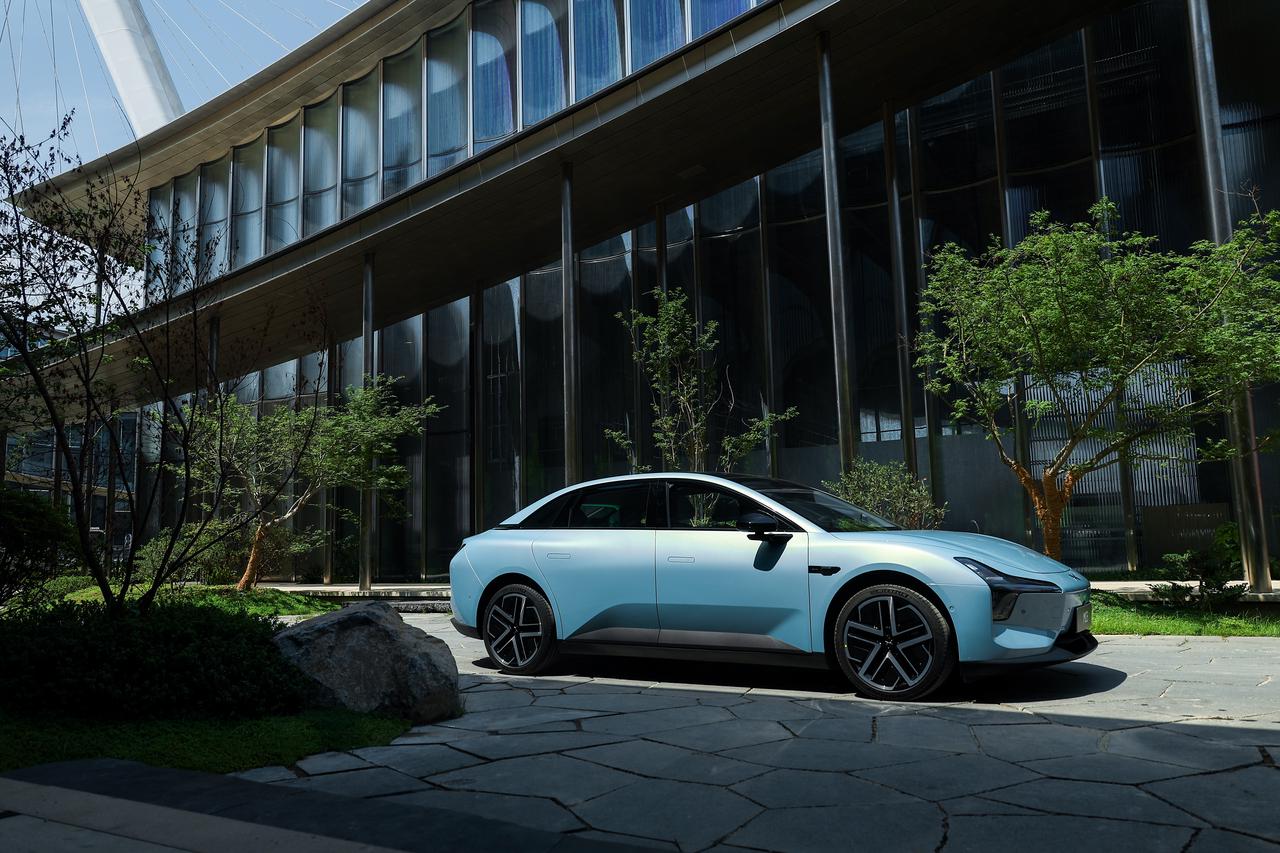
One of Xpeng’s best-selling models over the past year, the MONA M03, has finally received its “complete form” – the M03 Max.
The design and dimensions remain unchanged, but the M03 Max is equipped with two NVIDIA Orin-X chips, delivering computing power of 508 TOPS.
Furthermore, the M03 Max features the “full-blooded” version of its “AI Turing Smart Driving” system. Its capabilities are directly aligned with higher-end models like the P7+ and X9, enabling full-scenario Navigation Guided Pilot (NGP).
Other experience-critical configurations in the Max version have also seen significant upgrades. A prime example is that the M03 Max ships with the SkyOS XOS 5.7.0 infotainment system out-of-the-box, whereas the standard M03 requires an OTA update. The seats have also received minor improvements.
Regarding pricing, the “¥155,800” listed on the official website is no longer relevant. The final launch price has been pulled down to below ¥140,000.
The Xpeng MONA M03 Max offers two range variants: the 502km version is priced at ¥129,800, and the 600km version at ¥139,800.

The arrival of the M03 Max further strengthens Xpeng’s competitiveness in the ¥130,000 to ¥150,000 price segment. More importantly, at a time when competitors are heavily investing in smart technologies, eroding Xpeng’s once-distinct advantage, the M03 Max is expected to help Xpeng reclaim its technological leadership.
“It’s harder to defend a territory than to conquer it.” Facing market competition, how will Xpeng maintain its edge? During the post-launch media Q&A, He Xiaopeng and other executives shared their insights.
The “Low Price” Controversy
The announcement of the M03 Max price elicited cheers from the audience. The starting price of ¥129,800 indeed exceeded most expectations.
Regardless of how owners of the non-Max M03 models purchased last year might feel, media observers noted that the price is so low it might spark controversy.
For instance, how will Xpeng ensure profitability with the M03 Max priced so aggressively?
In response, He Xiaopeng explained that they have different product strategies for different price segments. For example, the recently refreshed X9 adopted a “more features, same price” strategy rather than simply lowering prices.
The implication is that pricing the MONA M03 Max at this “shockingly low” level is a necessary move to meet competition in its specific segment. He Xiaopeng also stated that, from a corporate perspective, maintaining stable development is the top priority, and “sales volume” is the best means to achieve that stability.

He pointed out that Xpeng’s gross profit margins have been improving over the past seven quarters. This demonstrates that the current pricing strategy is actually beneficial for the company’s profitability.
On the topic of profits, He Xiaopeng mentioned they have other methods to ensure profitability, such as focusing on core businesses and improving internal efficiency. He also expressed optimism about achieving the goal of “profitability in Q4,” especially with the launch of the all-new P7 in Q3.
Will the M03 Max Steal the Show?
Beyond the price, the M03 Max also boasts the same smart driving system as premium models like the P7+ and X9. Capable of full-scenario (covering highways, urban, and city roads) NGP, it may also gain capabilities like navigating complex scenarios (e.g., ETC lanes) via future OTA updates.
This raises a question: the ¥150,000 M03 Max and the ¥350,000 X9 can no longer be differentiated based on smart driving capabilities. Conversely, “smart assisted driving” seemingly can no longer serve as a premium differentiator across Xpeng’s product tiers.

He Xiaopeng addressed this situation with equanimity. He stated that the “democratization of smart driving” is part of Xpeng’s product philosophy.
“Similar hardware should deliver comparable software and AI capabilities. If the hardware differs, then differences in software and AI are understandable.”
If Xpeng wants to create tiered differentiation through software and AI, they will deliberately use hardware as the distinguishing factor.
In-house developed chips will likely be a key approach.
Long-term, as long as premium products leverage more powerful hardware, higher computing power, and more advanced algorithms to deliver superior software and AI experiences, they will still be able to command a premium based on high-level ADAS and other AI capabilities.
When asked if MONA models would use in-house developed chips, He Xiaopeng did not give a definitive answer.
He stated that Xpeng will continue procuring chips from partners for models across different price points. Future new models, once in-house chips are ready, may start incorporating hardware differentiation to create corresponding differences in software experience.
Looking ahead ten years, software and AI could account for half of a vehicle’s value, and users will be more willing to pay for different AI features in their cars. However, at this stage, He Xiaopeng believes “similar hardware delivering similar experiences” remains the fundamental logic.
The Future of MONA
Since its launch in August last year, the MONA series has accumulated sales exceeding 120,000 units, making it the undisputed sales pillar for Xpeng.
Regarding the future of the MONA brand, He Xiaopeng focused on topics of overseas expansion and brand independence.
On overseas expansion, He Xiaopeng did not provide a specific timeline but stated that MONA is inherently defined as a “global brand.” This means it will eventually be exported alongside Xpeng-branded products when conditions are right.
He reiterated that the M03 is only the first product under the MONA brand, with more models to follow. He views overseas expansion as a “long-term strategic layout,” emphasizing the importance of building solid foundations with local partners. Therefore, Xpeng won’t rush MONA’s overseas rollout.

Regarding “brand independence,” He Xiaopeng was clear: Xpeng will steadfastly maintain “platformized software and a unified brand,” and has no plans to spin off MONA as a separate sub-brand.
He also referenced recent moves by competitors, noting that many brands are consolidating internal resources. He believes this approach “is the right one,” aligning with the current competitive market trend.
“In the era of software-defined vehicles, you don’t need too many brands to create differentiation. As we move into the era of AI-defined cars, the trend towards resource centralization will become even more pronounced.”
This further clarifies MONA’s role within Xpeng’s lineup: leveraging platform-based software capabilities to create differentiation through smart driving features in the entry-level market, thereby building competitiveness.
Regarding the expected sales mix for the M03 Max, He Xiaopeng predicted this trajectory: “It might be higher initially, then gradually decline. But as the software team works hard to develop better versions, the sales proportion of the Max version will increase again.”
Dubbed by He Xiaopeng in the Q&A as “potentially historic,” whether the M03 Max can successfully become a new force in the ¥150,000 pure-electric sedan segment is something we should find out soon.
(End)
Discover more from ChinaEVHome
Subscribe to get the latest posts sent to your email.


[…] May 28, XPeng officially launched the MONA M03 Max edition. Following the event, Chairman He Xiaopeng and several senior executives participated in a group […]
[…] to He Xiaopeng, within the entire XPeng model system, the intelligent driving level of MONA M03 Max is on par with that of the X9 MAX version. He emphasized that a vehicle’s software […]
[…] XPeng MONA M03 MAX officially premiered this afternoon. The automaker announced that display models will arrive at […]