Which brand is the mid-year delivery winner?
While the early-year wave of “intelligent driving popularization” has yet to hit its peak, it was already being called to “slow down and scale back.” The fierce “price war” was barely underway before it was halted. The dominant market trend has now decisively shifted toward “anti-involution.”
In just six months, the Chinese new energy vehicle (NEV) market has seen multiple major reversals. The increasingly volatile market environment and policy changes are placing enormous pressure on automakers’ ability to adapt and withstand challenges.
Especially after “price wars” and various forms of “involution-style competition” were restricted, the market has become a purer battlefield for product strength. As a result, sales figures have become more meaningful indicators of a company’s competitiveness.
On July 1, major carmakers released their June sales data, revealing key metrics such as half-year deliveries and progress toward annual targets.


NIO
NIO announced that it delivered a total of 24,925 vehicles across all its brands in June 2025, representing a YoY increase of approximately 17.52% and a MoM growth of around 7.29%.

It is important to note that this figure includes deliveries from its sub-brands, Onvo and Firefly. Breaking it down: NIO brand delivered 14,593 units, Onvo delivered 6,400 units, and Firefly delivered 3,932 units.
The NIO brand alone saw a MoM increase of 9.97%, Onvo edged up by 2.6%, while Firefly remained largely stable compared to May.
Over the past six months, NIO delivered a total of 114,150 units—up 30.6% YoY—thanks to its multi-brand strategy. In Q2 alone, it delivered 72,056 units, a YoY increase of 71.2%, with key contributions from the Onvo L60 and the new “5566” model family.
Positive signs include Firefly stabilizing at around 3,000–4,000 units monthly, and Onvo’s L60 consistently reaching 6,000 units per month, demonstrating robust resilience.
Looking ahead, NIO plans to launch several new models in the second half of the year, including the new ES8, Onvo L80, and L90. Among them, the L90 is expected to offer impressive space and pricing, leaving significant room for growth in NIO’s overall performance.
XPeng
XPeng reported strong performance in June with 34,611 units sold, a YoY surge of 224% and a MoM increase of 3.24%.
XPeng also passed a major milestone: in the first half of 2025, it delivered 197,189 units—exceeding its entire 2024 total. Its Q2 sales reached 103,181 units, a new quarterly record for the company.

Based on its full-year target of 380,000 units, XPeng has achieved a completion rate of 51.84%—making it one of the few new EV players to surpass the 50% mark at mid-year. With the upcoming G7 and new P7 models expected in the second half, the company may even raise its annual target.
However, the launch of Xiaomi’s YU7 could pose a threat. The XPeng G7 will compete directly with the YU7, and any pricing adjustments to avoid this competition could disrupt the existing G6’s market position. Navigating this situation while maintaining momentum will be a critical challenge for XPeng in H2 2025.
Li Auto
Li Auto delivered 36,279 vehicles in June 2025, representing a YoY decline of approximately 24.06% and a MoM decrease of about 11.2%.

In the first half of 2025, Li Auto delivered a total of 203,938 vehicles. Compared to the same period in 2024, when Li Auto led the NEV startup segment with 188,981 deliveries, the modest YoY increase of 7.91% this year was not enough to maintain its top spot—Leapmotor has now taken the lead, reflecting the intensifying competitive landscape.
Notably, at the end of June, Li Auto announced a downward revision of its Q2 delivery forecast and lowered its full-year target from 700,000 units to 640,000 units, signaling mounting pressure on both its product appeal and sales channels.
Although all of Li Auto’s extended-range models have undergone upgrades—mainly involving configuration enhancements and chip replacements with Thor-U processors—these updates have not led to significant sales gains.
Looking ahead, the company’s focus will shift to its upcoming pure electric SUVs. The Li Auto i6 and i8 have already made their first appearances, with the i8 set to officially launch in July. In just six months, Li Auto has gone from being a market leader to a challenger. Its much-anticipated battery-electric SUVs must succeed—there is no room for error.
Leapmotor
In June 2025, Leapmotor delivered a record-breaking 48,006 vehicles, a YoY increase of 138% and a MoM increase of 6.52%.

Throughout the first half of 2025, Leapmotor’s sales have been steadily climbing—from 20,000 units per month at the beginning of the year to nearly 50,000 by June. It is now poised to become the second NEV startup, after Li Auto, to achieve 50,000 units per month under a single brand.
Leapmotor’s H1 sales reached 220,000 vehicles, completing 36.67% of its 600,000-unit annual target. Compared with rivals like XPeng and Xiaomi, Leapmotor’s target completion rate is less impressive.
However, with the launch of new models like the B01, updated C16 and C11, and a rumored flagship SUV, Leapmotor is highly likely to surpass the 50,000-unit monthly threshold.
Still, to meet its full-year goal, Leapmotor will need to average over 63,000 units per month in H2. Merely “stabilizing at 50,000” won’t be enough. The company must break through the 60,000–70,000 range to stay on track.
Xiaomi
Xiaomi reported over 25,000 deliveries in June, slightly lower than May’s 28,000 units. The company did not provide an explanation for the drop. However, SU7 models are still subject to waitlist scheduling, indicating that demand is not the issue. The more likely cause is a fluctuation in sales of the high-performance SU7 Ultra variant.

Aside from the early months of January and February (both around 20,000 units), Xiaomi’s monthly deliveries have consistently exceeded 25,000 units. In March, it peaked at 29,000 units, while April and May remained at around 28,000.
As of the first half of 2025, Xiaomi has delivered over 150,000 vehicles. Against its updated 350,000-unit annual goal, the company has achieved a 42.86% completion rate, placing it among the front-runners in the new EV startup space.
The second half of the year will be even more crucial.
Xiaomi’s upcoming YU7 model has already received 240,000 locked-in preorders within 18 hours of its announcement. If production and delivery proceed smoothly, Xiaomi is virtually guaranteed to hit its annual goal. That said, production capacity remains its biggest challenge—as it was in 2024. Even with the Phase 2 plant offering a 300,000-unit annual output, it may still fall short.
IM Motors
IM Motors announced it delivered 6,027 vehicles in June 2025. The company did not disclose May’s specific figures, but third-party estimates suggest sales were around 4,000 units—indicating a month-on-month increase of over 50%.

According to production and sales reports, IM Motors sold 14,746 units between January and May. Adding June’s numbers, its H1 total stands at just over 20,000 units.
IM’s CEO Liu Tao previously suggested the brand was aiming for its “second group of 100,000 user deliveries” in 2025, implying an annual target of 100,000 units. At the current pace, IM has only completed about 20%, making its goal appear increasingly distant.
Product-wise, the company revealed in April that it would launch three pure electric and two range-extended models in 2025. This is the first time IM Motors has confirmed the development of range-extended vehicles.
Among its new electric models, the LS6, L6, and LS7 have all debuted. For the second half of the year, a range-extended version of the LS6 is on the way, followed by a high-end six-seat flagship range-extender SUV expected in October.
With only half a year left, can IM Motors stage a strong comeback?
Zeekr & Lynk & Co
In June 2025, Geely Holding’s NEV division (Zeekr + Lynk & Co) delivered 43,012 vehicles, compared to 44,545 units in June 2024, marking a YoY decline of 3.44% and a MoM drop of 7.58%.
However, thanks to strong performance in earlier months, H1 total sales hit 244,877 units, up 14.5% YoY. Geely’s annual sales target for this unit is 710,000, with a H1 completion rate of 34.49%—a moderate performance.

Breakdown by brand:
- Zeekr: 16,702 units in June, 90,740 in H1.
- Lynk & Co: 26,310 units in June, 154,137 in H1.
In H1 2025, Zeekr relied heavily on its 007 GT model. However, sales figures for May and June suggest that its market impact may not have lived up to expectations. Its upcoming Zeekr 9X, positioned as a high-end luxury model, is unlikely to boost volume significantly.
Lynk & Co remains the core contributor to the group’s NEV sales. Its plug-in hybrid models are particularly strong. To maintain growth, Lynk has announced the launch of the Z10 PHEV, now named the Lynk & Co 10 EM-P, and the Lynk & Co 900, a high-end plug-in SUV that has already begun deliveries.
We expect clearer brand positioning and product segmentation between Zeekr and Lynk & Co in H2.
Voyah
Voyah announced June deliveries of 10,053 vehicles, up 83% YoY. Since March, Voyah has consistently delivered over 10,000 vehicles per month, demonstrating stable growth.

In H1 2025, Voyah delivered 56,128 vehicles, a YoY increase of 85%. But compared to its ambitious 200,000-unit annual target, the completion rate is only 28.6%. To meet the goal, H2 monthly sales must exceed 23,000 units.
Voyah recently updated its SUV product line:
- The Free+ model now comes with Huawei’s Kunpeng ADS 4.0 driving assistance system.
- Official launch is set for July 12.
While not on par with Xiaomi YU7 in buzz, Free+ managed to secure 10,000 preorders within 18 hours, offering a morale boost for the brand. Voyah is also preparing to launch a six-seat SUV codenamed “Taishan” later this year. Expectations remain high for stronger performance in H2 2025.
Avatr
Avatr delivered 10,153 vehicles in June 2025, up 117% YoY, though MoM sales fell 20.47%. Despite the dip, Avatr has now maintained four consecutive months of 10,000+ deliveries, showing resilience in a fiercely competitive market.

For H1 2025, total sales reached 59,084 units. Avatr hasn’t publicly set a 2025 target, but at the Avatr 06 launch, chairman Zhu Huarong laid out a long-term roadmap:
- 2027: Global sales of 400,000 units
- 2030: 800,000 units
- 2035: Targeting 1.5 million units
To hit such ambitious goals, Avatr must expand both its product portfolio and international footprint.
Its key product in H1 was the Avatr 06, offered in both BEV and EREV versions, and priced under ¥200,000 (≈$27,800). It remains the most affordable vehicle in Avatr’s lineup.
However, the next new model won’t launch until 2026, and it will be a six-seat luxury SUV, likely with limited volume potential. Thus, Avatr’s H2 task is to stabilize its sales base and prepare for broader product rollouts in the years ahead.
Deepal
Deepal announced that it delivered 29,893 vehicles in June 2025, representing a year-on-year increase of 79% and a month-on-month growth of 17%.

For the first half of the year, Deepal delivered a total of 143,236 vehicles. However, with an annual sales target of 500,000 units, the H1 completion rate stands at just 28.64%.
According to CEO Deng Chenghao, 2025 is a “product boom year” for Deepal, with support from a series of major launches and technology enhancements including its Super Range-Extended Platform and Huawei-powered intelligent systems. He remains confident that monthly deliveries will reach 40,000–50,000 units by year-end, ensuring the 500,000-unit goal is achievable.
In H1, Deepal’s headline product was the S09, while other models received standard updates. However, niche offerings like the G318 have not shown sustained sales momentum. The company may need to further develop more compelling, standout models to strengthen its market position.
Arcfox
BAIC announced June 2025 deliveries of 14,506 vehicles, up 9.86% YoY. Among them, Arcfox once again surpassed the 10,000-unit mark, with 10,352 units delivered, reflecting a 65.13% YoY increase.

However, compared to May’s performance of over 13,000 units, Arcfox experienced a month-on-month decline of 23.37%.
For H1 2025, Arcfox’s cumulative sales were around 55,900 units. In the January–April period, wholesale volume totaled 32,000, with a 1.5% market share in pure EVs—a result that BAIC executives Liu Guanqiao called “the best in history.”
Liu added, BAIC has pledged to launch a new model every 2–3 months, targeting full-category coverage to maintain competitiveness. Yet, Arcfox’s ambitious target of 600,000 annual sales within three years remains a distant goal.
Geely
Geely delivered a strong performance in June 2025, with 236,036 vehicles sold, a 42% YoY and 71% MoM increase. Among them, NEV sales accounted for 52%, slightly down from May’s 59%, totaling 122,367 units—an 86% YoY increase.

The Geely Galaxy brand sold 90,222 vehicles in June, bringing its H1 total to 548,808 units, a 232% YoY increase. (Note: Figures for Zeekr and Lynk have been covered earlier.)
Across its entire NEV portfolio, Geely delivered 725,151 vehicles in H1, representing a 126% YoY growth. With such momentum, Geely became the first automaker to officially raise its annual sales target to 3 million units.
As of June, Geely had sold 1,409,180 vehicles, achieving 46.97% of the new annual target—a level of progress that suggests the goal is well within reach.
Looking ahead, Geely will continue launching several key products:
- The Galaxy A7, targeting the entry-level A-segment.
- The Galaxy Warship, a boxy model aimed at lifestyle markets.
- The Galaxy M9, expected to compete in the ¥300,000+ ($41,800) mid-to-large SUV segment against rivals like AITO M7.
Geely’s Xingyuan EV series has maintained its lead in China’s pure EV market. Combined with a robust fuel vehicle foundation, the second half of the year will see Geely square off directly with BYD for market dominance.
BYD
Despite Geely’s impressive results, BYD remains firmly in the lead.
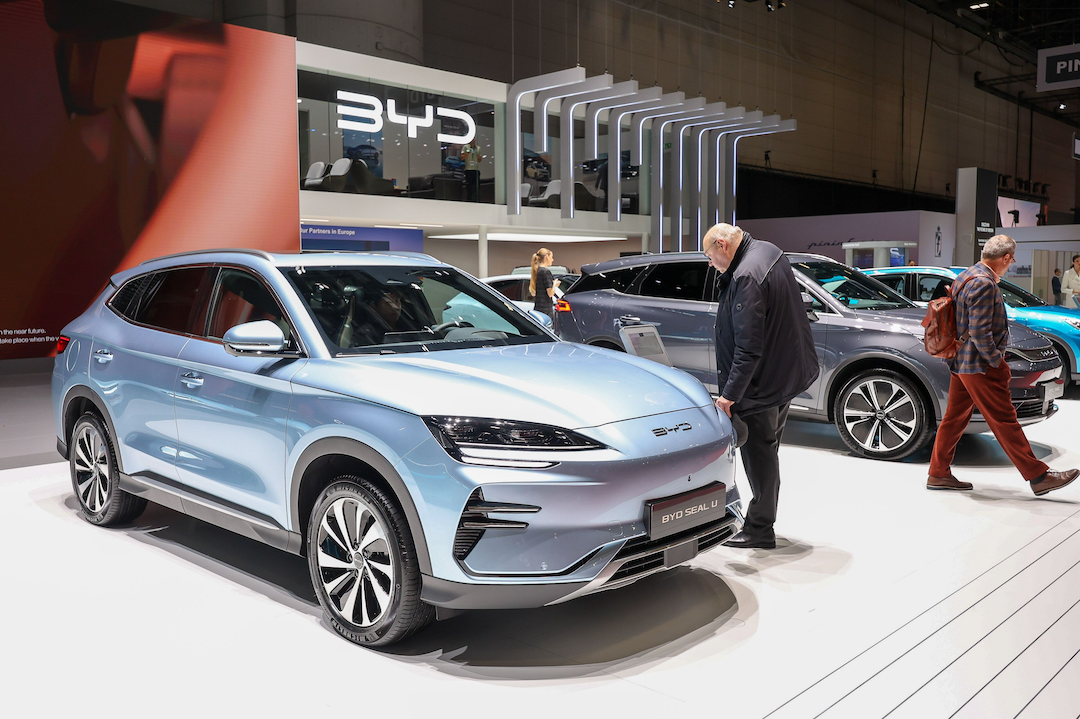
In June 2025, BYD sold a total of 382,585 vehicles, of which 377,628 were passenger cars—a YoY growth of 11% and MoM growth of just 0.19%, indicating stable performance.

The standout was BYD’s overseas sales. Combined exports of passenger cars and pickup trucks reached 89,699 units, representing a YoY surge of 229.8%.
Detailed breakdown for June:
- BYD (main brand): 342,737 units (+5.51% YoY, −1.62% MoM)
- Fangchengbao: 18,903 units (+605.34% YoY, +50.12% MoM)
- Denza: 15,783 units (+28.58% YoY, −0.15% MoM)
- Yangwang: 205 units (−50.96% YoY, +47.48% MoM)
Although Yangwang’s niche luxury models contribute minimally to total sales, Fangchengbao has become a major new growth driver. Denza and Yangwang, however, still struggle to generate volume.
For H1 2025, BYD sold 2,145,954 vehicles. Based on third-party reports of a 5.5 million-unit annual target, the current completion rate is just 39.02%.
In 2025, BYD launched a series of campaigns to boost deliveries, including a “mass-market intelligent driving” initiative in February and a renewed price war in late May. However, due to macro and industry factors, these efforts have not yielded the expected results.
BYD has also invested heavily in its three sub-brands this year—Fangchengbao, Denza, and Yangwang—bringing more models and price adjustments. But only Fangchengbao has seen notable growth. The heavy lifting still falls on BYD’s Dynasty and Ocean series.
As traditional price-cutting loses steam, what new strategies will BYD deploy in H2 to hit its ambitious target?
We’ll be watching closely.
Discover more from ChinaEVHome
Subscribe to get the latest posts sent to your email.