In the game of “besieging Tesla’s Model Y,” the XPeng G7 enters as a powerful new contender.
On July 3, XPeng Motors officially launched its all-new mid-size SUV, the XPeng G7, targeting family users. The vehicle is available in two configurations: Max and Ultra. Officially described as “the world’s first super AI car with L3-level computing power,” the G7 is XPeng’s first truly new model of the year. Its debut also offers a glimpse into XPeng’s evolving product strategy.
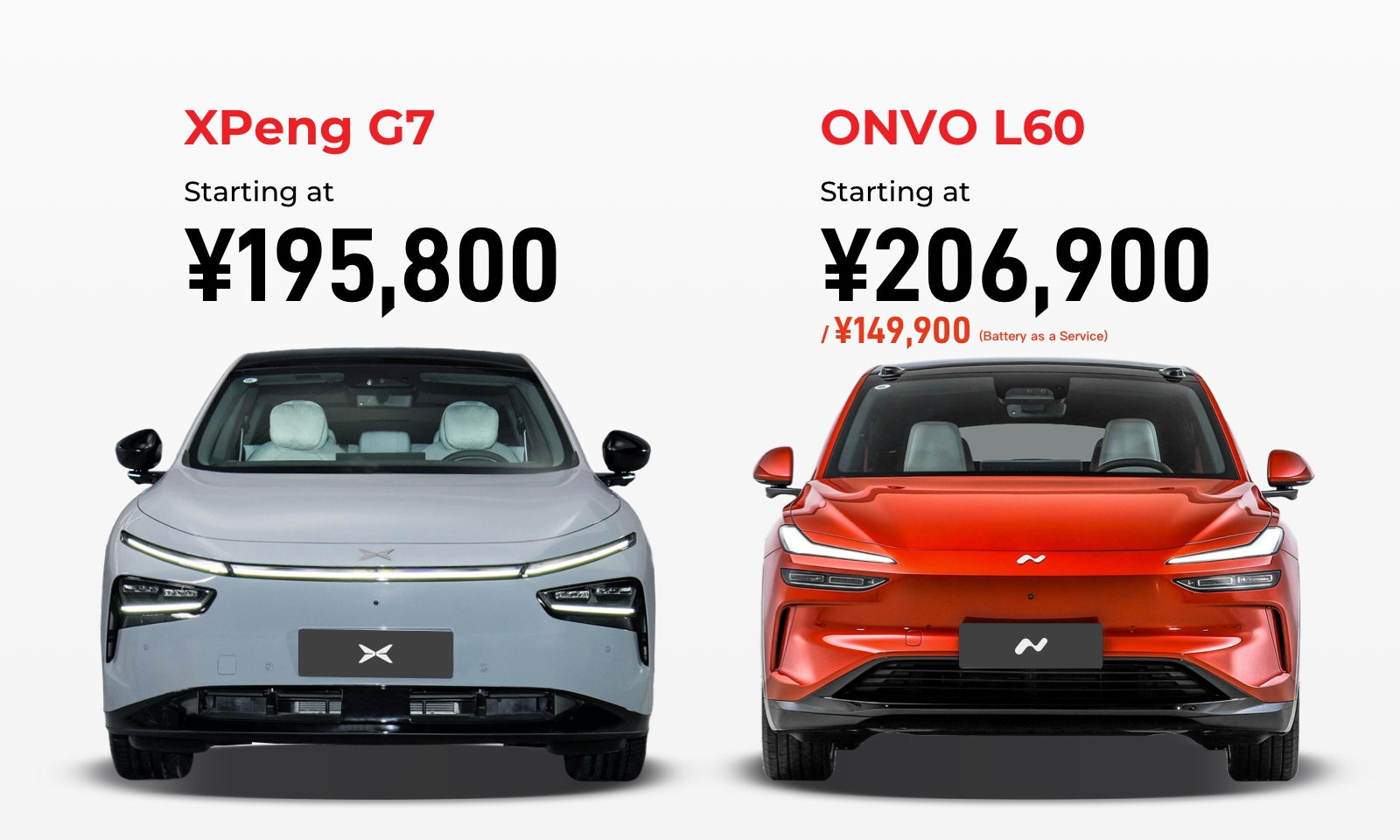
In the current mid-size pure electric SUV market, the ONVO L60 and XPeng G6 have performed notably well, ranking just behind the Tesla Model Y. Thus, in its quest to challenge the Model Y, XPeng G7’s most direct competitor is the ONVO L60. Instead of directly comparing with the Model Y, it’s more insightful to examine how the G7 stacks up against the L60.
The XPeng G7 lineup has been streamlined, with clear differences between the three versions and price differentiation to suit varying user needs:
- G7 Max 602 km range: RMB 195,800 ($27,412)
- G7 Max 702 km range: RMB 205,800 ($28,812)
- G7 Ultra 702 km range: RMB 225,800 ($31,612)
By comparison, the ONVO L60 is officially priced between RMB 206,900 and RMB 255,900 ($28,966 – $35,826). With the BaaS (Battery-as-a-Service) battery rental plan, buyers can deduct RMB 59,000 ($8,260) from the list price.

The XPeng G7 measures 4892 × 1925 × 1655 mm, with a wheelbase of 2890 mm and front/rear track widths of 1635/1650 mm. The G7 offers advantages in length and height, providing more vertical space for passengers thanks to its tall body and CTC battery structure. This aligns with XPeng’s marketing focus on spaciousness.
In comparison, the ONVO L60 measures 4828 × 1930 × 1616 mm, with a longer wheelbase of 2950 mm and wider track widths of 1666/1677 mm. The L60’s wider body and longer wheelbase provide better space efficiency, while its lower stance and wider track enhance stability during high-speed cornering.

Built on an 800V high-voltage platform, the G7 supports 5C ultra-fast charging. Depending on the version, the CLTC range is between 602 km and 702 km, with an energy consumption of 13.2 kWh per 100 km.

The ONVO L60, on a 900V platform with 3C fast-charging batteries and battery-swapping technology, offers a CLTC range of 525 km to 730 km. The single-motor version consumes 12.1 kWh/100 km, while the dual-motor version consumes 12.7 kWh/100 km—making the L60 more efficient overall.

While the G7 offers longer entry-level range, the L60’s charging-swapping capability and BaaS plan give it a clear advantage in recharging speed, convenience, and affordability.
A key selling point of the G7 is its intelligent driving system. The entire G7 lineup is equipped with Turing AI driving and features the industry’s first on-board VLA+VLM large models, enabling L3-level autonomous driving capability.
- The G7 Ultra is equipped with 3 Turing AI driving chips + Snapdragon 8295P cockpit chip, delivering a total computing power of 2250 TOPS.
- The G7 Max features 2 NVIDIA Orin-X driving chips + Snapdragon 8295P, for a total of 508 TOPS.
XPeng claims the G7 can:
- Automatically recognize speed bumps and rough roads,
- Identify parking lot gates and ETC toll entrances,
- Park autonomously without requiring visible parking lines,
- Re-plan routes in real-time during autonomous driving.

By comparison, the ONVO L60 adopts a pure-vision solution with seven 8-megapixel cameras and a 4D imaging radar, driven by 1 NVIDIA Orin-X and 1 Snapdragon 8295P chip, totaling 314 TOPS. While lower in computing power than the G7, the L60 is expected to benefit from the distilled version of NIO’s world model.

Inside, both models emphasize simplicity and refinement. The G7 offers more storage compartments and a wraparound center console, while the L60 uses contrasting wood trims for a premium feel. Both feature concealed ambient lighting.
Both cars run on the Snapdragon 8295P cockpit chip with 60 TOPS of computing power. However, the G7’s Turing chip can supplement cockpit performance when needed, offering up to 810 TOPS of AI power for the cockpit.
The L60 also impresses with its Coconut OS and a high-spec Snapdragon 8295P, paired with 24GB RAM and 256GB onboard storage. Its 18-speaker, 1020W audio system supports 7.1.4 Dolby Atmos.

Both vehicles are five-seaters. The G7 comes standard with features like an 87-inch AR-HUD, ventilated, heated, and massaging seats front and rear, electrically adjustable seats, rear tray tables, and optimized space for taller occupants. XPeng claims even 1.9-meter-tall passengers will feel comfortable. The cabin also offers over 30 storage compartments.
The L60 features ventilated, heated, and massaging front seats, with an electrically adjustable leg rest for the passenger seat. It supports a “bed mode” connecting front and rear seats and has an 8-inch rear entertainment screen to control multimedia and comfort features. Additionally, a 52L refrigerated compartment is hidden under the trunk floor.
As XPeng’s first major release for H2 2025, the G7 bears significant sales expectations. While the Xiaomi YU7 has already taken the lead in the Model Y challenge, the G7 aims to carve its share without losing ground to Xiaomi. Competitive pricing alone won’t be enough.
After the launch, XPeng reported that the G7 secured over 10,000 orders within 9 minutes—less impressive compared to Xiaomi YU7’s record-breaking sales, but a notable improvement over the G6’s 5000 orders in 7 minutes at its launch.

In the hotly contested mid-size EV SUV market, the Tesla Model Y remains the top seller, with the ONVO L60 emerging as a strong contender. While the G7 excels in intelligent driving and spaciousness, the L60 leverages BaaS to lower purchase costs, leaving both models highly competitive.
Their similar pricing ranges ensure a fierce battle for market share. Who will successfully steal market share from Tesla, and who will falter in the competition? The answer will unfold in the months ahead.
Discover more from ChinaEVHome
Subscribe to get the latest posts sent to your email.