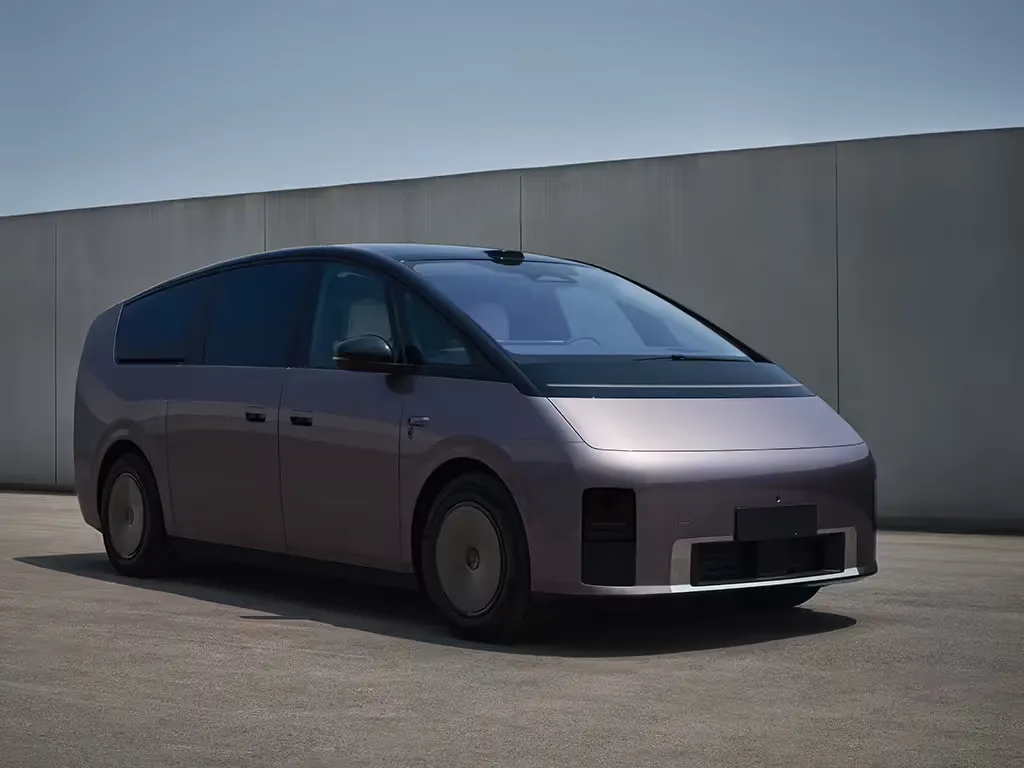
At STELATO Night, Richard Yu clarified the driving incident, unveiled the new brand logo, and emphasized S9’s intelligent luxury positioning within the unified HIMA ecosystem.
“Earlier, someone filmed me supposedly sleeping while driving. Actually, I was using ADS and briefly looked down at my phone. For this, I turned myself in to the police for the first time in my life and paid the fine…”
Richard Yu’s candid confession sparked laughter at the event, making it one of the most memorable moments of the STELATO Night launch.
However, the true highlight of “STELATO Night” was the first public unveiling of the brand’s logo. The event itself aimed to engage the user community and update core users on the brand’s latest developments and future plans.
At the beginning of the event, BAIC Group Chairman Zhang Jianyong reaffirmed the company’s commitment and persistence in developing car brands. STELATO also revealed its new brand logo, which features a more memorable geometric design compared to the previous letter-only style.

On stage, Richard Yu explained that with the new emblem, the five brands under Harmony Intelligent Mobility Alliance (HIMA) have at least unified the outer contours of their logos. Yu also redefined the core values of STELATO, emphasizing technology, humanity, and nature, with the overarching theme of “intelligent luxury” remaining central to STELATO’s brand identity.
After introducing the basic information, Yu revisited the key features of the STELATO S9 for the audience.
Relaunch
The market is already very familiar with the STELATO S9. Particularly after the launch of the extended-range version in the first half of this year, its sales have been rising steadily. According to official data, the S9 delivered 4,154 units in June, ranking first in the “over 300,000 yuan ($42,000) NEV sedan” category.
When reintroducing the S9, Yu quickly skimmed over the exterior design, range, and power—standard features—and focused instead on its comfort features and intelligent systems.
Speaking of range, Yu claimed that the CLTC pure electric range of 816 km realistically translates to “over 600 to 700 km” in real-world conditions; as for the extended-range version with a claimed combined range of 1,355 km, actual range exceeds 1,000 km.

On the topic of intelligent driving, Yu said that the current ADS 3.3 version already offers an excellent experience. Based on his personal use over the past few months, he “barely had to take control.” He also announced that the STELATO S9 will be upgraded to ADS 4 in the future, and called on regulators to finalize L3 regulations soon, enabling more use cases for intelligent driving assistance.
It was during this discussion that Yu shared the now-famous anecdote about the convenience of intelligent driving, leading to the earlier humorous moment.
Yu also praised the STELATO S9’s zero-gravity seats, giving a vivid example: after a morning meeting in downtown Beijing, he traveled to the event venue in zero-gravity seat mode and “slept the whole way—very comfortable.”
He further mentioned the STELATO S9’s sun protection capabilities. Despite offering excellent physical UV protection, the model had been overshadowed in online discussions by rival brands. Yu joked about his lack of marketing skills.
In closing, Yu teased that STELATO’s new vehicle will arrive in the fall. This car is almost certainly the station wagon version of the STELATO S9, which has already been listed at the Announcement on On-road Motor Vehicle Manufacturers and Products issued by the Ministry of Industry and Information Technology (MIIT). Compared to the sedan, its biggest difference will be the larger trunk space.
Building Synergy
According to online sources, the upcoming AITO M7 will feature a significantly redesigned exterior aligned with HIMA’s family design, bringing it closer to the aesthetics of the AITO M8 and M9.
Although this update is for the AITO brand, it follows the same logic as the unveiling of STELATO’s new logo today.
The underlying strategy is clear: HIMA seeks to unify design language and brand visuals, minimizing the perceptual gap between cars built in partnership with different automakers, thus lowering consumer cognitive costs.
This echoes Yu’s earlier remarks: from the start, HIMA intended to integrate partner automakers’ models under a single brand ecosystem.
Although policy constraints have prevented a fully unified brand, efforts to align the five sub-brands—AITO, LUXEED, MAEXTRO, STELATO, and SAIC—through shared design elements and similar logos represent a practical compromise.

More broadly, HIMA’s strengthened role in coordinating resources and shaping brand strategy marks a significant step toward maturity for the HIMA brand matrix.
Huawei’s role in the automotive sector is no longer merely that of a supplier; it now influences brand definition and consumer perception, wielding significantly greater influence.
But the reality remains: except for AITO, other HIMA sub-brands still struggle with sales. Take STELATO, for example. According to automotive bloggers, from the start of 2025 to June 24, total sales stood at around 8,500 units.

Last year, Yu set a sales target of one million units for HIMA. So far, aside from AITO, the other sub-brands have contributed little toward this goal (the SAIC brand’s models will only launch at the end of this year).
The question now is: how much can further synergy boost HIMA’s overall sales? And how will STELATO, while maintaining its “intelligent luxury” positioning, continue to gain market share and influence through improved sales performance?
The challenges are far from over.
Discover more from ChinaEVHome
Subscribe to get the latest posts sent to your email.