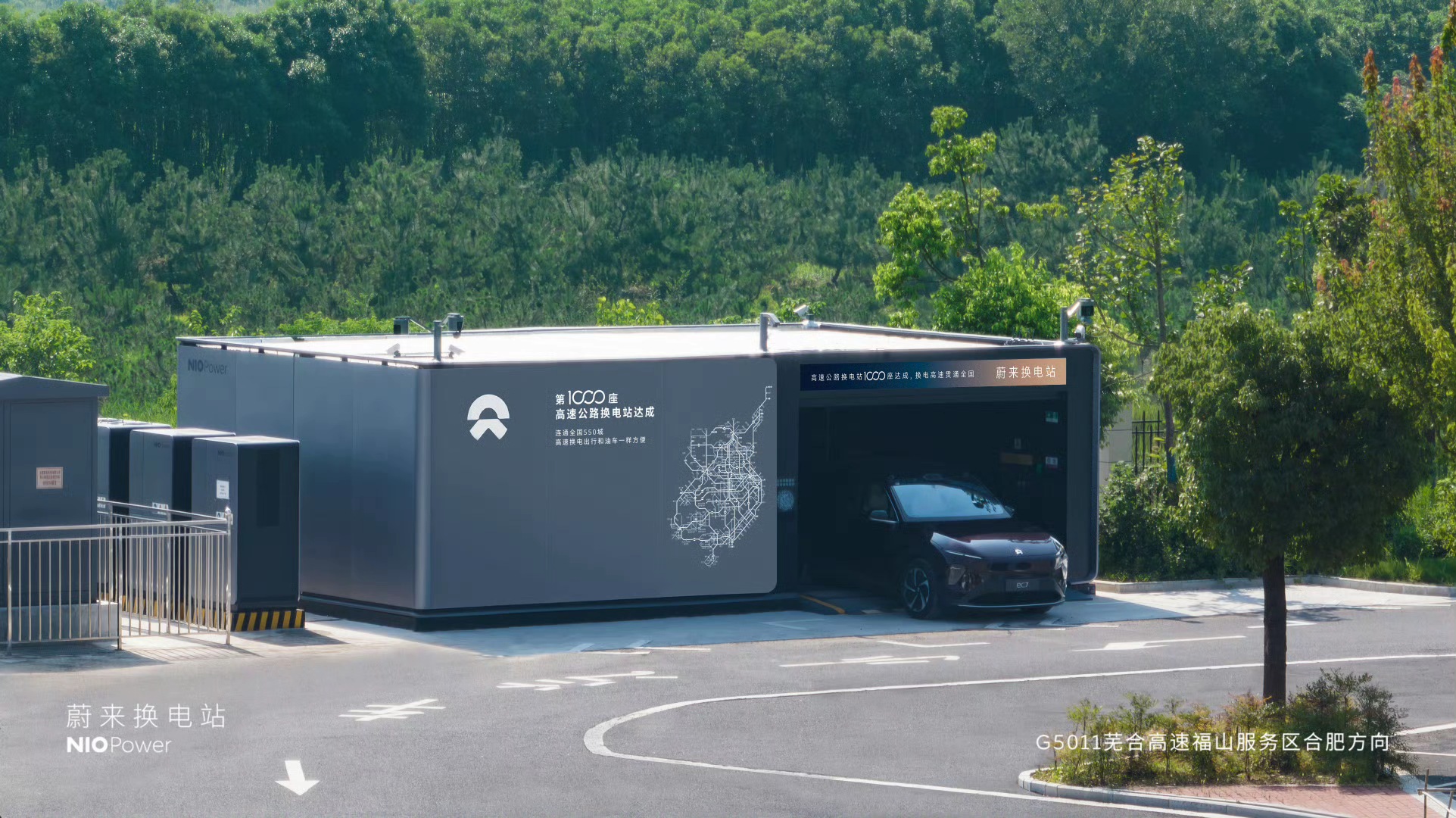
- NIO’s 1,000th highway battery swap station officially went online at the Fushan Service Area on the G5011 Wuhu–Hefei Expressway.
- The company has completed a nationwide battery swap network along major highways, now connecting key cities across China.
On July 9, NIO officially announced the completion of its 1,000th highway battery swap station.
The latest station, located at the Fushan Service Area on the G5011 Wuhu–Hefei Expressway, signifies the completion of NIO’s high-speed battery swap network across major cities, now connecting 550 cities across China. With this achievement, range anxiety for NIO and ONVO users on highways is effectively eliminated.

The network spans a wide geographic range—from Fuyuan in the east to Kashgar in the west, Mohe in the north to Sansha in the south—forming a trunk-line energy network of “nine vertical and nine horizontal highways, covering 14 mega-city clusters.”
A key strength of NIO’s battery swap system lies in its speed and efficiency. The fourth-generation swap station can complete a battery change in just 2 minutes and 24 seconds. Equipped with 23 battery slots, each station is capable of delivering up to 480 swaps per day, a 22% increase in efficiency over the previous generation. Paired with 640 kW ultra-fast liquid-cooled charging piles, the system also achieves a 300 km range boost with just 5 minutes of charging.
Beyond serving long-distance highway travel, NIO is also accelerating its county-level penetration strategy. By the end of 2025, the company aims to achieve “county-level battery swap accessibility nationwide” across 27 provincial-level administrative regions, further strengthening its rural and regional energy service network.

As of July 9, NIO has built over 8,000 charging and battery swap stations, including 3,399 battery swap stations and 4,659 charging stations. Highway swap stations now account for nearly 30% of the total, with the number of swap stations having reached approximately 85% of NIO’s annual target.
The 1,000-station highway milestone marks a significant breakthrough in NEV energy replenishment, narrowing the gap between charging and refueling efficiency, and setting a new benchmark for the industry.
Discover more from ChinaEVHome
Subscribe to get the latest posts sent to your email.