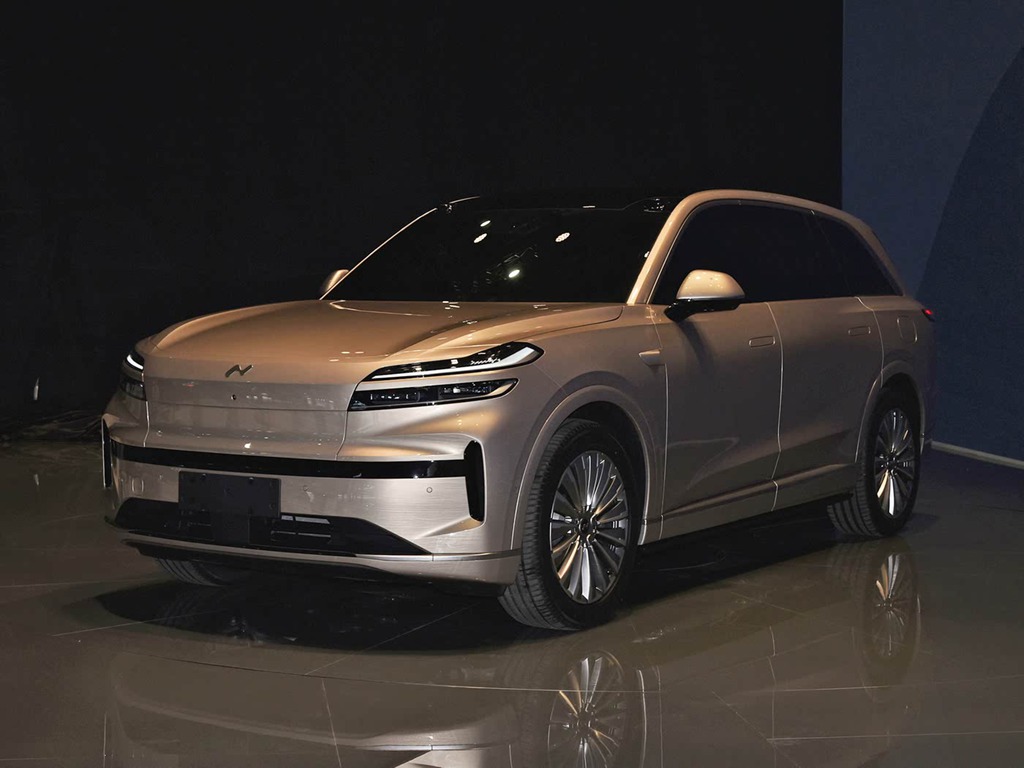
ONVO L90 launches with aggressive BaaS pricing, maximizing space, efficiency, and safety, redefining large electric SUVs with in-house innovations.
Last night, the ONVO L90 officially opened for pre-orders.
Following CEO William Li’s livestream promise last week that the price would “stay under RMB 300,000 ($42,000),” the L90 debuted at a pre-sale price of RMB 279,900 ($39,186).
With the standard 85kWh battery priced at RMB 86,000 ($12,040), the BaaS (Battery as a Service) pre-sale price drops to just RMB 193,900 ($26,700).
And with an additional RMB 2,000 ($280) deposit deducting RMB 5,000 ($700) from the price, the actual BaaS pre-sale comes down to an astonishing RMB 190,900 ($26,726).
This is only the pre-sale price. The L90 will officially launch at the end of July, with deliveries starting on August 1.

In short: the L90 is NIO’s biggest “disruptor” this year, likely the only premium electric SUV over RMB 200,000 ($28,000) that’s unaffected by the Xiaomi YU7.
As our first-look video for the ONVO L90 says: “Delivery speed wins the game, because pricing is no longer an issue.”
But behind such an aggressive price, how capable is the L90? Is it the technological flagship for ONVO’s next-gen EV competition?
Let’s dive in.
Efficiency Wizardry
William Li describes the L90 as a “revolutionary three-row electric family SUV.”

The essence of the L90’s innovation lies in its in-house tech that optimizes space, energy consumption, and safety for large three-row EVs.
The full-size body claims to achieve “VIP comfort for every seat, effortless 6-person, 10-suitcase capacity, and cargo space in both the front and rear”—no other three-row SUV offers all three.

The L90 measures 5,145 mm in length, with an interior longitudinal space of 4,195 mm.

Every row has over 1 meter of legroom: the second-row aisle is 180 mm wide, with a cabin height of 1,330 mm.

Even with all three rows in use, the trunk still holds 430 liters, plus an additional 340 liters up front—exceeding many mid-size SUVs in storage.

How does the L90 “squeeze” out such space? William Li credits “technology-driven extraordinary space.”
Examples include: a 340 kW permanent magnet motor producing over 450 hp in a compact 37-liter unit; a battery pack designed for swapping yet just 116 mm thick; and an intelligent fuse that saves 8.4 liters of space.

Other optimizations: the rear suspension saves 15% lateral space, a steep 30.5° slanted thermal module frees 90 liters, a 49-in-1 heat management module adds 50 liters, and a compact HVAC design liberates another 50 liters.

In total, 36 space innovations drive what ONVO calls “technology-enabled spaciousness.”
This space optimization also leads to weight savings.
Despite its 5.15-meter size, the single-motor L90 weighs just 2.25 tons, and the dual-motor version only 2.36 tons.
Compared with rivals like the Li Auto L9, AITO M9, and Lexus LX, the L90 is nearly 200 kg lighter than the BMW X7.

Lightweight design improves not just efficiency but durability.
Combined with its highly integrated systems and NIO’s EV technology, the L90 tackles a longstanding challenge: energy efficiency for large electric SUVs.
Big SUVs face steep aerodynamic and weight penalties. Even the benchmark Tesla Model X, with a 100kWh battery and a 0.24 drag coefficient, achieves only 664 km CLTC range. The smaller Model Y hits 750 km with a 78.4kWh battery.

Back to ONVO: on its 900V NT3 platform, the 5.15-meter L90 with an 85kWh battery and 340 kW motor achieves 605 km CLTC range.
While this may seem modest compared to mid-size EVs claiming 700+ km, it’s outstanding for a large SUV.
Compared to the slightly larger AITO M9, which uses a 100kWh battery and 390 kW dual motors for the same 605 km range, the L90 is notably efficient.
Aerodynamically, the L90 achieves an impressive drag coefficient of 0.25 despite its boxy design.

Moreover, thanks to its next-gen electrical architecture, the L90’s system-level energy consumption is minimal: its 85 kWh battery can sustain static standby for over 1,200 days.

A True Flagship
The L90 is ONVO’s flagship, and it delivers on quality, comfort, and safety.
In fact, its craftsmanship arguably exceeds expectations for its price—although the higher-end NIO ES8 sits above it in the hierarchy.
Highlights include a 17.2-inch center screen and a 17.3-inch rear infotainment display, both boasting 3K resolution.


The Snapdragon 8295 chip and Coconut 2.0 OS power the system, and the AR-HUD is upgraded to 35 inches, offering premium clarity and positioning.

The vehicle houses 23 speakers with a maximum output of 2,048W, branded as “ONVO Sound Premium”—the top audio system for the ONVO brand.

Noise insulation is flagship-level too, with 214 soundproofing components and 60 mm foam carpets. Double-glazed glass spans the panoramic roof, front windshield, and side windows.

The three-row interior focuses on robust comfort, with two wood finishes and high-quality seating: 13-layer construction, 15 mm soft foam plus 20 mm cushioning, and seat widths exceeding 530 mm across all rows.
Ventilation and massage are standard on the first and second rows—and remember, this all comes at a BaaS pre-sale price of just RMB 193,900 ($26,700).
Ambient lighting follows NIO’s signature style: visible glow without visible sources.

For assisted driving, the L90 uses a pure vision system paired with a single Nvidia Orin-X chip, similar to the L60. While not class-leading at this price point, it supports highway and urban NOA and memory parking.
Safety was a major highlight in William Li’s presentation, with the director reminding him to speed up.
The L90’s ultra-rigid steel-aluminum hybrid body offers 38,150 Nm/deg torsional stiffness, with 27.4 kg of submarine-grade 2,000 MPa steel and an 84% mix of aluminum and high-strength steel.

The front uses an ultra-wide 7-series aluminum crash beam covering 80% of the width. The battery bay features 2,000 MPa steel crossbeams and 6-series aluminum side sills.
All trims come with 9 airbags, including a massive 137-liter fox-ear passenger airbag to prevent head injuries.
Rear safety is also prioritized, with reinforced cage structures and a one-piece aluminum rear roof beam.
A 72-in-1 integrated rear floor casting, high-strength aluminum rear crash beams, and energy-absorbing structures further enhance protection.

The side curtain airbags extend 2,920 mm in length and 511 mm in height, fully covering the third row, with a capacity of 56 liters.
And of course, NIO’s end-to-end AEB plays a critical role in accident prevention—it prevented 28,029 incidents for ONVO users in just one month.
Lastly, existing ONVO and Firefly customers enjoy loyalty bonuses: 30,000 points (worth RMB 3,000, $420) for Firefly owners, and 50,000 points (worth RMB 5,000, $700) for L60 Premier Edition owners upgrading to an L90.

From the launch venue, we can only say: when the price was announced, the crowd went wild.
Are you satisfied with the L90’s pre-sale price?
Discover more from ChinaEVHome
Subscribe to get the latest posts sent to your email.