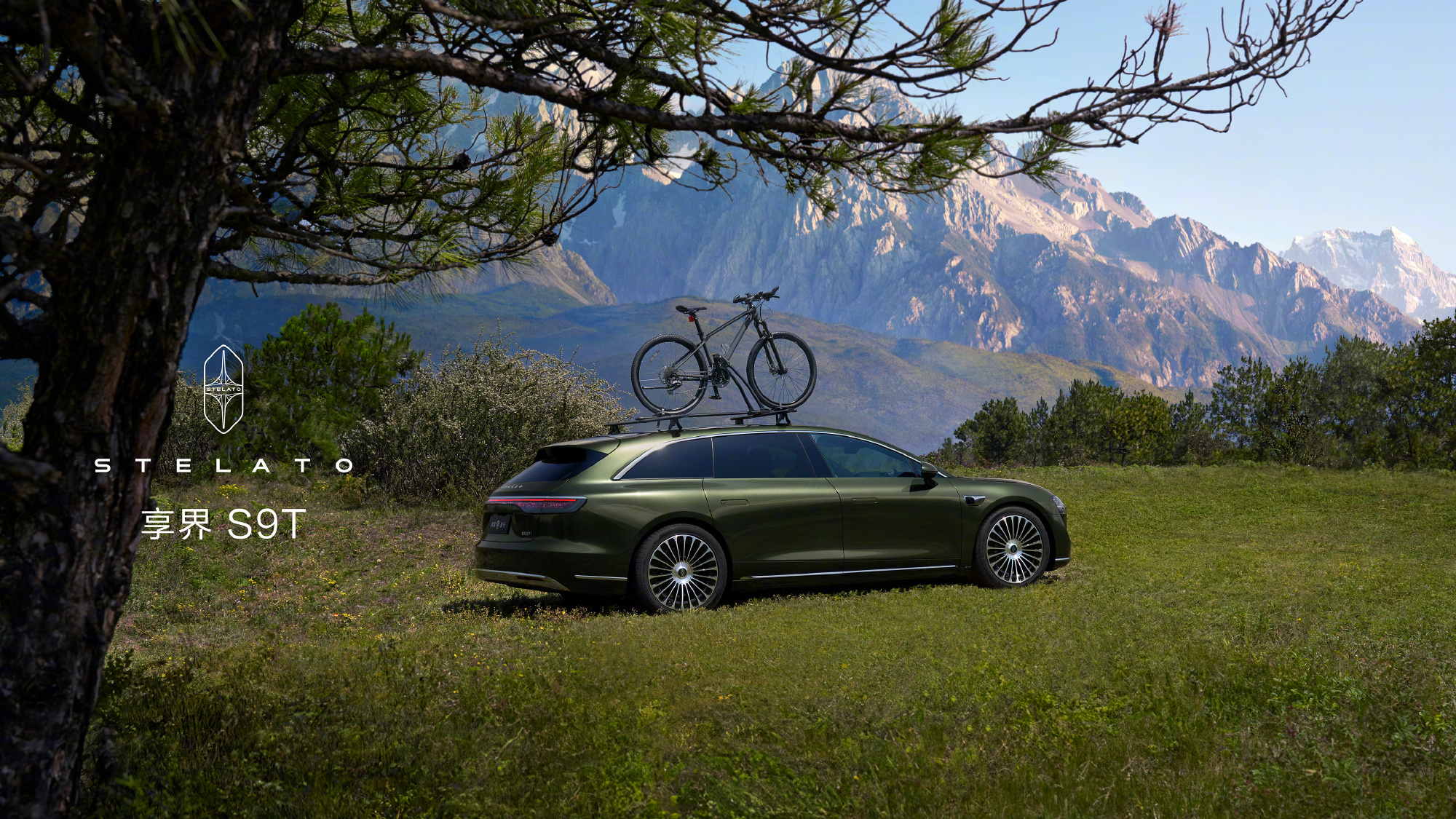
STELATO S9T previews China’s NEV wagon future, blending luxury, utility, and market maturity in an increasingly diverse domestic EV landscape.
On the morning of July 14, without prior notice, Richard Yu released official renderings of the station wagon version of the STELATO S9—named the STELATO S9T.
At the “STELATO Night” event a week earlier, Yu revealed that the station wagon variant of the S9 would hit the market in the fall. In other words, it may still be some time before we see the STELATO S9T in person.

Still, this teaser rollout has generated significant buzz. The STELATO S9T in the renderings is undeniably stunning, especially considering the current void in the RMB 300,000–400,000 ($41,000–$55,000) segment of domestic NEV station wagons. Its high design completion level has raised expectations.
From another perspective, although “NEV station wagons” are not yet a mainstream vehicle type in China, there have been breakout hits in recent years, gradually expanding across different price segments.
Could it be that spring is finally arriving for China’s homegrown NEV wagons?
A More Family-Friendly STELATO S9
Based on previous leaks, we can outline some of the S9T’s likely product features.
Following global station wagon design trends over the past 50 years, the STELATO S9T is expected to share the same platform, chassis, and powertrain as the S9. The key difference will likely be the shift from a sedan (three-box) body to a wagon (two-box) layout, with significantly expanded cargo space.
If we’re not strict about differentiating between “wagon,” “GT,” “shooting brake,” or “estate,” the most direct comparison to the S9 and S9T duo is Denza’s Z9 and Z9GT.
Denza’s Z9 and Z9GT share the same architecture and interior configurations, with identical pricing across different SKUs. Their main distinction lies in body style and consumer aesthetic preference—sedans are seen as more “business-oriented,” while wagons or GTs carry more of a family-friendly vibe.

The Denza Z9GT boasts a 488L trunk compared to the 375L of the Z9 sedan. Similarly, folding down the rear seats creates more interior space: the NIO ET5T offers up to 1687L compared to 1540L in the ET5 sedan.
For family-oriented storage optimization, the Zeekr 007GT is another case in point—it includes a ski pass-through in the rear armrest, a feature not found in the regular 007 model.
Fundamentally, station wagons aim to combine the longitudinal space of SUVs with the driving dynamics of sedans. However, for the S9T, rear seat design may prove challenging.
The original S9 promotes its “zero-gravity” rear seats as a major selling point. In contrast, most wagons prioritize fold-flat rear seats for maximum cargo flexibility. If the S9T wants to keep the zero-gravity seats while making them foldable, that would pose a significant engineering challenge for Huawei and BAIC.

In terms of performance, the S9T is likely to inherit the S9’s dual powertrain options—pure electric and extended-range—with 0–100 km/h acceleration ranging from 3.9 to 7.3 seconds. The air suspension and Huawei’s “Tuling” chassis platform are also expected to carry over.
In sum, one of the key aspects to watch is how the Harmony Intelligent Mobility Alliance (HIMA) team preserves the “luxury experience” of the sedan while adapting to family-use scenarios.
Notably, Denza’s Z9GT drew criticism for having a mini fridge in the rear armrest that prevented the seats from folding down. Whether the S9T delivers a “correct” interpretation of a wagon remains to be seen and will ultimately depend on market feedback.
The Rise of Distinctive NEVs
During the ICE era, some Chinese automakers like Roewe and Baojun tried to introduce wagons, but most were entry-level models that made little impact.
In recent years, more automakers have begun offering distinctive models like shooting brakes and station wagons across a wider and more comprehensive price range.
At the RMB 150,000 ($20,600) level, there’s the BYD Seal 06 GT; at RMB 200,000 ($27,400), the Zeekr 007GT; at RMB 250,000 ($34,300), the Zeekr 001; at RMB 300,000 ($41,000), the NIO ET5T. At RMB 400,000 ($55,000), there’s the Denza Z9GT—and possibly the similarly priced STELATO S9T.
In short, from RMB 150,000 to 400,000 ($20,600–$55,000), Chinese consumers now have domestically made NEV wagons from top brands. Previously, options were limited to premium ICE wagons from joint ventures—often with added markups.
This shift stems from two key reasons.
The first is straightforward—automakers have realized that selling NEV wagons in China is viable.
Since the NEV boom began in 2021, wagons like the Zeekr 001 and NIO ET5T have risen to prominence.
From its mass production launch in October 2021 through June 2025, the Zeekr 001 has delivered over 300,000 units, making it the top-selling Chinese-brand EV priced above RMB 250,000 ($34,300).

Though not as strong in absolute volume, the NIO ET5T has steadily gained internal sales share since launch, even surpassing the ET5 sedan to become NIO’s top-selling sedan.
From June 2023 to June 2025, ET5T sales reached about 93,000 units. In the past six months alone, it became NIO’s second-best-selling model after the ES6, with 21,000 units sold—over twice that of the ET5 (with over 8400 units).

The second reason is that growing acceptance of niche models signals a maturing Chinese NEV market.
Just like Maslow’s Hierarchy of Needs, once consumers’ basic demand—EV battery and drivetrain competence—is met, attention shifts toward higher-level desires like emotional satisfaction.
Compared to traditional sedans, wagons offer more potential for such satisfaction: sleeker designs, greater presence, a balance of space and driving pleasure.
Furthermore, automakers’ “same price, same spec” strategies are flipping the conventional pricing model of ICE wagons on its head.
Take Volvo’s V60 vs. S60 as an example. For the same configuration, the V60 costs RMB 30,000–50,000 ($4,100–$6,800) more in MSRP. With dealership discounts, the price gap can exceed RMB 100,000 ($13,700).
Thus, the popularity of domestic NEV wagons is a prime example of how Chinese automakers leverage the supply chain to transform a niche category.
Empowered by China’s NEV supply chain, consumers no longer need to pay hefty premiums for personalized models. “Wagon freedom,” once unthinkable during the ICE era, is now within reach.
In the end, it’s not just NEV wagons that are in bloom. As long as the supply chain maintains its edge and the market remains stable, China’s NEV industry will truly enter a golden age of diversified innovation.
Discover more from ChinaEVHome
Subscribe to get the latest posts sent to your email.