- Refreshed Li Auto MEGA interior and smart tech leaks show diamond-quilted seats, larger rear screens, and concealed vents.
- MIIT filings confirm optional side/rear solid-state LiDAR, Thor M100 chip, modest power and battery boosts, and rear-wheel steering.
- Sales remain far below targets after PR crises and charging pain points, leaving MEGA's premium comeback uncertain.
Following the launch of the updated Li L Series, Li Auto now appears to be preparing the next round of updates for its battery-electric lineup.
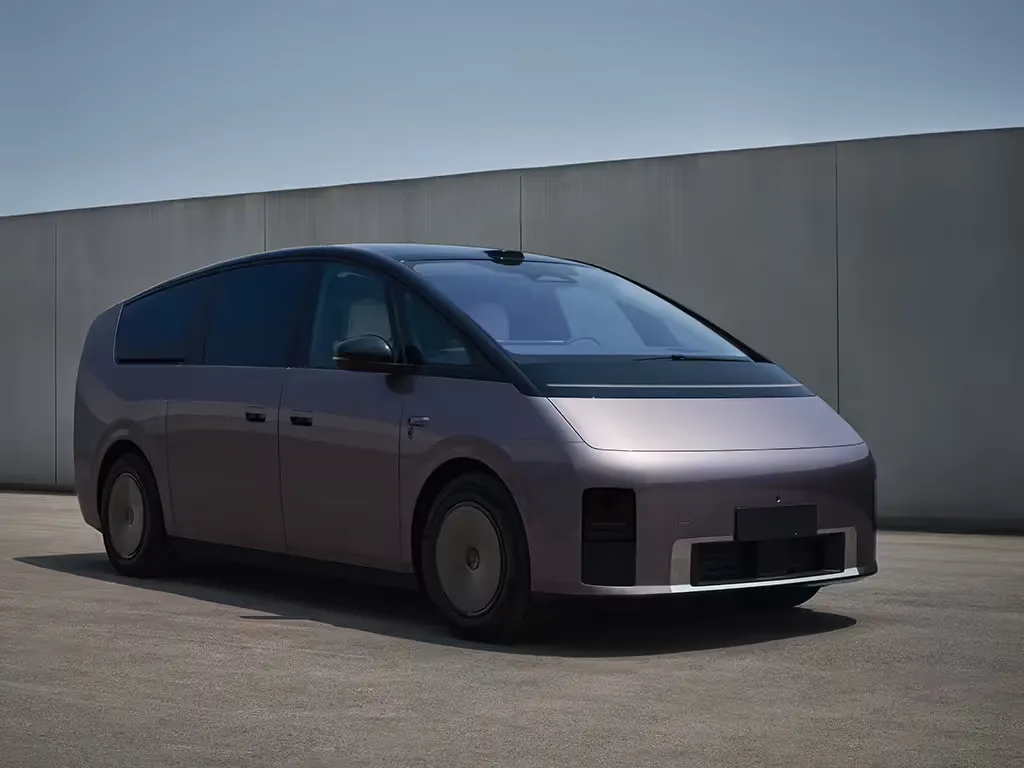
On July 22, footage from a Beijing TV news report unexpectedly revealed what appeared to be the interior of the refreshed Li Auto MEGA Home.

The brief clip showed the second-row cabin and part of the interior, revealing a number of design and feature upgrades compared with the current model.
This is not the first public appearance of the refreshed MEGA Home.
The vehicle had already surfaced in China’s Ministry of Industry and Information Technology (MIIT) filing batch No. 408.
Combined with the newly leaked images and regulatory filings, it is becoming clear that the facelift focuses primarily on interior refinements and smart technology upgrades.
With the interior now partially revealed, it’s worth taking a closer look at what has changed on the updated MEGA Home.
More importantly, could these upgrades help the MEGA lineup move beyond the shadow cast by its two major public-relations crises?
Upgraded features
As mentioned above, the key improvements on the refreshed MEGA Home center on the cabin and intelligent driving technologies.
Most of the upgrades can be identified from the leaked images.

Compared with the current model, the interior revisions are concentrated on design refinements and functional enhancements.
For example, the seats adopt a new diamond-quilted pattern, the fold-out tables are larger, the floor-mounted seat rails offer a longer adjustment range, and the air vents feature a completely new design.
Some reports suggest the second-row air vents have been redesigned as concealed electrically operated units, matching the latest front-row vent layout.
In addition, the refreshed MEGA Home adds vanity mirrors for second-row passengers—likely one on each side—while the center console display for rear occupants has been upgraded to a larger full-color screen.
Judging from the leaked images, the display may also show blind-spot camera feeds, allowing rear passengers to better monitor approaching traffic.

Many of these features have already appeared on flagship MPVs such as the Luxeed V9.
For the refreshed MEGA Home, these additions appear more like catching up with the latest segment trends.
Perhaps the most noteworthy change is a new longitudinal roof beam running through the center of the cabin.
Similar in concept to NIO’s “Sky Island” design, the structure could theoretically improve body rigidity while enabling independent left and right sunshade controls.
The trade-off may be a slightly less open cabin feel.
The front cabin has yet to be fully revealed, although the refreshed MEGA Home is expected to adopt an overall interior design language and display layout similar to the latest-generation Li L9.
The smart driving system is also expected to receive significant upgrades.
According to MIIT filings, in addition to the forward-facing LiDAR unit, the refreshed MEGA Home will support optional side and rear solid-state LiDAR sensors to enhance perception capabilities.
It is also widely expected to adopt Li Auto’s in-house developed Thor M100 intelligent driving chip.
Hardware upgrades have likewise been confirmed. The electric motor output and battery capacity have both been modestly increased, while Huawei and CATL remain the suppliers for the motor and battery systems.
The refreshed model will also introduce rear-wheel steering for the first time, addressing one of the shortcomings of the current vehicle.
Together with a more luxurious cabin and additional convenience features, the updated MEGA Home moves closer to what could be considered the vehicle’s “fully realized” form.
While closing product gaps is standard practice for any mid-cycle refresh, the MEGA faces challenges beyond its hardware.
As Li Auto’s first battery-electric model and the starting point of its pure EV strategy, the series has encountered obstacles that extend well beyond product competitiveness.
Challenges beyond the product
Back in 2023, when Li Auto first officially unveiled the MEGA name, founder Li Xiang made an ambitious prediction: the model would become the best-selling passenger vehicle priced above RMB 500,000 ($73,600), regardless of powertrain or body style.
Actual market performance has fallen well short of that goal. Since deliveries began in 2024, monthly sales of the MEGA lineup have never exceeded 4,000 units.
Roughly 20 days after the MEGA went on sale, Li Xiang admitted in an internal letter to employees that the company had misjudged the pace of its battery-electric strategy.

Later, during the 2024 Li Auto AI Talk event, he again acknowledged that the company had overestimated the size of the MEGA’s addressable market.
Meanwhile, controversy surrounding the vehicle’s exterior design, followed by an earlier vehicle fire incident, subjected the MEGA to two waves of intense public criticism.
Li Xiang described the incidents as “the largest smear campaign in automotive history.”
Although the company believes these incidents were handled appropriately, their long-term impact is unlikely to disappear quickly.
As a battery-electric vehicle, part of the MEGA’s early controversy was also linked to the immature state of Li Auto’s ultra-fast charging network.
As Li Xiang once put it, the Net Promoter Score (NPS) for the charging experience associated with the MEGA was “only in the 30s.”
That said, the MEGA has experienced periods of stronger sales performance.
According to Li Auto, MEGA deliveries surpassed 3,000 units in August 2025 and again in September, making it the best-selling battery-electric vehicle priced above RMB 500,000 ($73,600) for two consecutive months.
In the following months, however, monthly deliveries fell back below 1,000 units, with June sales reaching just 326 units.

Although it remains the top-selling large battery-electric MPV—currently a niche segment with few direct rivals—the result remains well below Li Auto’s original expectations.
Competition in the premium electric MPV segment is far from limited. Rivals including the Zeekr 009, Denza D9 EV (Flash Charging Edition), the Buick Electra Century EV, as well as plug-in hybrid competitors such as the Voyah Dream and the Luxeed V9, all compete with lower entry prices and continue to put pressure on the MEGA.
Even so, the MEGA still has opportunities ahead.
As of the end of June 2026, Li Auto had built 4,097 ultra-fast charging stations across China, equipped with 22,585 charging stalls and covering 290 cities nationwide.
As its charging network continues to expand alongside the refreshed vehicle’s hardware upgrades, Li Auto may be better positioned to compete in the premium battery-electric MPV market above RMB 500,000 ($73,600).
The MEGA is only one part of Li Auto’s broader battery-electric strategy.
In the second half of the year, the company is also expected to launch its flagship electric SUV, the i9, targeting the same RMB 500,000 ($73,600) price segment.
Together, the two vehicles will serve as key showcases for the Li Auto brand, demonstrating the company’s strengths in core technologies, ultra-fast charging infrastructure and customer service ecosystem.
Discover more from ChinaEVHome
Subscribe to get the latest posts sent to your email.