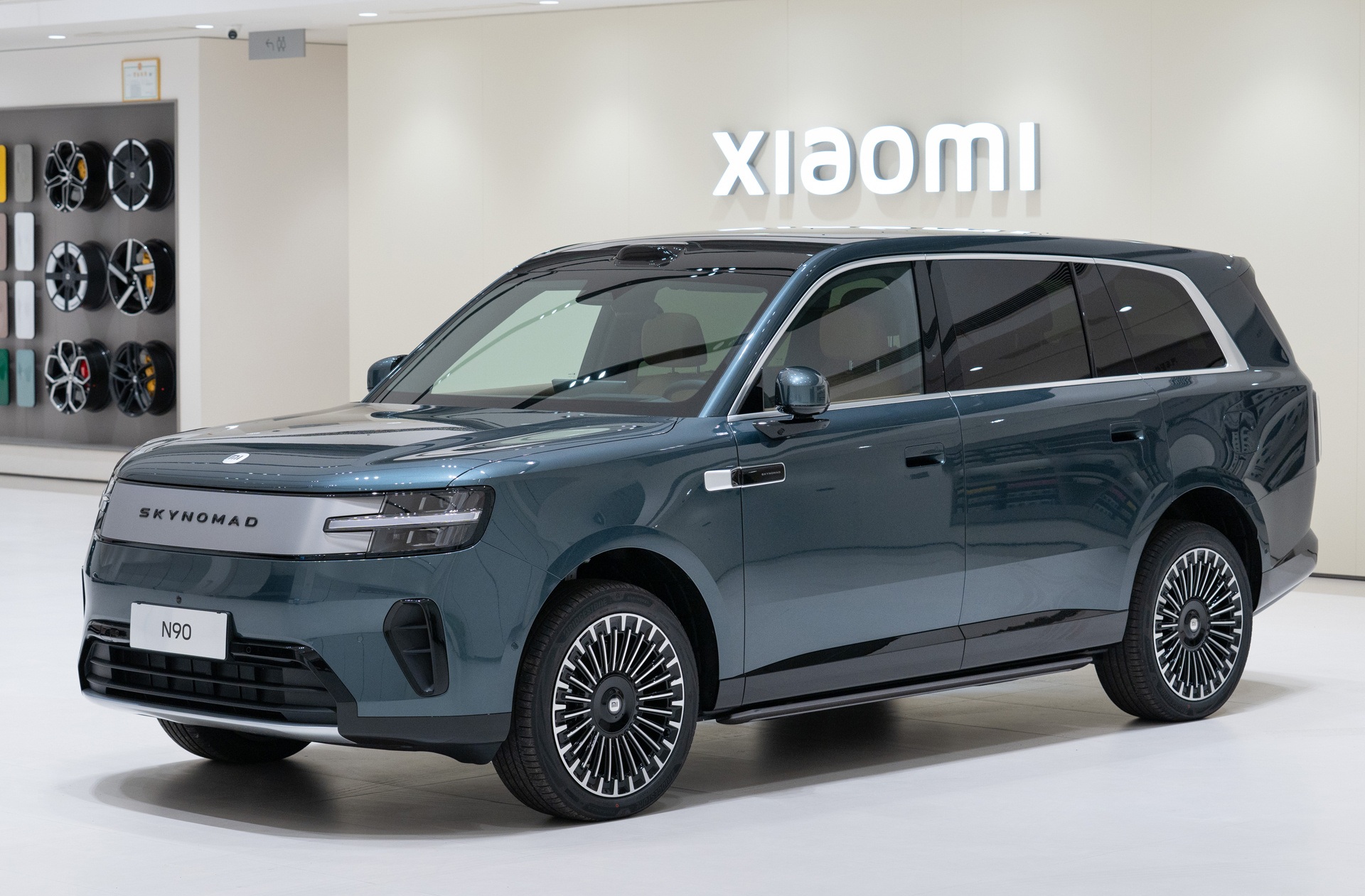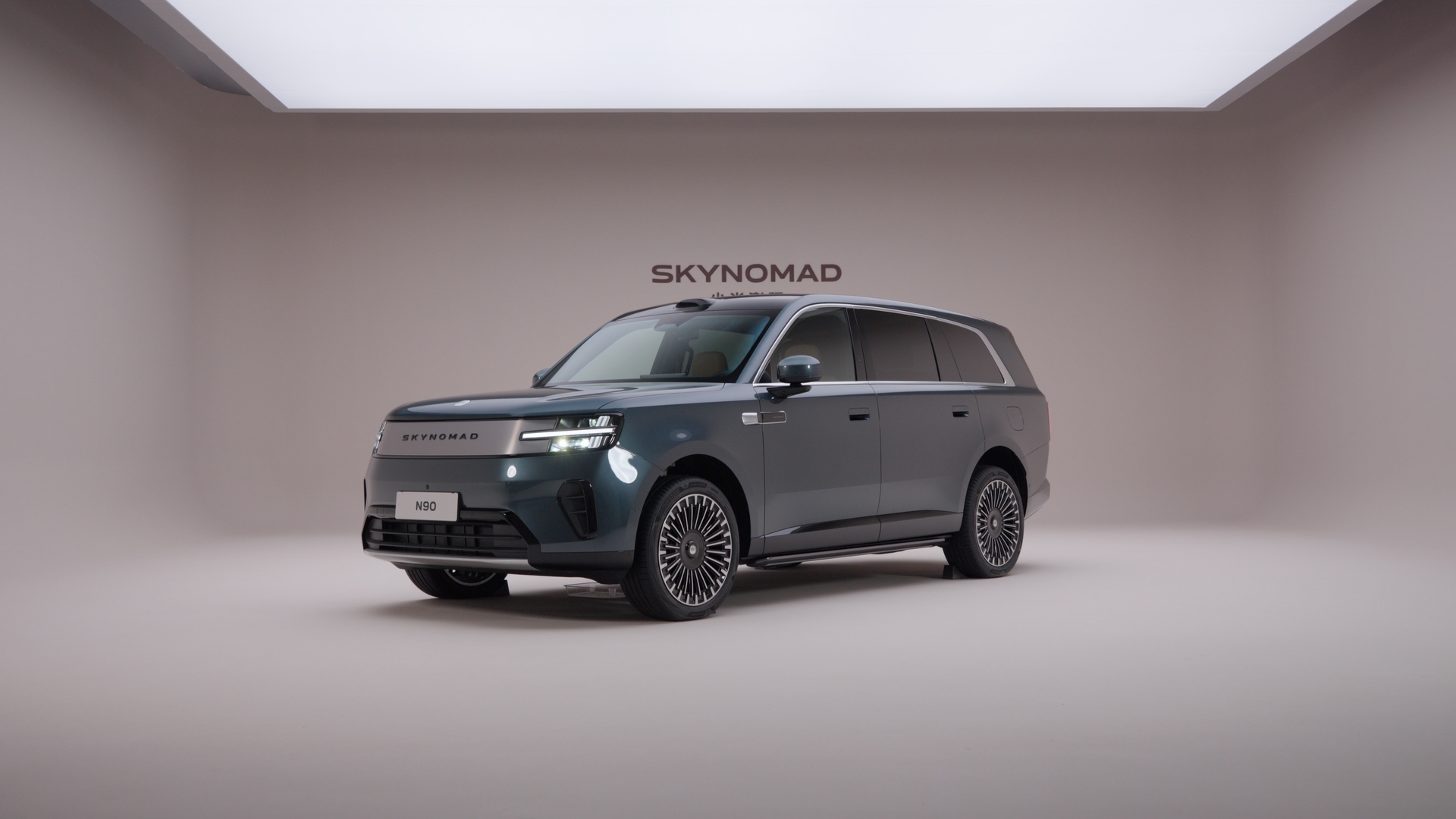
- Xiaomi launches SkyNomad N70 and N90 EREV SUVs with pre-sale prices from $38,470 to $44,390.
- Kunlun Platform yields a flat floor and 4.4 m² usable cabin enabling flexible 2+2+3 seven-seat layouts.
- N70 Max offers 505 km EV range and up to 1,705 km combined range using Xiaomi’s 1.5L range extender.
After weeks of intensive teasers, Xiaomi officially unveiled SkyNomad, the company’s second vehicle lineup, on the evening of July 30.
Much like Xiaomi Auto’s first “Tech Launch Event” held at the end of 2023, the presentation centered on the SkyNomad series focused primarily on product technologies, engineering concepts and functional innovations rather than marketing.
During the event, Xiaomi also announced the pre-sale prices for the N70 Max and N90 Max.
The SkyNomad N70 Max starts at RMB 259,900 ($38,470), while the SkyNomad N90 Max is priced at RMB 299,900 ($44,390).

Xiaomi founder Lei Jun revealed that Standard and Pro variants will also be introduced in the future. Given that the vehicles are still in the pre-sale stage, the final entry price of the SkyNomad lineup could still move lower.
Before discussing pricing further, however, it is worth taking a closer look at what Xiaomi’s second vehicle family actually brings to the market.
How Is SkyNomad’s “Large Cabin” Different?
Lei Jun said the presentation would explain the engineering foundation—or, as he described it, the “secret behind the spacious cabin”—through three core technologies: the Xiaomi Kunlun Platform, Xiaomi Kunlun Super Range Extender and Xiaomi Kunlun Comprehensive Safety Architecture.
The company clearly intends to make “space” the central theme connecting the lineup’s three technological pillars: the vehicle architecture, extended-range powertrain, and active and passive safety systems.
In typical Xiaomi fashion, Lei first walked the audience through the fundamentals of an electric vehicle chassis, explaining which components occupy underfloor space and why they often limit interior room.

Once the engineering challenge had been identified, Xiaomi moved on to its solution.
The first improvement focused on the rear electric drive unit.
Lei said that by optimizing component placement and reducing packaging size, vehicles built on the Xiaomi Kunlun Platform reduced floor thickness by 145 mm.

The fuel tank was another area of optimization. After evaluating different configurations, Xiaomi settled on a 60-liter tank and repositioned it to free up additional cabin space.
As a result, the company achieved a completely flat floor, with the thickest section measuring just 298 mm.
Another engineering priority was maximizing usable interior space. By redesigning the rear suspension layout and repositioning air-conditioning ducts, the Xiaomi Kunlun Platform delivers a total usable cabin area of 4.4 square meters.

With this packaging efficiency, vehicles on the platform can accommodate a 2+2+3 seven-seat configuration.
The second-row seats also offer an exceptionally large sliding range: when moved fully rearward, second-row legroom reaches as much as 1.55 meters.
When moved fully forward without affecting normal driving, cargo capacity expands to 1,831 liters.

According to Xiaomi’s presentation, the cabin’s sliding rails also support optional accessories such as folding tables, further expanding interior use cases.
In short, Xiaomi’s strategy for maximizing interior space rests on two key approaches: minimizing floor thickness to improve vertical room, while optimizing rear suspension geometry—including the adoption of an H-shaped control arm—and HVAC duct routing to maximize longitudinal cabin space.
The specifications illustrate the results most directly. In the SkyNomad N90, cabin height reaches 1,233 mm, second-row seating space measures 950 mm, and the center aisle between second-row seats is 180 mm wide.
Third-row passengers receive 890 mm of seating space and 962 mm of headroom.

Of course, both the N70 and N90 are already substantial vehicles.
The N70 measures 4,960 × 1,998 × 1,765 mm with a 2,950-mm wheelbase, while the N90 measures 5,285 × 1,998 × 1,825 mm with a 3,080-mm wheelbase, placing both firmly in the large SUV category.
At the same time, Xiaomi’s emphasis on maximizing interior packaging and minimizing rear wheel intrusion also means higher-end variants on the Kunlun Platform will likely forgo rear-wheel steering.
In other words, the Xiaomi Kunlun Platform is unlikely to underpin ultra-premium products.
Even before official pricing is announced, it is reasonable to expect that the flagship N90 Max will remain positioned as a relatively accessible offering.
505 km Electric Range, 1,705 km Combined Range
The second major topic shifted to the extended-range powertrain, where Lei Jun introduced key specifications related to range and performance.
Regarding driving range—one of the market’s biggest concerns—Xiaomi revealed that the N Series will initially offer two battery options: a 52-kWh lithium iron phosphate pack and a 76-kWh ternary lithium battery.

Combined with Xiaomi’s energy efficiency—consumption as low as 15.85 kWh per 100 km—the N70 Max equipped with the 76-kWh battery delivers up to 505 km of pure-electric CLTC range.
The larger N90 Max achieves 464 km under the same test cycle using the identical battery pack.

Both the N70 and N90 use a Xiaomi-customized 1.5-liter turbocharged range extender supplied by Dong’an Power, featuring a thermal efficiency of 42%.
Combined with fuel consumption as low as 6.26 liters per 100 km, the N70 Max delivers a combined driving range of up to 1,705 km with a full battery and full fuel tank.
The third technological pillar, “Comprehensive Safety,” occupied less presentation time.

Specifications such as a cage-type body structure and 2,200-MPa ultra-high-strength steel are no longer particularly unusual.
The more notable announcement was Xiaomi’s introduction of its own battery branding, the Longjia Battery.
Strictly speaking, the Xiaomi Longjia Battery represents a battery safety system rather than self-developed battery cells, which continue to come from supplier partners.
Lei Jun emphasized that Xiaomi is responsible for product definition, battery pack design and development, participation in cell design, and full-process quality control.
The different wording also provides a clear picture of Xiaomi’s level of involvement within the Longjia Battery program.
More tangible was Xiaomi’s claim that Longjia battery packs undergo durability testing equivalent to 300,000 km of use to ensure resistance to thermal runaway and other safety risks.
Lei also highlighted additional powertrain specifications for the N90 Max, including the ability to add 285 km of range in 15 minutes, a 20%-80% charging time of 18 minutes, a dual-motor powertrain producing 310 kW, 0-100 km/h acceleration in 5.9 seconds, and a top speed of 190 km/h.

It is evident that long driving range is one of the SkyNomad lineup’s primary selling points. Xiaomi hopes both its pure-electric range and combined driving range will rank among the best in the extended-range segment.
Ultimately, Xiaomi’s strategy of combining large battery packs with long driving range follows the prevailing direction of today’s extended-range market.
Rather than redefining the category, Xiaomi is leveraging its strengths—particularly in battery and electric powertrain technologies—to stand out within an already established competitive framework.
Taking On the “TV, Refrigerator and Sofa” Formula
While introducing the N90 Max in greater detail, Lei Jun joked, “TVs, refrigerators and sofas should be our area of expertise. Let’s show everyone how we compete.”
The remark reflects Xiaomi’s extensive ecosystem, which already spans all three product categories.
It also acknowledges that the now-common “TV, refrigerator and sofa” formula originated largely with extended-range SUVs, making direct competition inevitable as Xiaomi enters the segment.

So how does Xiaomi’s answer compare?
Based on the specifications revealed so far for the N90 Max, the package appears competitive rather than groundbreaking.
The “TV” is represented by an optional 21.4-inch, 3K rear entertainment display.
The “refrigerator” is a 9-liter heating-and-cooling compartment integrated into the movable center console. The “sofa” consists of up to four optional zero-gravity seats.
Objectively speaking, none of these features are particularly rare in the RMB 250,000 ($36,800) price segment, and their inclusion alone is unlikely to fundamentally reshape the vehicle’s competitiveness.
Other intelligent features—including a 4-nm cockpit SoC, Nvidia Thor-U processor and a 25-speaker audio system—may likewise prove insufficient on their own to determine consumer purchasing decisions.
Looking back, the N90 Max’s real competitive advantage over rivals may lie in its highly flexible and imaginative interior space.
Lei Jun said the cabin includes as many as 18 preset space configurations.

The concept of presets implies that every movable component—including the center console and both first- and second-row seats—can be electrically adjusted and quickly configured through voice commands using Xiaomi’s XiaoAI assistant.
Combined with optional powered doors and a wide range of accessories—including sliding rail tables and tea tables—Xiaomi has transformed the SkyNomad N90 Max into a highly automated and adaptable living space capable of supporting diverse use scenarios.
Building the entire vehicle around the concept of “space”—from functional definition to styling—represents the SkyNomad lineup’s most distinctive competitive advantage.
Another unexpected selling point is safety.
Unlike traditional automakers that emphasize body rigidity and crash-test performance, Xiaomi drew considerable attention by introducing an emergency floating capability on the SkyNomad N90 Max.

At the same time, several of Xiaomi’s redundant safety designs—including triple-redundancy door handles and dual-redundancy emergency tailgate release mechanisms—are likely to gain widespread attention online, further boosting discussion and visibility for the SkyNomad lineup.
Finally, it is worth noting that Xiaomi has established clear differentiation between its two vehicle families, demonstrating a level of product definition that even some traditional automakers have struggled to achieve.
The core SU and YU series focus on driving dynamics, reinforcing their positioning through connections with racetracks and lap-time performance to attract driving enthusiasts.
Although today’s event focused primarily on the N90 Max, the SkyNomad lineup has already established a distinct identity through features such as its configurable interior and “seven passengers plus seven suitcases” packaging concept.
And Xiaomi is still holding back one more surprise—a camping version featuring a height-adjustable roof. That special variant could become another highlight of Lei Jun’s future launch presentations.

Pricing also remains a key variable.
The two announced pre-sale prices both apply to the flagship Max variants.
This suggests two things: first, Standard versions could be priced RMB 30,000-40,000 ($4,400-$5,900) lower; second, as is common industry practice, official launch prices may come in below pre-sale levels.
What if, when the lineup officially launches in September, the N70 starts at RMB 199,900 ($29,400) and the N90 at RMB 249,900 ($36,800)?
It is still too early to judge how much disruption the SkyNomad lineup will bring to China’s extended-range vehicle market.
One thing is already becoming clear, however: competitors will need to pay close attention.
Discover more from ChinaEVHome
Subscribe to get the latest posts sent to your email.