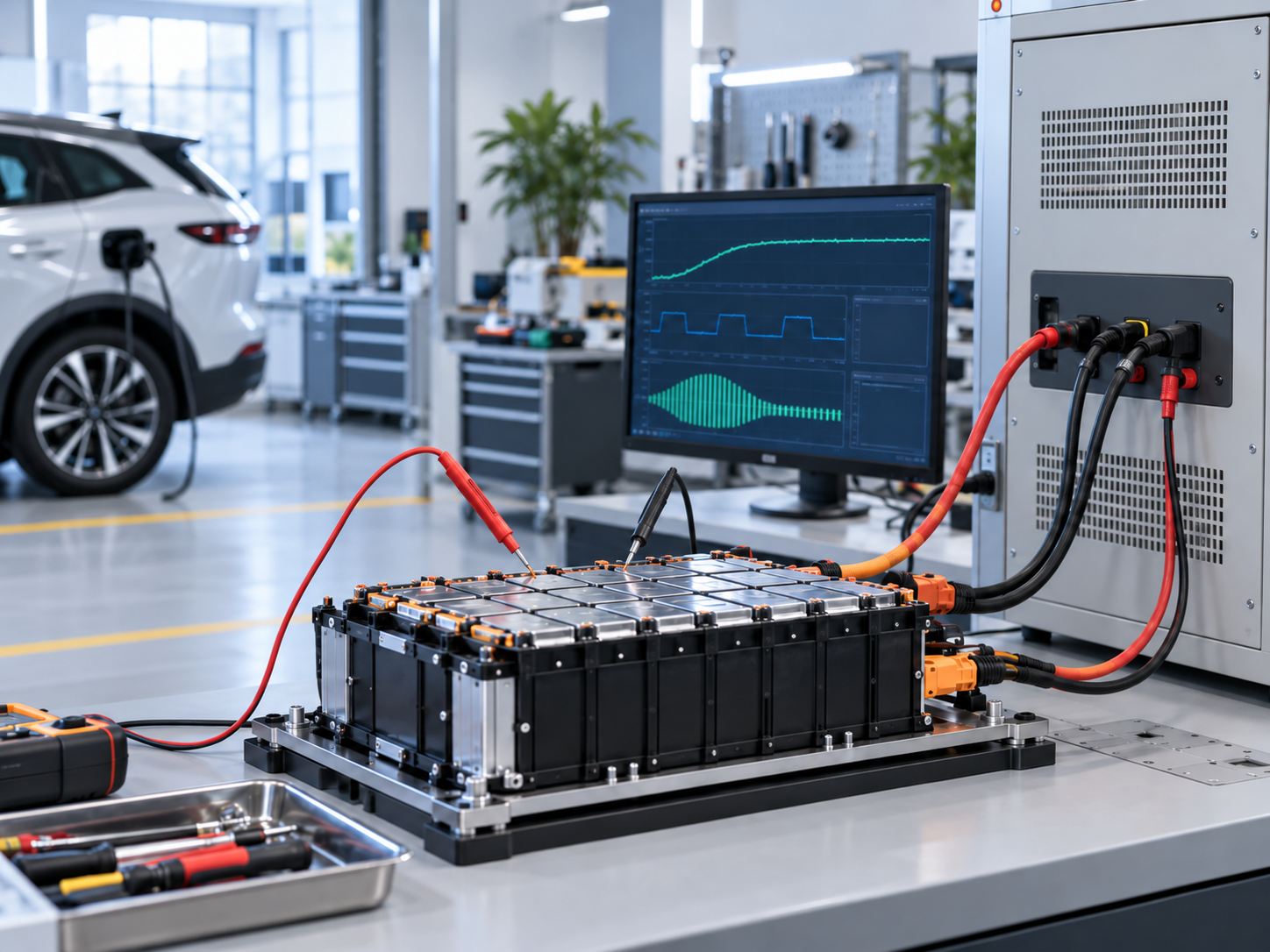
- China issued a unified national standard (GB/T 48100—2026) for in-service EV traction-battery testing, aligning methods across risk screening, used-car trades and functional assessments.
- The standard mandates tests for appearance, airtightness, insulation, thermal management, usable-capacity retention, voltage and internal-resistance consistency, effective March 1, 2027.
- Targets used-vehicle and NEV segments competing on transparency, but execution risks include nationwide lab capacity, consistent enforcement, data integration and scaling tests amid rapid NEV fleet growth.
On October 21, China’s State Administration for Market Regulation and the Standardization Administration of China released the national standard Test Methods for In-Service Traction Batteries of Electric Vehicles (GB/T 48100—2026). It will take effect on March 1, 2027.
The standard covers testing of traction batteries in electric vehicles already in service and applies to scenarios including battery risk screening, used-car transactions and functional assessments.
Under the standard, testing covers appearance, airtightness, insulation performance and thermal management systems.

It also defines general test conditions for batteries in service and provides methods for estimating usable-capacity retention, voltage consistency and internal-resistance consistency.
Previously, in-service traction battery testing lacked a unified methodology. Different testing agencies or used-car platforms could therefore produce significantly different assessments of the health of the same battery.
With the new standard in place, testing items and methods will have a common reference, potentially improving transparency around battery condition and used-vehicle transaction information.
The standard was led by China Automotive Technology and Research Center Co. (CATARC), with substantial participation from China Automotive Software (Shenzhen) Co. A total of 14 industry companies jointly drafted the document.
The participating organizations span vehicle manufacturing, traction-battery development, third-party testing and academic research, combining practical inspection requirements with technical expertise to support implementation.
The standard comes as China’s new energy vehicle (NEV) fleet and market penetration continue to grow rapidly.
According to data from the Ministry of Public Security, China had 43.97 million NEVs in operation at the end of 2025, accounting for 12.01% of all vehicles.
In the first half of 2026, 5.622 million NEVs were newly registered nationwide, up 27.86% year over year and accounting for 44.97% of all new vehicle registrations during the period.

As new-vehicle sales rise, the number of in-service vehicles requiring evaluation and resale is also increasing.
Data from CPCA show that retail sales of new energy passenger vehicles reached 1.084 million units in September 2026, with the retail penetration rate hitting 67%, up 9.1 percentage points from a year earlier.
Cumulative retail sales for the first nine months reached 7.758 million units.
As NEVs enter a broader phase of use and replacement, battery health assessments, used-car pricing and safety-risk screening increasingly require test results that are accurate and comparable.
Beyond in-service testing, China is also advancing full-lifecycle management of traction batteries.
In August, the Ministry of Industry and Information Technology said China would study and draft administrative regulations on the recycling and reuse of NEV traction batteries.
It also plans to introduce a digital battery ID system to make battery origins traceable and destinations trackable.
The country targets lifting the annual comprehensive utilization volume of retired traction batteries to above one million tonnes by 2030.
Discover more from ChinaEVHome
Subscribe to get the latest posts sent to your email.