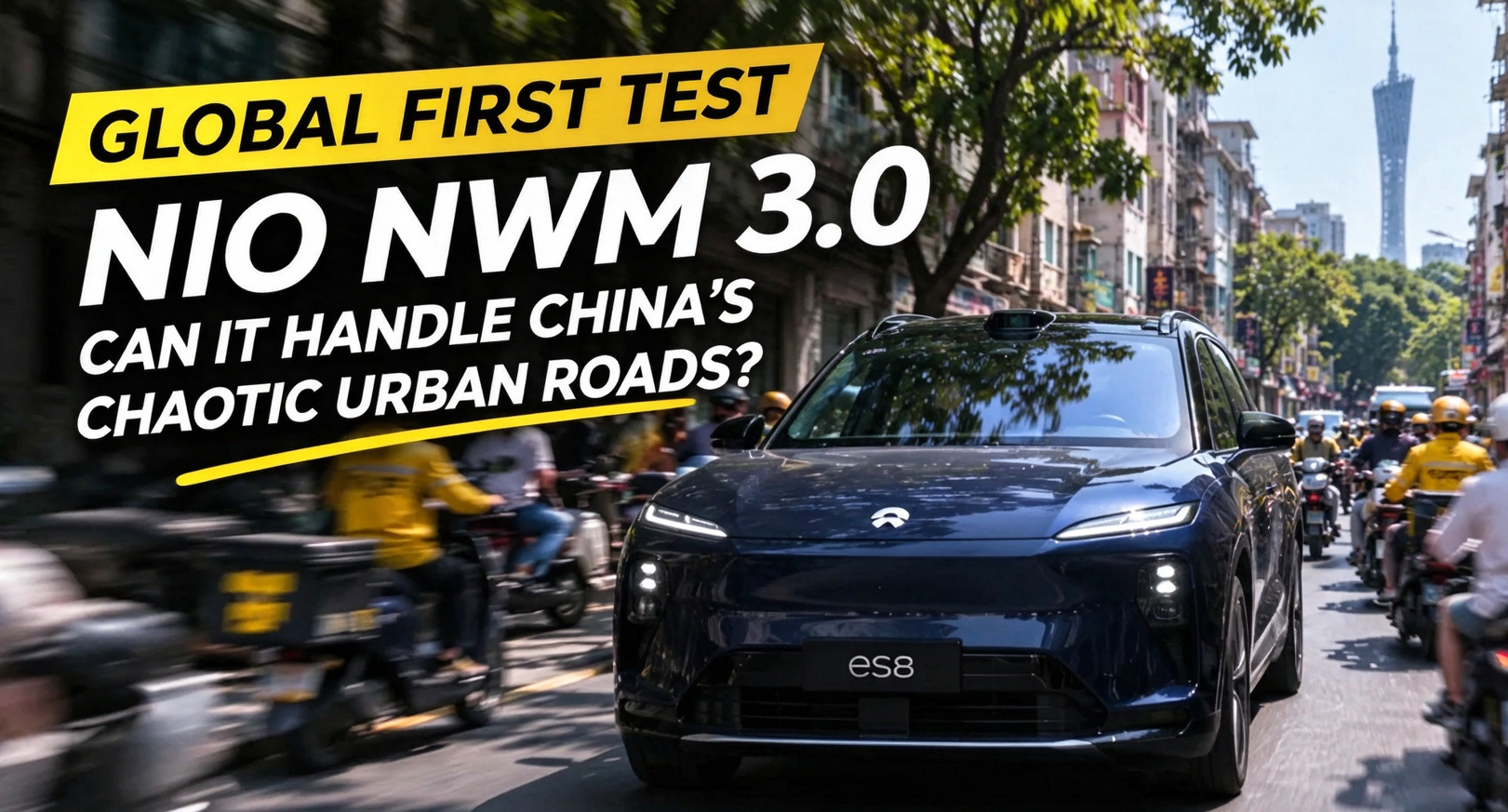
- NIO debuted NWM 3.0 on an ES8 in Guangzhou, showing a strategic push to upgrade intelligent driving capabilities to better handle chaotic urban scenarios and win local consumer trust.
- The ES8 completed a 1 hour 40 minute urban route including underground garage navigation, curved ramps, complex intersections and roundabouts, with zero manual takeovers reported.
- NWM 3.0 targets rival autonomous-driver features from other Chinese EV tech stacks, but execution risks include limited test sample size, delayed footage release, real-world variability and scaling latency improvements.
Before I had even tightened my grip on the steering wheel, the car had already completed an evasive maneuver.
This morning, as we crossed a small bridge leaving Ersha Island in Guangzhou, an electric scooter suddenly cut into our lane from the front right.
I was startled. My hands instinctively moved toward the steering wheel, and my foot was ready to hit the brake.
But at that very moment, the ES8 I was driving had already made a small adjustment to steer around it.
The whole thing happened very quickly.
It was the first moment that morning when I got a clear, firsthand sense of what Ren Shaoqing had meant by “low latency” during his presentation at NIO IN the previous day.
At the time, however, I had no idea that this was actually one of the simpler scenarios I would encounter during the day’s test drive.
Welcome to our written report on the global first drive of NIO’s new intelligent driving system, the world model NWM 3.0.
I hope this account will give readers a general sense of where NWM 3.0 has made progress.
Setting Off With One Question in Mind
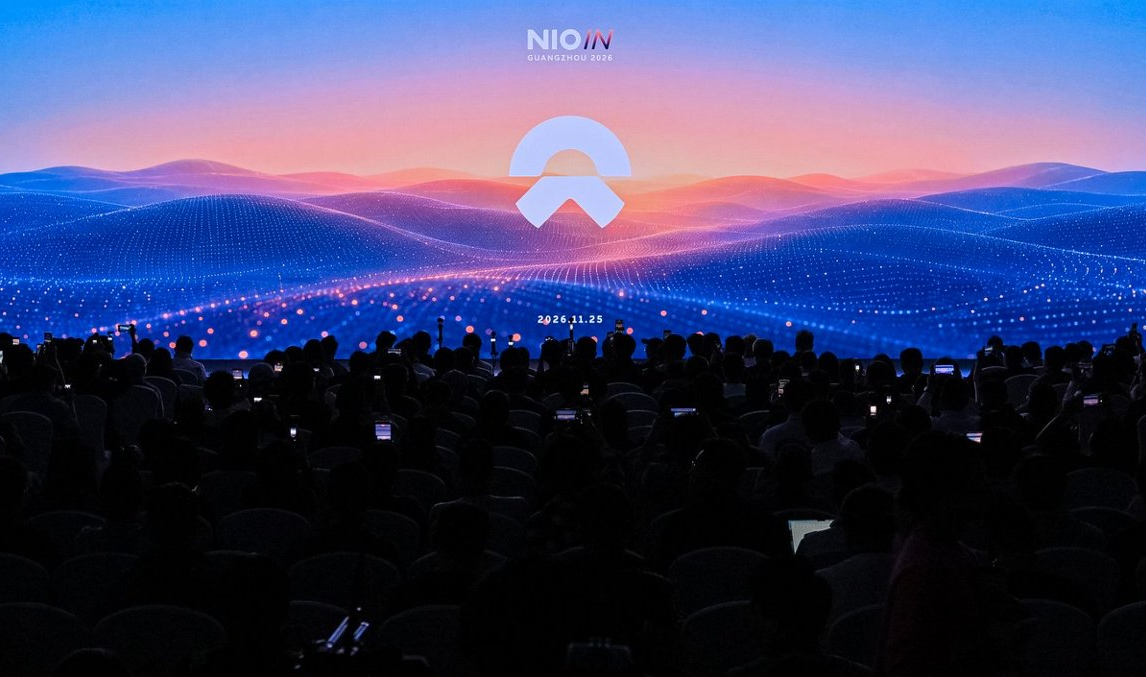
On November 25, NIO held its NIO IN Technology Day in Guangzhou, unveiling its new world model, NWM 3.0.
In my article, “Inside NIO’s Push to Rebuild Its Business Around AI,” I discussed the company’s direction in intelligent technology and how it relates to embodied intelligence.
I raised a question in that article.
At NIO’s current stage of development, what do the company’s existing and prospective customers really want to know?
Is NIO’s intelligent driving actually good? Is it practical enough to use, and should they use it?
The answers to these questions will be crucial to NIO’s future development. They are also fundamental to the company’s progress.

This morning, I picked up an ES8 five-seat version equipped with the NWM 3.0 Pioneer Experience Edition at NIO House near Canton Tower in Guangzhou.
The scope of today’s test was relatively limited, with only a small number of participants taking part in the morning and afternoon sessions.
We also filmed the drive, but under the current schedule, the footage will not be released until the end of December. So for now, I will use this article to share my impressions.
First, a quick overview of the route.
We set off from Canton Tower at 10:20 a.m., joined Guangzhou Avenue, crossed Guangzhou Bridge and headed down onto Ersha Island.
From there, we followed Yanjiang Road toward Dashatou, entered old-city streets such as Wenming Road and Huifu West Road, passed the Beijing Road intersection, crossed the river via Jiefang Bridge, and drove along part of the Inner Ring Road.
We then exited near Haizhu Bridge, passed Zhongda Ferry Terminal and entered the urban village near Kecun before returning to Canton Tower.
The entire drive took around 1 hour and 40 minutes, with zero manual takeovers.
Anyone familiar with Guangzhou should have a fairly good idea of the kind of route this was.
I have lived in Guangzhou for many years, yet some of the streets we drove through today were places I had never even driven to myself.
The Car Reacted Before I Could Grip the Wheel
We started directly from the B2 level of the underground parking garage at Canton Tower.
The car navigated the garage autonomously, found the exit and passed through the gate on its own.
At one point, it made a left turn but misjudged the available space, with a pillar blocking its path. It reversed slightly, repositioned itself and then found room to complete the turn.
This capability was already available in version 2.5. My impression is that version 3.0 handles it with greater finesse.
However, the experience was brief, so I would not draw too many conclusions from it.

There is a sharply curved ramp leading down from Guangzhou Bridge onto Ersha Island.
Between 2020 and 2023, this was a popular testing location for many intelligent driving systems. Back then, quite a few vehicles simply could not navigate the ramp.
Trying to force their way through would almost certainly result in a collision.
Today, the ES8 negotiated it smoothly.
The electric scooter mentioned at the beginning of this article provided my first real surprise.
We were leaving Ersha Island and crossing a short bridge. Several bicycles and electric scooters were traveling along the right side of the road.
Suddenly, a woman riding an electric scooter moved into our lane to get around a slower bicycle ahead of her. She encroached on roughly three-quarters of our vehicle’s width.
My first instinct was to take over.
But before I could even get my hands firmly on the steering wheel, the car had already made a small steering adjustment and avoided her.
Pay attention to that: it was a very small maneuver.

The car did not make a sharp turn in response to the sudden intrusion, nor did it give me the impression that it was panicking.
This was the first time I had experienced so clearly the difference between NWM 3.0 and the production version of 2.5.
Ren Shaoqing covered a lot of ground in his presentation the previous day, including lower latency, end-to-end optimization and more refined perception.
These terms are difficult to fully appreciate when they appear on a PowerPoint slide.
But when you are sitting in a car and an electric scooter suddenly cuts into your lane, you begin to understand at least part of what they mean.
As the test drive continued, I realized that the benefits of lower latency went well beyond faster reactions.
The Ability to Probe and Anticipate
After leaving Ersha Island, we reached an intersection near Jiangwan Gas Station.
This is a location that ChinaEV Home almost always passed through during its previous intelligent driving tests.
Why?
Because it is difficult.
You need to turn right first, then immediately move left into one of the two left-hand lanes within a space of just a few meters. Otherwise, you will end up in a straight-through lane.
At the same time, the road facing you is one-way, with vehicles also turning left out of it.
We were turning right while they were turning left, bringing two streams of traffic into conflict within a very limited space.

We had tested many intelligent driving systems here before, and quite a few had failed. Some chose the wrong lane, while others ended up in awkward positions with no clear way forward.
Today, however, the car moved decisively to the left immediately after turning right.
It showed a good understanding of the overall traffic situation and made the right judgment.
A little farther ahead, its performance at a small roundabout also put a smile on my face.
When I was younger, I used to find this stretch of road particularly frustrating to drive.
There were cars everywhere, coming from different directions and pushing their way into the same space. You had to keep yielding while looking for an opening to move forward.
Today, the ES8 handled it without much drama.

It yielded when necessary, while also inching forward. Even when other vehicles cut in, it did not always bring itself to a complete stop.
Instead, it maintained speeds of around 1 km/h, 2 km/h or 5 km/h, gradually moving forward.
I found myself wondering what to call this kind of behavior.
The word that came to mind was “probing.”
When we drive ourselves, we do this all the time.
For example, at an intersection without a clearly established right of way, I might edge forward slightly to see how the other driver responds. If they keep moving, I yield. If they stop to let me through, I continue.
Through our own movements, we gather more information about the other party’s intentions, then adjust our actions in response.
It is a continuous process.
NWM 3.0 gave me a strong sense that it could do the same thing.
And many of the situations that followed reinforced this impression.
Low Latency May Enable a New Kind of Driving Capability
There were two situations near Zhongda Ferry Terminal that left a particularly strong impression on me.
In the first, we were driving straight ahead when I spotted two cars about 50 meters away in the opposite direction, preparing to turn left into a side street.
I noticed that the ES8 began slowing down well in advance, gradually rolling forward as it decelerated.
As soon as the two cars had passed, it almost immediately accelerated, taking advantage of the opening and moving through smoothly.
This may sound simple, but think about what is involved. If the car had been moving faster, it might have needed to brake sharply upon reaching the intersection.

If it had been moving more slowly, other vehicles might have entered the space before it got there.
The system needs to know not only where those two cars are, but also where they will be by the time it reaches the intersection.
It then needs to adjust its speed based on that prediction.
After passing Zhongda Ferry Terminal, we turned right onto the street alongside Zhongda University’s side entrance and encountered a similar situation.
An elderly person was crossing the road very slowly.
Our car had already reduced its speed, rolling forward at a slower pace. Once the pedestrian had cleared the space we needed to pass through, the car made a slight adjustment to the right and accelerated.
At another intersection, there was a bicycle on our right.
The cyclist suddenly moved forward, so our car stopped briefly. When the bicycle stopped, our car edged forward again.
The cyclist then appeared ready to move, but stopped after seeing our vehicle approaching.
Only after confirming that the cyclist had stopped did our car accelerate more decisively and cross the intersection.
These situations all point to the same thing.
The system is not simply identifying objects, nor is it merely reacting to events that have already happened.
At least based on what I experienced today, it is beginning to demonstrate the ability to use continuous movements to probe, assess and understand the intentions of other road users.
I consider this an important capability. In the past, some might have described this kind of intelligence as “emergent.”
During the drive, I asked the NIO intelligent driving engineer accompanying us a question.
I asked how much latency had been reduced in version 3.0 compared with version 2.5.
He said that in absolute terms, the improvement might amount to around 400 to 500 milliseconds. But in terms of the reduction factor, latency had been cut by approximately three to five times.
Four or five hundred milliseconds is less than half a second. But what does that fraction of a second mean in a constantly changing physical world?
My understanding is that it does not simply allow the system to initiate an action earlier. It also gives the system more time to update its judgments and actions in response to changes in the environment.
It has a larger spatiotemporal window in which to process problems.
Situations that the system might previously have been unable to handle in time can now be addressed.
Scenarios that once required the vehicle to stop and wait may now allow it to keep moving slowly while continuously assessing and adjusting its behavior.
These capabilities became particularly apparent when we later entered the urban village near Kecun.
Into the Delivery Riders’ Hive
After passing Zhongda, the navigation system took us into a network of narrow streets and alleys near Kecun.
Despite having lived in Guangzhou for so many years, I had never been to these places.
The roads were narrow, with construction barriers, temporarily parked vehicles and all kinds of obstacles.
That was when we came face to face with a large fire engine.
I glanced at the space between the two vehicles and thought passing each other would be an extremely tight maneuver.
But the ES8 did not flinch.
It crept forward at around 1 or 2 km/h. The fire engine did not come to a complete stop either, and the two vehicles squeezed past each other at an extremely low speed.
The proximity warning kept beeping inside the cabin, but the vehicle’s movements remained remarkably stable.
One kilometer per hour, two, three, four, five—little by little, we made it through.

I could even see in the rearview mirror that the fire engine turned its wheels to the left after the two vehicles had passed each other.
That scene stayed with me.
In a space like this, coming to a complete stop does not necessarily solve the problem. Sometimes two vehicles need to coordinate with each other and continuously adjust their positions while moving to find a way through.
It is a form of negotiation.
After passing the fire engine, we continued along the road.
Then things started getting increasingly surreal. It felt as though we had driven straight into a beehive.
A beehive full of food delivery riders.
The farther we drove, the more electric scooters appeared in front of, behind and alongside us. They kept weaving past the front, rear and sides of our vehicle.
There were also large numbers of motorcycles and electric scooters parked temporarily along the roadside.
First, we encountered an oncoming vehicle and had to pass it while countless electric scooters continued weaving around us.
I watched the ES8 inch forward at 1 or 2 km/h, probing for space and gradually finding a way through.
It made it.
But a little farther ahead, an even more unusual situation emerged.
A circular raised area suddenly protruded from the right side of the road, with numerous motorcycles parked inside it.
The already narrow road became almost a single lane at that point.
And, of course, another car was approaching from the opposite direction.
If you were driving yourself, what would you need to do in that situation?
First, you would have to let the oncoming vehicle pass.
Second, you would need to think about how to get through afterward. There were still large numbers of electric scooters moving forward behind and alongside you.
If you stopped completely, the space you had just made available might immediately be occupied by other road users.
I watched the ES8 inch forward amid the constant flow of electric scooters, making small steering adjustments to leave enough room for the oncoming vehicle.
Once that vehicle had passed, as expected, a large number of electric scooters behind us on the left began moving forward.
Our car, meanwhile, continued to creep along at a very low speed.
It began steering to the left, inching forward until it confirmed that there was enough room to pass. It then executed a continuous, remarkably stable maneuver.
And just like that, it got through.
No takeover.
I genuinely found the performance impressive.
I don’t know—perhaps it is only in China that you can encounter traffic participants in such density and complexity. It may also be that only a handful of intelligent driving systems in the domestic market could potentially navigate a situation like this.
Of course, that is my personal assessment based on today’s experience, not the conclusion of a comparative test.
Think about what a system needs to understand to navigate a situation like this.
It is not just the car in front of you, or the electric scooters on your left and right.
It needs to understand what is happening across the entire 360-degree physical environment, as well as what might happen next.
More importantly, that environment is changing extremely quickly.
As you inch forward, the other road users in the surrounding space may also change their behavior in response to your movement. You then have to reassess the situation based on those changes.
I don’t think words alone can adequately convey what that scene was like.
Fortunately, we happened to have a 360-degree panoramic camera mounted at the front of the vehicle today. I hope the video, which should be released in just over a month, will give viewers a better sense of what happened and show what a capable intelligent driving system can achieve at this stage.
After getting through that section, a thought suddenly crossed my mind.
I felt that autonomous driving really could become a reality one day.
Cutting Out the “Middleman”
Why was the improvement so significant this time?
I also asked the engineer accompanying us about this.
He described an interesting change. Put simply, the process from image input to the final execution of an action has cut out the “middleman.”
Previously, the system might first have had to interpret what it saw, then pass that interpretation to a downstream system for execution.
According to the engineer, NWM 3.0 now has a more direct process, linking image inputs from five cameras to the final output of vehicle actions.

Of course, this is a simplified explanation intended to make the concept easier to understand.
But it at least helped me understand why the car demonstrated such low latency and such continuous driving behavior in many of the situations we encountered today.
In yesterday’s article, I discussed NIO’s intelligent technology strategy, its world model and embodied intelligence.
Today’s test drive gave me a much more tangible sense of the ideas I had written about.
A vehicle uses cameras to observe the physical world, a model to understand and predict that world, and its own movements to interact with it.
The physical world then changes in response to the vehicle’s actions, and those changes become new inputs for its observations and decisions.
The cycle continues.
Not Without Room for Improvement
After covering so many aspects of the drive that impressed me, I also want to discuss two situations where I believe there is still room for improvement.
The first occurred shortly after we left Canton Tower.
As we turned from a small side street onto Guangzhou Avenue, the main road was moving relatively quickly, and we needed to turn right before taking a ramp.
I felt the car was somewhat too conservative during this maneuver.
Based on my observation of the traffic at the time, there was sufficient space and the road was not particularly congested. The car could probably have turned and moved through a little faster.
This was not a major issue.
What I found interesting, however, was the answer I got when I asked a staff member accompanying us a question.
I asked whether this relatively conservative driving style had been deliberately configured through a Reward Model, or whether it was something the system had learned by itself from large amounts of data.
He said it was the latter.

In other words, according to his explanation, this driving behavior had been learned by the model itself.
It had effectively trained itself to behave this way.
That was interesting.
The second situation deserves more attention.
We exited the Inner Ring Road and headed toward Haizhu Bridge, but instead of crossing the bridge, we needed to enter its access road.
At the time, we were in the leftmost lane of the Inner Ring Road and were positioned relatively far to the left after exiting. Based on the route ahead, the vehicle should actually have moved to the right earlier.
However, there was a fast-moving car behind us on the right.
Our vehicle continued forward until I suddenly felt that something was not quite right.
If it waited any longer to move right, the window for entering the access road would become extremely narrow.
It eventually yielded to the car approaching from behind on the right, then made two or three consecutive lane changes to enter the access road.
Looking in the rearview mirror, there appeared to be enough space for the lane changes. But I felt the overall route planning was not good enough.
The final lane change in particular was rather abrupt, with the vehicle crossing the lane marking in a somewhat forceful manner.
In fact, we could already have entered the access road from the second or third lane from the right. That final lane change was unnecessary.
While I was writing this article, NIO also shared the results of its review of the incident.
According to the company’s explanation, a waypoint had been set near Haizhu Bridge, but the waypoint had not been positioned correctly. This led to the vehicle’s behavior, rather than any inherent limitation in the system’s capabilities.
I am including NIO’s explanation here as well.
As for how the final production version will handle similar situations, we will have to test it again. After all, what we experienced today was only a Pioneer Experience Edition, not the final production version.
Returning to Yesterday’s Question
We set off from Canton Tower and returned to Canton Tower 1 hour and 40 minutes later.
Over those 100 minutes, I felt my confidence in NIO’s intelligent driving system build gradually, one scenario at a time.
From the electric scooter that suddenly cut into our lane on Ersha Island, to the small roundabout near Jiangwan Gas Station, Zhongda Ferry Terminal, the extremely tight encounter with the fire engine, and finally the delivery riders’ beehive.
The farther we drove, the more apparent the gap between version 3.0 and the current production version of 2.5 became.
Of course, a single drive without manual intervention does not mean a system can operate without takeovers in every situation.
Nor does it mean drivers can afford to relax their attention or neglect their responsibilities behind the wheel.

But today’s experience gave me a new answer to the question I raised yesterday.
Is NIO’s intelligent driving actually good? Is it practical, and should people use it?
I think if the final production version of NWM 3.0 can maintain the capabilities demonstrated by today’s Pioneer Experience Edition, then with version 3.0, buyers considering a NIO vehicle may genuinely no longer need to treat intelligent driving as a major concern.
That was my biggest takeaway from today’s 100-minute drive.
At the end of December, we will also look for an opportunity to conduct a more in-depth evaluation of the final production version of NWM 3.0.
There should be two videos: one covering the Pioneer Experience Edition we filmed today, and the other featuring the final production version.
We will also be able to see how much the model—which continues to learn and improve every day—has changed over the course of just over a month.
Stay tuned to ChinaEV Home.
See you at the end of December.
Discover more from ChinaEVHome
Subscribe to get the latest posts sent to your email.