It has been a while since the pre-release of Xiaomi YU7, yet its popularity remains undiminished.
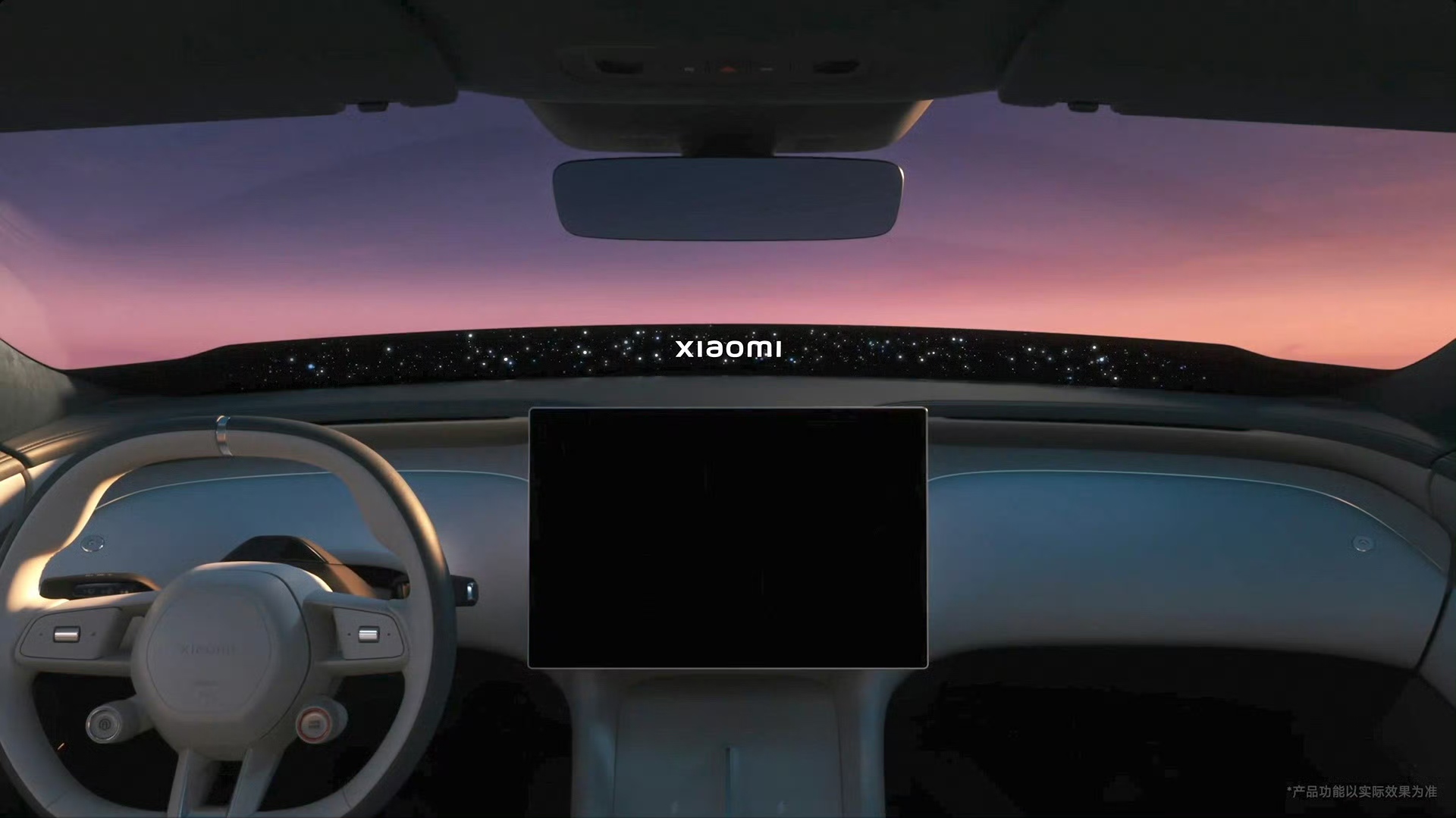
In the national car owner groups that we have organized, netizens are still enthusiastically discussing some of the product highlights of YU7, among which Xiaomi’s ” HyperVision” is the most talked-about.

On the one hand, since Xiaomi YU7 is only pre-released, there may still be other selling points that haven’t been disclosed. Among the currently revealed features, “Xiaomi HyperVision” is indeed the most eye-catching. On the other hand, the “Xiaomi HyperVision,” which represents the P-HUD (Projection Head-Up Display) technology, is regarded as the next-generation in-vehicle display solution, and there is plenty of room for discussion about its pros and cons.
Some netizens think that the display method of Xiaomi HyperVision is very “cool,” while others question its practicality and actual display effect.
Before the display vehicles are fully in place and road tests are allowed, due to the lack of the most authentic experience and comparison, the discussion around “Xiaomi HyperVision” is expected to continue for a while.
However, by analyzing the underlying technical principles and referring to other cases, we can still make a basic judgment on the real value of Xiaomi YU7’s “Xiaomi HyperVision.” After all, is it worth our expectation?
The Reality of “Xiaomi HyperVision”
Understanding the underlying technical principles is the first step for us to further understand the technological value of Xiaomi’s “Xiaomi HyperVision” panoramic display.
From a technical perspective, Xiaomi’s “Xiaomi HyperVision” is a specific application of P-HUD technology, in other words, this technology is of the same origin as the commonly seen HUD function in the industry.
The “distant screen” that is often discussed together is just a combination of multiple physical screens placed closer to the windshield on the dashboard, which is a completely different technical route from “Xiaomi HyperVision.”
Fresh but Mature
What can slightly reassure the potential users of YU7 is that although P-HUD made its debut as a “new technology” in 2023, its maturity is beyond imagination.
In March 2023, BMW showcased its innovative cockpit design philosophy globally through the Neue Klasse concept car. This concept car abandoned the traditional “center console screen” and instead used a HUD that runs through the cabin to display complex information such as vehicle conditions and road conditions.

Because of its “spanning from left to right A-pillar” visual effect, BMW named it “Panoramic HUD,” and the name “P-HUD” came from this.
The reason why it is said to have “beyond imagination” maturity is that although P-HUD has innovative experiences, neither the complexity of the imaging nor the overall cost is as high as the current mainstream W-HUD and AR-HUD.
Comparing the imaging light paths, the “PGU” (Picture Generation Unit) of P-HUD can directly project the display image onto the imaging area of the front windshield (that is, the blackened area), and the human eye can directly capture the image.

In contrast, W-HUD needs at least two sets of large and small reflection mirrors to refract the display image onto the front windshield, which makes the light path more complicated and the volume of the entire imaging system much larger. Therefore, both the cost of W-HUD itself and the design difficulty of the dashboard are higher than those of P-HUD.
From another perspective, this is also the result of innovation in the display aspect of P-HUD.
Because the display content of P-HUD is fixed in a specific area (W-HUD supports small-range adjustments in height and angle, etc.), and the position is lower, the imaging light path can be designed to be simpler.
Precisely because the technical difficulty is not high, after BMW introduced the P-HUD concept in 2023, China’s supply chain followed up in the first place and launched several landing solutions.
At the CES in 2025, Huizhou Hua Yang, the supplier of Xiaomi YU7’s P-HUD, exhibited their P-HUD technology solution. At the same time, other vendors such as Zejing, Yili Electronics, Harman, Valeo, TCL & HuaXing, Hyundai Mobis, and BOE also exhibited similar technical solutions.
BMW’s concept solution came from Bosch. However, neither Xiaomi nor Hua Yang has disclosed what advantages Hua Yang’s P-HUD solution has compared to other suppliers.
The fact that almost all the top solution providers have “one in hand” fully shows that P-HUD itself has no great technical difficulty and is already a “mature” technology.
Under this premise, another factor determines the experience of Xiaomi HyperVision.
Experience Beyond the Past
The image of P-HUD is fixedly projected onto the blackened area at the bottom of the front windshield. Its inherent advantage is that it is less affected by light. In theory, as long as suppliers focus on improving the display effect of the PGU, they can get good feedback in terms of experience.
BMW’s iDrive cockpit concept platform exhibited at CES at the beginning of the year has a P-HUD image composed of three 12-inch TFT screens. It can achieve a maximum brightness of 1000 nits and a contrast ratio of 100000:1.

According to the official data previously released by Xiaomi, the PGU module of the “Xiaomi HyperVision” on YU7 is also composed of three screens, with a single screen size of 11.98 inches, supplied by TCL & HuaXing, and the total display area is 1.1 meters long.
Compared with BMW’s (Bosch’s) solution, Xiaomi’s (Hua Yang’s) screen material has taken a further step, using Mini Led. To briefly introduce, although Mini Led is also based on Lcd technology, it has upgraded the backlight module to greatly improve brightness and contrast ratio.
It can be seen that, thanks to the 903 backlight partitions, the maximum brightness of YU7’s Xiaomi HyperVision is 1200 nits, and the contrast ratio is theoretically far beyond 100000:1.

In addition, with the cooperation of <1% reflectivity (SEC) and ≤0.01% transmittance, the first thing that Xiaomi YU7’s Xiaomi HyperVision can ensure is the clarity of the display.
Especially compared with ordinary HUDs, the experience has been greatly improved.
In terms of the PPD (pixels per degree of vision) parameter alone, traditional HUDs are between 20 and 40, while center console screens are mostly between 70 and 90 (the higher the PPD, the more delicate the image effect). Xiaomi’s “Xiaomi HyperVision” reaches 108 and is called a “retina-level” standard.
However, on Zhihu, a creator who claims to be an insider in the HUD industry mentioned that the current landing difficulty of P-HUD is that “it has extremely high requirements for the interior size chain.” The method to judge whether it has been done well is also very simple. If the font displayed on the P-HUD of the mass-produced YU7 does not deform, it means that this problem has been overcome.
Combined with the “ability to display a variety of information” and the support for customizable content that Xiaomi simply mentioned at the press conference, it is believed that this “Xiaomi HyperVision” can bring more freshness. It is even possible that it can completely replace the traditional center console screen.
But the question is, is it worth it?
The Price of Showing Off
As we all know, P-HUD technology was not first introduced by Xiaomi, and mature solutions had already landed two years ago. But until the debut of Xiaomi YU7, apart from the possibility of BMW’s new electric vehicles being equipped with it, no other car companies have promoted the adoption of P-HUD.
Why is that?
Mature but Expensive
One possible reason is cost.
P-HUD’s direct competitor in the ecological niche is the “instrument screen.” On some models, it can replace both the instrument screen and W-HUD at the same time.
However, to realize its value, P-HUD needs at least three screens combined into a matrix, plus a series of structures such as PGU. The cost is much higher than the simple screen-only solution and slightly higher than the instrument screen + W-HUD solution.
According to supply chain data, the BOM cost of W-HUD is about 1000 yuan, while AR-HUD is 2000 yuan.
According to an estimate by a HUD insider on Zhihu, if car companies adopt P-HUD, consumers will have to pay at least an additional 5000 yuan for this configuration. He commented in his message, “And if converted into a large screen, the customer (referring to the car manufacturer) can buy 2 to 3 screens.”

“Expensive” is only one aspect of the reason. From the solutions of BMW and Xiaomi, P-HUD indeed has some practical shortcomings.
The most typical one is the limitation of the display layout itself. Its display height is strictly limited. It can only horizontally arrange basic vehicle information and some entertainment information (such as music information). The large-size map navigation images that can be displayed on W-HUD/AR-HUD cannot be shown on P-HUD.

With limited practicality, no touch capability, and higher costs, these factors combined make P-HUD a function point that is “not cost-effective” in a rational sense.
Moreover, P-HUD also has a lower alternative – the “distant screen” that appears on brands such as Avita and Lincoln.
Basically, all the functions that P-HUD can achieve can also be realized by the distant screen. The direct screen splicing method is used, with lower costs, less occupation of the dashboard internal space, no need to blacken the front windshield, and lower maintenance costs later on.
How much difference is there?
Colleague Ah Wei is the only person in the company who has experienced both the YU7 and the Aveta 06. He is the most suitable person to answer the experience differences between YU7’s “Xiaomi HyperVision” and Avita’s “distant screen.”
According to his feedback, in the same indoor environment, Xiaomi’s Xiaomi HyperVision feels “more transparent” with more delicate display images; the viewing angles of the two are close, and in the driver’s seat, one can clearly and quickly scan all the information.

However, in terms of switching the focus of vision, the relatively farther “Xiaomi HyperVision” is better than the “distant screen” from the human eye position. The subjective feeling is that the “Xiaomi HyperVision” is closer to the ground and is less likely to cause visual fatigue.
Some group members are very concerned about the “black border” issue. Colleague concluded that the “Xiaomi HyperVision” performs better, after all, it is projected onto a completely black area, and the UI is also mainly black.
But at the same time, Ah Wei also emphasized that in the future, if conditions permit, comparing the two vehicles under outdoor bright sunlight will lead to more accurate conclusions.
He also added that in terms of the anti-interference ability of the display image, it seems that Avita’s “distant screen” is doing better at present. Simply put, the dashboard reflection of Xiaomi YU7 is more likely to interfere with the display information of the “Xiaomi HyperVision,” while this problem is not obvious with the “distant screen.”
Finally, Ah Wei pointed out a very important point. In the currently experienced version, due to the low height of the display area of the “Xiaomi HyperVision,” the displayed content is slightly less than that of Aveta’s “distant screen.”

The most typical example is navigation information. The distant screen can display a rectangular, relatively complete navigation picture, while YU7 can only display navigation information through a combination of simple arrows and text.

To sum up, in terms of static comparison, the experience of “Xiaomi HyperVision” and “distant screen” is in a state of mutual advantage and disadvantage. But considering the cost, what “Xiaomi HyperVision” truly leads in is still the word “technology sense.”
The Same Approach
Based on the above information, the conclusion that can be drawn is that the greatest value of the “Xiaomi HyperVision” on Xiaomi YU7 is still the old and often-discussed “emotional value.”
Looking back at Xiaomi SU7, After interviewing many car owners, it was found that female car owners have a particularly strong perception of the selling point of “double-layer silver-plated glass panoramic roof.” It can even be said that some female users came just for this feature.
As products on the same platform with similar development and project initiation times, YU7 naturally thinks about how to create more product selling points that can “go viral” in communication, just like SU7.
At present, the “technology sense” brought by “Xiaomi HyperVision” indeed has the potential to “go viral.”
In terms of results, even without user experience, Xiaomi’s “Xiaomi HyperVision” has attracted widespread attention and discussion. There are also quite a few potential users who have started to pay attention to Xiaomi YU7 because of the Xiaomi HyperVision.
Of course, discussing whether “Xiaomi HyperVision” is a successful selling point and thereby deducing the market potential of YU7 is still too early. It is important to know that the information officially disclosed about “Xiaomi HyperVision” is still incomplete.
YU7 is still a car full of suspense, whether it is product highlights or the final price. Moreover, Lei Jun still has plenty of time to prepare a series of “heart-touching” product stories for YU7.
The good show of YU7 has just entered the climax.
Discover more from ChinaEVHome
Subscribe to get the latest posts sent to your email.