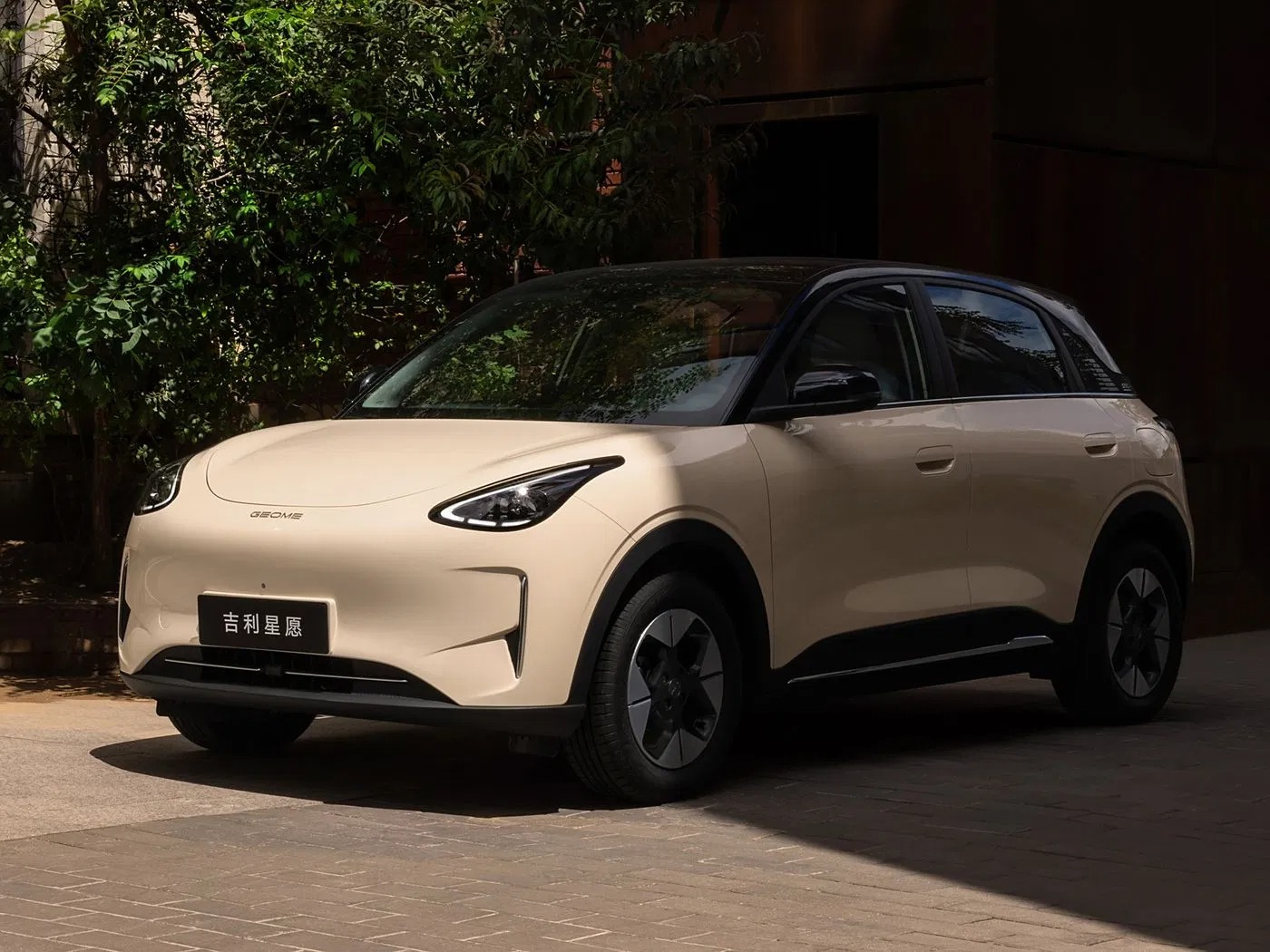
In August, electric vehicles claimed all top 10 spots in sales rankings. Among them, Geely Xingyuan led the market with sales of 46,057 units, thanks to its strategic pricing and appealing interior space.
China’s hatchback market remains dominated by pure electric vehicles.
In the hatchback segment, traditional fuel-powered models such as the Honda Fit and Volkswagen Polo have been rapidly replaced by pure electric vehicles. In August, the sales volumes of these two fuel models stood at just 23 units and 107 units respectively, a far cry from their former popularity.
For consumers in this market, cost of use and affordability are key factors in their car-purchasing decisions. Pure electric hatchbacks have quickly gained market favor by narrowing the gap with fuel-powered vehicles in terms of ownership costs and cost-effectiveness.
In August, pure electric models claimed all top 10 spots in the new energy hatchback sales ranking. Among them, the top 5 models sold a total of 135,500 units, accounting for 76.73% of the total 176,600 units sold by the top 10 models, indicating a high degree of market concentration.
The listed models include familiar “classic” pure electric hatchbacks such as the Wuling Hongguang MINIEV, BYD Seagull, Changan Lumin, and BYD Dolphin, as well as newer models launched in the past two years, such as the Aion UT and Geely Xingyuan.
How did each of them perform in August? Let’s take a closer look.
No. 1: Geely Xingyuan – 46,057 Units

Launched in October 2024, the Geely Xingyuan can be described as a “sudden rising star” in the market.
Priced at RMB 68,800 – 97,800 (approximately USD 9,664 – 13,738) at current guide prices, the model has maintained a steady upward sales trend since its launch. With 46,057 units sold in August, it not only secured the top spot in hatchback sales but also ranked among the best-selling new energy vehicles across all categories.
The success of the Xingyuan lies in its accurate grasp of the core needs of A0-class compact car users. Its 2,650mm wheelbase, combined with an 85% “space utilization rate” (analogous to the “floor area ratio” in real estate), delivers interior space comparable to that of an A-class sedan. Additionally, the 70L frunk and 375L trunk (expandable to 1,320L) address the storage needs of family users.
Meanwhile, all Xingyuan variants come standard with the Flyme Auto infotainment system and offer two CLTC range options – 310km and 410km – meeting the basic intelligent needs of users in this price segment. This “transcending-segment” competitive strategy is perhaps the key to the Xingyuan’s advantage over similar products.
No. 2: Wuling Hongguang MINIEV – 37,828 Units

Following the Xingyuan, the “traditional three giants” of micro electric vehicles maintained stable performance. The Wuling Hongguang MINIEV sold 37,828 units in August, with a year-on-year growth of 42.96% and a month-on-month increase of 38.38%, demonstrating strong market resilience.
This may be attributed to the limited-time car purchase policy launched by Wuling Hongguang in August.
Under the policy, consumers who purchased the third-generation Hongguang MINIEV in August could enjoy a maximum discount of RMB 12,000. After the discount, the 120km Easy Edition was priced at RMB 23,800 (approximately USD 3,343), compared to the original price range of RMB 35,800 – 46,900 (approximately USD 5,029 – 6,588).
Furthermore, Wuling Hongguang has high brand recognition in third- and fourth-tier cities as well as rural markets. Despite challenges from new competitors like the Geely Xingyuan, the Hongguang MINIEV remains in the first echelon of sales, thanks to its accumulated user base and strong distribution network.
No. 3: BYD Seagull – 23,031 Units

The BYD Seagull sold 23,031 units in August, also securing a spot in the first echelon of the electric hatchback market.
Positioned as a cost-effective pure electric compact car, the Seagull is priced at RMB 69,800 – 85,800 (approximately USD 9,805 – 12,053). It continues BYD’s consistent product strategy of meeting users’ basic needs within a limited cost range.
However, similar to other mid-to-low-end BYD models, the Seagull is facing a sales decline. Before July this year, its monthly sales had stably exceeded 30,000 units, and even approached 35,000 units at one point. In July, sales dropped to 22,941 units, and although there was a slight recovery in August, the figure still lags behind its previous performance. The impact of multiple competitive new models has affected the Seagull’s sales.
No. 4: Changan Lumin – 14,570 Units

The Changan Lumin ranked fourth with sales of 14,570 units, down 7.2% year-on-year but up 10.5% month-on-month. More commonly known by its nickname “Nuoyumi” (Glutinous Rice), this compact car recently gained popularity on social media due to its distinctive headlight design.
Priced at RMB 37,900 – 61,900 (approximately USD 5,324 – 8,696), the Lumin offers a range of CLTC driving ranges from 130km to 301km and is equipped with basic intelligent in-car features, meeting users’ fundamental smart mobility needs.
As product capabilities of models in this market segment are relatively similar, exterior design has become a key factor influencing purchasing decisions. Facing competition from models like the Geely Xingyuan and BYD Seagull, the Lumin’s unique design helps it maintain a foothold in the basic micro electric vehicle market.
No. 5: BYD Dolphin – 13,968 Units

Priced at RMB 99,800 – 129,800 (approximately USD 14,000 – 18,200), the BYD Dolphin is a relatively high-priced product in the new energy hatchback market. The launch of models represented by the Geely Xingyuan has diverted market share in the RMB 60,000 – 80,000 segment, while the Dolphin’s own RMB 100,000 – 130,000 segment is also facing unprecedented competition.
The Dolphin’s core advantages lie in being the first model based on BYD’s e-Platform 3.0: its 2.7m wheelbase provides ample interior space, and it features more mature three-electric (battery, motor, electronic control) systems and advanced driver assistance capabilities. These attributes appeal to young families and young commuters with established mobility needs.
No. 6: Wuling Bingo – 12,078 Units

Priced at RMB 56,800 – 88,800 (approximately USD 7,979 – 12,475), the Wuling Bingo sold 12,078 units in August.
The model offers three CLTC range options – 203km, 333km, and 410km. With a length of nearly 4 meters and a wheelbase of 2,560mm, it is a typical urban commuter car, though slightly smaller in size than the Geely Xingyuan.
To enhance competitiveness, the 2025 Wuling Bingo S is set to launch on September 27. Its pre-sale price ranges from RMB 68,800 to 81,800 (approximately USD 9,665 – 11,491), with two CLTC range options: 325km and 430km.
No. 7: Geely Panda Mini – 10,318 Units

The Geely Panda Mini is another pure electric compact car from Geely to make the list. Priced at RMB 29,900 – 53,900 (approximately USD 4,200 – 7,572), it sold 10,318 units in August, a figure close to that of the Wuling Bingo.
Unlike most pure electric compact cars on the market, the Panda Mini features a unique “square box” design, giving it high recognition.
Beyond its design inspired by Japanese K-Cars (Kei Cars), the model also stands out among its peers with a starting price of RMB 29,900, CLTC ranges of 120km/210km, and standard 22kW DC fast-charging functionality – a rarity among two-door compact cars in its class. These features make it appealing to users concerned about range anxiety and tired of long charging times.
No. 8: Bestune Pony – 8,703 Units

The Bestune Pony, which recently launched a new “Milk Coffee Brown” color option, sold 8,703 units in August, ranking eighth on the list.
With a uniform CLTC range of 222km across all variants, this compact car is priced at RMB 34,900 – 45,900 (approximately USD 3,498 – 6,448) and is one of FAW Bestune’s flagship models.
The Bestune Pony has a length of only 3 meters and a wheelbase of 1,953mm, making it the smallest model on the list. The newly updated 2026 version includes new features such as Bluetooth key, keyless start, and creep mode, enhancing the overall user experience.
No. 9: Aion UT – 5,782 Units

GAC Group’s Aion UT also focuses on “transcending-segment” configurations and practicality. With a length exceeding 4.2 meters and a wheelbase of 2,750mm, the Aion UT offers CLTC ranges of 330km and 420km – slightly outperforming its competitor, the Geely Xingyuan, in terms of size and range.
Priced at RMB 69,800 – 101,800 (approximately USD 9,805 – 14,300), the Aion UT adopted a “larger-car-vs-smaller-segment” strategy at launch: it aimed to establish a cost-effectiveness advantage in the competitive hatchback market by offering more spacious interiors and longer ranges at a similar price point.
However, its consistent monthly sales of 4,000 – 5,000 units are clearly underwhelming. Aion RT, a model in a similar predicament, recently cut down on variants and reduced advanced driver assistance hardware to lower its price floor and compete more directly in the market. Will the Aion UT, which has not yet been updated this year, take similar action?
No. 10: NIO firefly – 4,293 Units

NIO’s firefly secured the last spot on the list with sales of 4,293 units.
Positioned as a “premium intelligent electric compact car,” it is the most expensive model in the top 10, with a price range of RMB 119,800 – 125,800 (approximately USD 16,800 – 17,700). However, with NIO’s Battery as a Service (BaaS) plan, the price can be adjusted to RMB 79,800 – 85,800 (approximately USD 11,200 – 12,100), bringing it closer to the mainstream price range of this market segment.
The firefly boasts features rarely seen in pure electric compact cars, such as frameless rearview mirrors, 256-color ambient lighting, the 8155P in-car chip, and 128 TOPS of ADAS computing power. These details and intelligent configurations make it a viable option for urban young adults and families seeking a second car.
The firefly has already entered markets such as the Netherlands and Norway, aligning with NIO’s original vision of positioning it as a global model.
(End)
Discover more from ChinaEVHome
Subscribe to get the latest posts sent to your email.