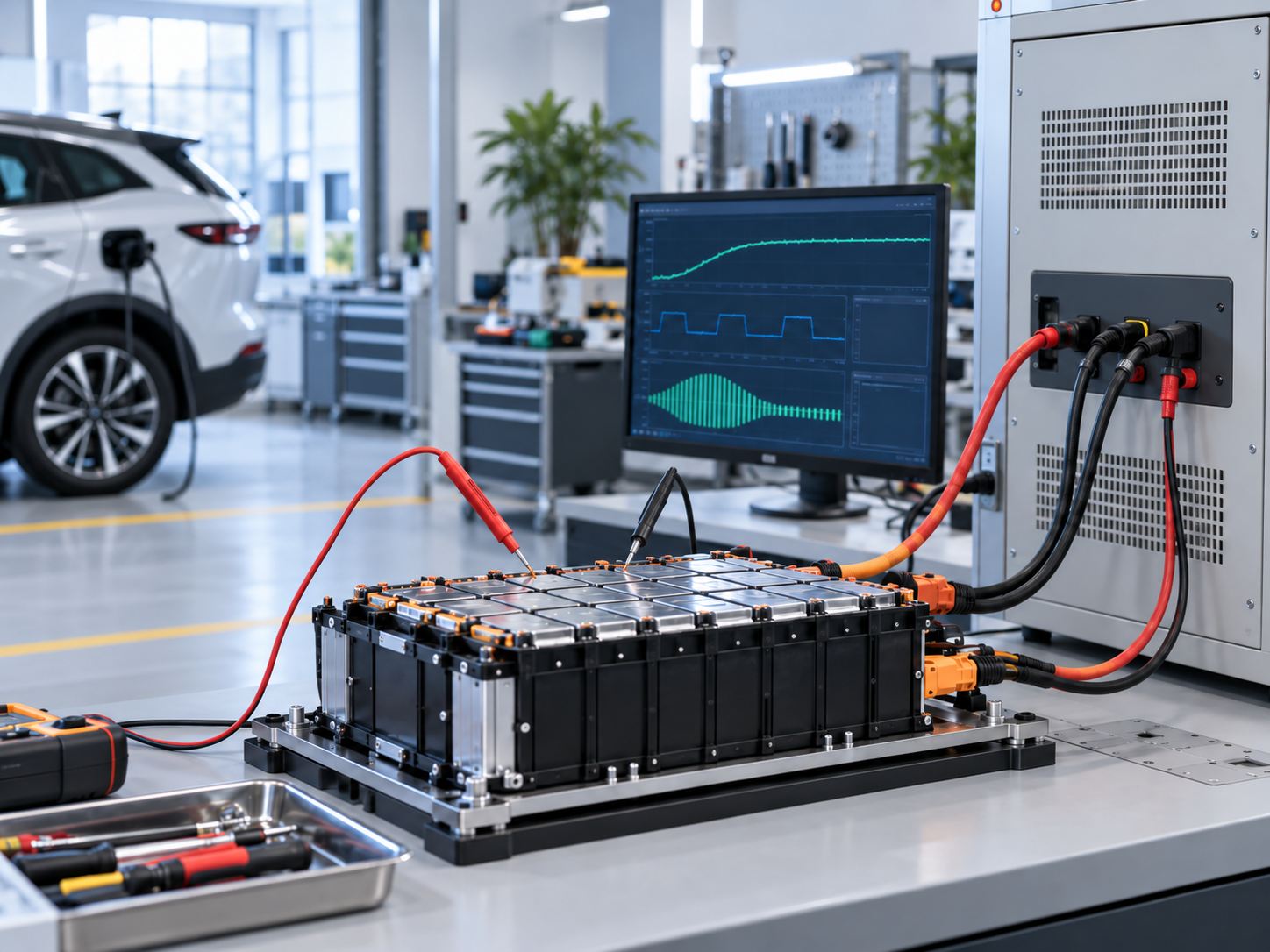
With major interface challenges now being resolved, China’s solid-state battery development is shifting from early exploration to real industrial progress.
In the race to define the “next-generation” of power batteries, all-solid-state batteries have long been seen as a key direction—promising higher energy density, better safety, and longer lifespans.
Yet practical barriers such as unstable interfaces, brittle electrolytes, inconsistent production, and high costs have kept commercialization out of reach.

According to a recent CCTV report, a Chinese research team has made a major breakthrough in one of the core hurdles of all-solid-state lithium-metal batteries — the solid–solid interface between electrodes and electrolytes. They introduced a combined material approach: “iodine-ion glue + flexible framework + fluorination reinforcement.”

In essence, the new design fills microscopic gaps between electrodes and electrolytes to improve adhesion, adds an elastic structural framework for greater mechanical resilience, and uses fluorinated polymers to enhance stability under high voltage.

While breakthroughs are emerging on the technical front, industrial players are also accelerating pilot-scale validation. CATL, Gotion High-Tech, and Sunwoda have each revealed their own R&D roadmaps for solid-state batteries.
CATL plans small-scale production by 2027, using a hybrid polymer–sulfide system to balance ionic conductivity and mechanical stability.
According to chief scientist Wu Kai, the technology currently rates around 4 on a 9-point maturity scale, with a goal of reaching 7–8 by 2027.

Gotion High-Tech’s “Golden Stone” series has completed a 0.2 GWh pilot line with a 90% yield rate and is now undergoing road testing. A 2 GWh mass-production line is under design, targeting small-batch output by late 2026.

Sunwoda, meanwhile, is progressing across three generations: its first-generation semi-solid batteries are already in production; the second generation is in pilot testing; and the third-generation full solid-state battery has passed verification, with a 1 GWh pilot line set for 2026, followed by second-generation rollout in 2027.

Ultimately, many companies’ timelines converge on 2027, a year that could mark the beginning of solid-state batteries’ true industrialization phase — as China edges closer to solving one of the field’s most persistent engineering puzzles.
Discover more from ChinaEVHome
Subscribe to get the latest posts sent to your email.