China’s NEV market surged in 2025, with significant production increases and evolving powertrain supplier dynamics noted in the report.
The China Passenger Car Association (CPCA) has released its October 2025 Insight Report on New Energy Vehicle (NEV) Powertrain Systems, summarizing the structural shifts in China’s NEV market and the evolving landscape of powertrain suppliers. The report shows that the sector continues to expand at a rapid pace.
From January to October, China produced 12.672 million NEVs, up 28.1% year-on-year, with cumulative penetration rising to 46.4%.
Growth has come from dense product launches, accelerated technology upgrades, and expanding export volumes. Throughout 2025, NEVs have acted as the primary driver of industrial restructuring across China’s automotive sector.
In market structure, sedans accounted for 45.1% of passenger vehicle sales in September, down 1.7 percentage points from a year earlier; SUVs held 43.9% and MPVs 3.6%. Year-on-year, sedans and SUVs grew 15.1% and 15.7% respectively, while MPVs surged 39.3%.

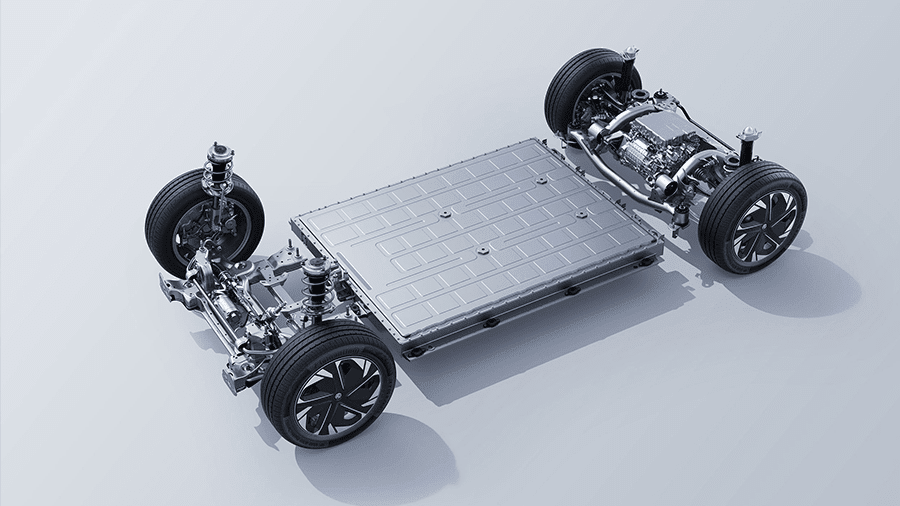
In power batteries, September installed capacity reached 73.7 GWh, up 39.9% year-on-year; average battery capacity from January to September stood at 53.0 kWh, up 17.3%. Battery supply remained concentrated among BYD, Tesla and Xiaomi.

Prismatic cells accounted for 98.6% of total cell shipments, while cylindrical and pouch formats remained marginal.
Lithium iron phosphate continued to expand its presence, maintaining a cost-safety-durability advantage and holding dominant share in mid-to-entry-level segments.

Supplier concentration increased: the top three battery makers held 72.2% share in September, while the top ten represented 95.4%.
CATL maintained industry leadership at 42.1%. CALB, driven by stronger volumes from XPeng and Leapmotor, secured third place with 8.2% share, more than doubling year-on-year.
The traction motor sector also remains highly consolidated, with the top ten players holding a combined 62.7%, all posting sequential growth. BYD Fudi Power was heavily supported by the Qin PLUS, which accounted for 10.9% of its contribution.
Inovance Powtrain raised share through Xiaomi’s YU7. Huawei Motor’s volumes were primarily supplied to the AITO M-series, with the M8 contributing 33.1%.

In electronic control systems, the top ten suppliers held 67.8% share. BYD Fudi Power, Inovance Powertrain, Tesla and Inbol saw year-on-year declines.
Huawei continued to center its supply around Seres, holding a 63.1% share. Grebo, part of the Geely system, stood out by relying on the Star Wish model, which represented 92% of its matched volume.

The report also highlighted progress in sodium-ion battery technology. The chemistry offers advantages in low-temperature performance, fast charging capability and raw-material cost, but still faces challenges in energy density, cycle life and industrial maturity. CATL, Zhongke Haina and BYD are accelerating R&D and deployment.
Discover more from ChinaEVHome
Subscribe to get the latest posts sent to your email.