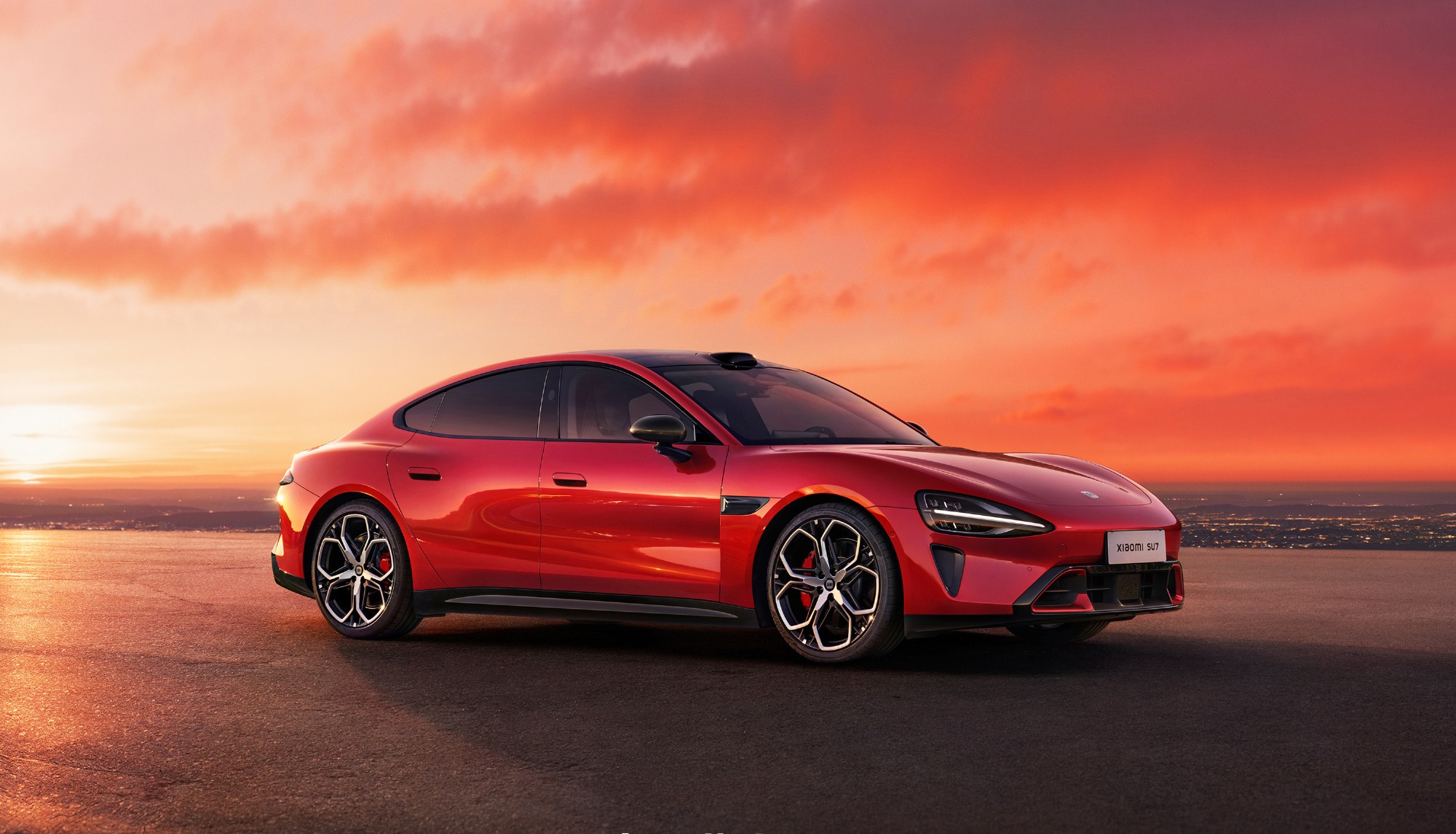
- Xiaomi's SU7 new-gen sold over 15,000 locked orders in just 34 minutes, signaling huge launch demand.
- Standard and Pro trims upgraded to 800V architecture plus LiDAR, NVIDIA Thor, and 4D radar as standard.
- Pro CLTC range jumps to 902km while prices rise modestly, positioning SU7 as a top competitive EV in its segment.
After a full two years, Xiaomi’s first and foundational car model — the SU7 — has finally received its first significant generational update, with the official prices announced yesterday.

Much like its explosive debut two years ago, this launch has again stirred the fiercely competitive new energy vehicle market.
Notable figures from the automotive industry, including He Xiaopeng (XPeng) and Wang Chuanfu (BYD), attended the event to witness the new-gen SU7’s unveiling.
Getting to the product, the new car still comes in three trims: Standard, Pro, and Max, with official prices set at RMB 219,900 ($30,540), 249,900 ($34,710), and 303,900 ($42,210) respectively.

Compared to the pre-sale prices, the final cost is RMB 6,000 ($833) to 10,000 ($1,389) lower, but the starting price is still RMB 4,000 ($555) higher than the first-generation model.
Despite pressure from rising component costs, Xiaomi CEO Lei Jun emphasized during the launch that the increase in value for the new SU7 far outstrips the price hike.
The new car saw its locked orders surpass 15,000 units within just 34 minutes of sales opening, an initial indicator of strong market enthusiasm.
Core Upgrades
The most significant upgrades for this generation are seen in the Standard and Pro trims, whose platforms have been comprehensively upgraded from the first-gen’s 400V to an 800V high-voltage architecture, paired with a renewed three-electric system.

The new V6s Plus motors see a power increase (235kW for Standard/Pro, 288kW for Max), and the CLTC comprehensive drive efficiency is improved by 1.5%, which Lei Jun described as “giving away an extra 2 kWh of battery for free.”
As a result, the Pro trim’s CLTC range jumps from around 830km to 902km — the longest in the lineup — without a substantial increase in battery capacity.

More importantly is the “democratization” of hardware configurations:
- ADAS Hardware: The new SU7 comes with LiDAR, NVIDIA’s Thor chip, and 4D millimeter-wave radar as standard across all trims, supporting high-level automated driving features based on the “Xiaomi XLA Cognitive Large Model.” This marks a stark contrast to the first-gen Standard trim, which only had basic sensors.
- Chassis & Comfort: The Pro trim now gets the dual-chamber air suspension + CDC adjustable dampers previously exclusive to the Max version. The braking system is also upgraded to front four-piston calipers and 265mm wide rear tires, enhancing stopping power.
- Battery Safety: The battery pack has added a “bulletproof coating” on the underside and a new front underbody protective beam to improve passive safety against impacts.
For the top-tier Max trim, upgrades are more about refining its already high specifications, such as upgrading the air suspension to a dual-chamber setup.
Therefore, this generational change can be seen as a powerful “reinforcement” of the first-gen model’s competitive shortcomings, particularly for the mid and lower trims.

Interior Evolution: More User-Centric Details
Inside the cabin, the changes are also significant.
The dashboard adopts a more mainstream symmetrical design, with horizontally arranged cupholders and physical buttons enhancing both refinement and usability.
Building on the well-received magnetic ecosystem (9 standard points), the new car adds 9 more magnetic points and provides 27W power to the expansion interfaces.
The seats are a major focus: the driver’s seat padding is thicker, it offers 18-way power adjustment, and the cushion length is adjustable by 60mm. 10-point massage and active side bolsters are now standard across the lineup.
A zero-gravity seat is optional for the front passenger, rear seat cushions are upgraded, and the in-car cooler/warmer now uses an independent compressor.

Market Outlook: Can It Be a Hit Again?
In its less than two-year lifecycle, the first-gen Xiaomi SU7 achieved cumulative deliveries of 381,000 units, even outselling benchmarks like the Tesla Model 3 and BMW 3 Series in full-year 2025 sales.
For the new generation, the biggest question is: Can it be a blockbuster again?

Despite the RMB 4,000 ($555) price increase, considering its comprehensive and targeted upgrades in the 800V platform, ADAS hardware, chassis comfort, and cabin details, the new SU7’s product strength is significantly more well-rounded.
Backed by Xiaomi’s powerful brand appeal and a more balanced product offering, it may not completely replicate the phenomenal hype of the initial launch, but it will undoubtedly remain a highly competitive sales benchmark in the RMB 200,000 ($27,780) – 300,000 ($41,670) pure-electric sedan segment.
Its final performance will depend on sustained delivery capability and evolving market conditions.
Discover more from ChinaEVHome
Subscribe to get the latest posts sent to your email.